


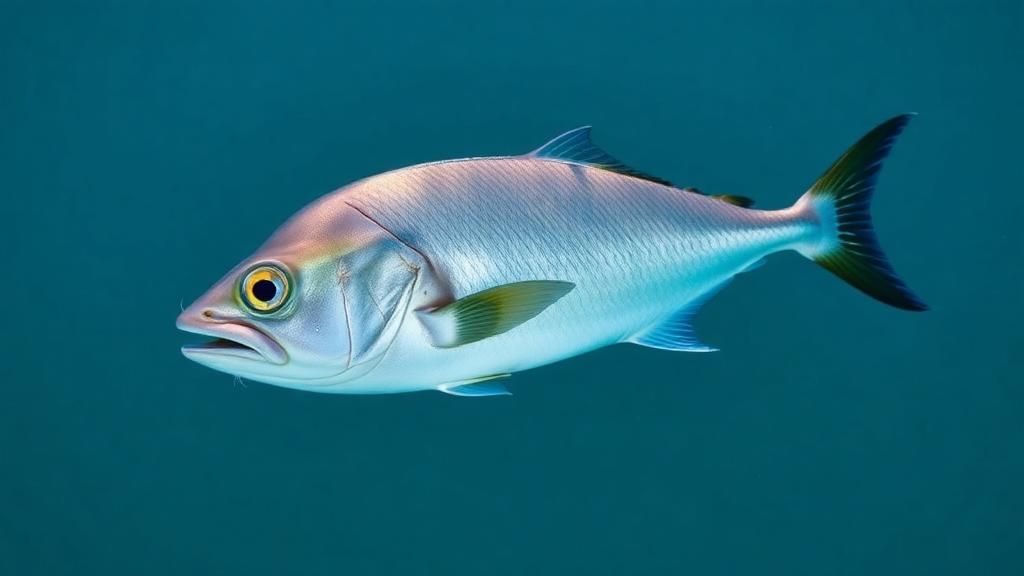
A sleek, silver-and-green predator from warmer seas has now been confirmed in the Black Sea. In a report published in the journal Nature Conservation, researchers document the first verified record of the white trevally (Pseudocaranx dentex) in Bulgarian coastal waters, captured near Varna on 24 July 2025. The finding pushes the species’ known range roughly 330 kilometres north of its previous northernmost confirmed occurrence in the Bosphorus Strait and marks the first time this thermophilic carangid has been verified in the fully marine waters of the Black Sea proper.
The specimen was taken by a recreational diver using a speargun in shallow coastal waters about 4.5 metres deep over a sandy bottom at the Trakata locality in Varna Bay, at coordinates 43°13.04061’N, 27°58.63438’E. The fish was photographed in situ, preserved on ice, and subsequently measured and weighed in the laboratory. It measured 354 millimetres in total length, 285 millimetres in standard length, and weighed 703 grams—figures consistent with a medium-sized individual of a species whose adults typically reach around 400 millimetres in standard length, and whose maximum reported Mediterranean size is 702 millimetres total length and 4,126 grams.
Identification rested on a combination of body morphology, coloration, and meristic counts. The specimen displayed the diagnostic profile of P. dentex: an elongate, deep, and moderately compressed body; an elongated snout; a weakly developed adipose eyelid; an upper jaw terminating anterior to the eye margin; a smooth cleithrum margin lacking papillae; and a single row of blunt, conical teeth on both jaws, with additional teeth on the tongue. The spinous portion of the dorsal fin was relatively high, with the longest spine exceeding the height of the soft dorsal lobe—a notably long first dorsal spine being a key distinguishing trait of the species. The pectoral fins were longer than the head, and the entire body was covered with small cycloid scales.
Coloration matched the species’ known appearance: pale greenish-blue dorsally and silvery ventrally, with a prominent black spot on the posterodorsal margin of the operculum and a yellow lateral stripe that broadens posteriorly. The bases of the soft dorsal and anal fins showed yellow pigmentation, while the caudal and soft dorsal fins were dusky yellow. Meristic features recorded for the specimen—9 dorsal spines, 24 dorsal soft rays, 3 anal spines, 20 anal soft rays, and 25 vertebrae, with a lateral line of 57 scales in the curved portion and 39 posterior scutes—fall within the ranges reported for Mediterranean and Atlantic populations, further supporting the taxonomic determination.
Sixteen morphometric characteristics were measured with digital calipers to the nearest 0.1 millimetre, following the protocols of Smith-Vaniz (1986). These included total length, body depth at the first dorsal fin origin, head length, snout length, orbit diameter, upper and lower jaw lengths, distances from the snout tip to the origins of the first and second dorsal fins, to the pectoral and pelvic fin insertions, and to the anal fin origin, as well as pelvic and pectoral fin lengths, interorbital length, and standard length. Expressed as percentages of total length and head length, all values corresponded well with published descriptions of the species, confirming the identification beyond reasonable doubt.
The white trevally is a thermophilic member of the family Carangidae with a remarkably broad distribution across tropical and subtropical waters of all major ocean basins, from South Africa, Japan, Australia, and New Zealand to Hawaii and New Caledonia in the Indo-Pacific, and from North Carolina and Bermuda to southern Brazil in the western Atlantic. In the eastern Atlantic and adjacent seas it ranges from the Mediterranean and the Azores to Madeira, the Canary Islands, Cape Verde, Ascension Island, and St. Helena. Adults typically inhabit coastal waters, bays, and estuaries, forming schools near the bottom or around reefs and rough substrates, while juveniles favour shallower estuarine and shelf habitats.
Within the Mediterranean, the species’ presence has been well documented: along the eastern and southern Adriatic coasts, the Italian coast, the southeastern coast of Sicily between 2013 and 2017, fish assemblages around Lampedusa Island, Syrian waters, the Levantine Sea, the coast of North Cyprus during 2015–2016, and the Libyan coastline. In the Aegean Sea, it has been recorded in the Cyclades Archipelago and, in extensive monitoring between 2009 and 2019, around fish aggregation devices in Kuşadası Bay, aquaculture cage areas in Güllük Bay, and reef habitats in Gökova Bay. Earlier investigations of fish trap catches from the Bosphorus region had already indicated the presence of thermophilic Mediterranean elements in the transitional waters between the Sea of Marmara and the Black Sea.
The previous northernmost confirmed record of P. dentex came from the Beykoz coast in the Bosphorus Strait, reported in 2023. Because the Bosphorus retains oceanographic and faunal characteristics more typical of the Marmara Sea, that record may not represent actual penetration into the Black Sea basin. By contrast, the Varna Bay specimen constitutes the first verified occurrence of the species in offshore waters of the western Black Sea, extending its known distribution by roughly 330 kilometres northwards—a substantial leap for a single confirmed record and evidence that the species is capable of considerable range shifts in response to changing environmental conditions.
One detail of the specimen proved particularly intriguing: its stomach was empty. This is notable given the species’ typical diet of benthic invertebrates and small demersal fishes, and given that suitable prey is abundant along the Bulgarian coast, including crustaceans such as Crangon crangon and Palaemon elegans, mollusks such as Mytilus galloprovincialis and Donax trunculus, and polychaetes such as Hediste diversicolor. The absence of food may indicate either a recent arrival that had not yet acclimatized to local feeding grounds, or a broader trophic mismatch between the species’ preferred prey and the current state of the benthic community—a scenario potentially linked to ongoing ecological shifts in the Black Sea.
The arrival fits a well-documented climatic pattern. Satellite-based sea surface temperature observations for the Black Sea show a statistically significant increase of approximately 0.65 ± 0.07 °C per decade from 1982 to 2020, with persistent warming across seasons, accompanied by an increased frequency and duration of marine heatwaves—on the order of 1.4 additional events and 2.8 extra heatwave days per decade. Operational data from the Copernicus Marine Service estimate a cumulative warming of roughly 0.5 °C per decade along the western Black Sea coast since the early 1990s. These thermal changes underpin a process known as meridionalization—the northward range expansion of warm-affinity species driven by ocean warming—already documented in the Mediterranean for P. dentex and other thermophilic fishes such as the dusky grouper (Epinephelus marginatus) and the blue runner (Caranx crysos).
The ecological stakes are considerable. As a fast-growing, generalist predator occupying mid- to upper trophic levels, P. dentex feeds by ram-filtering and suction on plankton and benthic invertebrates as a juvenile, and on a broad spectrum of prey as an adult, including squid, cuttlefish, finfish, crabs, shrimps, sea stars, sea urchins, and bivalves. Spawning involves pelagic eggs and generally occurs in summer. Its entry into the Black Sea could alter food web dynamics through predation and competition with native taxa, and its successful establishment under warming conditions could signal broader functional changes in the ecosystem, especially if other thermophilic species follow similar trajectories. The authors underscore the need for sustained ichthyofaunal monitoring to detect emerging distributional patterns, assess impacts on native communities, and inform adaptive conservation and fisheries management as the Black Sea continues to warm.
Subject of Research: First confirmed record of the white trevally (Pseudocaranx dentex) in the Black Sea from Bulgarian coastal waters and its climate-driven range expansion
Article Title: First record of the white trevally ( Pseudocaranx dentex ) in the Black Sea: a new occurrence from Bulgarian coastal waters
Article References: Bekova, R., & Prodanov, B. (2025). First record of the white trevally (Pseudocaranx dentex) in the Black Sea: a new occurrence from Bulgarian coastal waters. Nature Conservation, 60, 139-149. https://doi.org/10.3897/natureconservation.60.168638
Image Credits: AI Generated
DOI: 10.3897/natureconservation.60.168638
Keywords: white trevally, Pseudocaranx dentex, Black Sea, Bulgaria, Varna Bay, first record, thermophilic species, meridionalization, climate change, sea surface temperature, range expansion, marine heatwaves
Cite Scienmag News
Patricia Pace. (October 19, 2026). Warm-water white trevally makes first confirmed appearance in the Black Sea. Scienmag. https://scienmag.com/warm-water-white-trevally-makes-first-confirmed-appearance-in-the-black-sea/
Patricia Pace. "Warm-water white trevally makes first confirmed appearance in the Black Sea." Scienmag, 19 October 2026, https://scienmag.com/warm-water-white-trevally-makes-first-confirmed-appearance-in-the-black-sea/. Accessed 19 October 2026.
Patricia Pace. "Warm-water white trevally makes first confirmed appearance in the Black Sea." Scienmag. October 19, 2026. https://scienmag.com/warm-water-white-trevally-makes-first-confirmed-appearance-in-the-black-sea/


