


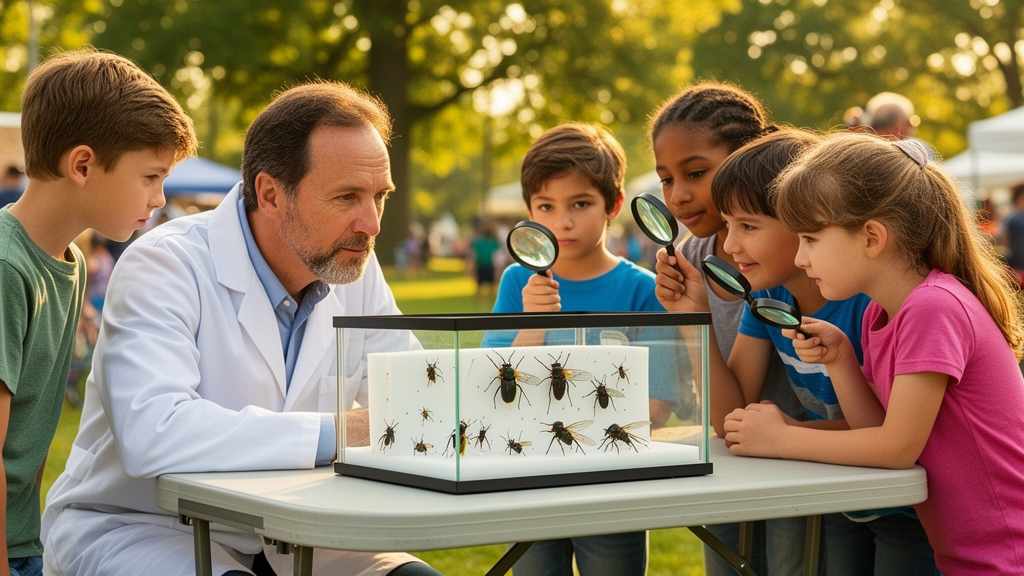
Natural history museums hold some of the most extraordinary records of life on Earth, yet many of their most fascinating specimens never make it past the storeroom door. At National Museums Scotland, that paradox was particularly acute for entomology. The institution cares for more than 10 million natural sciences specimens, roughly 2.5 million of them insects, but its galleries have long been dominated by vertebrate displays. The reason is simple physics and perception: insects are small, and displaying very small animals is technically challenging. In 2016, the curatorial team recognised this bias and decided to do something about it, not by rebuilding the galleries, but by taking the insects to the public in the form of portable, low-cost display drawers designed for outreach events.
The scale of the challenge, and the opportunity, is considerable. Museums engage audiences through permanent displays, temporary exhibitions, school visits, community workshops and large-scale themed events, and research has shown that insect festivals can strengthen interactions among scientists, professionals and the general public, promoting a genuine sense of community. But gallery space is fixed, and the specimens that fit comfortably into a vertebrate-oriented display case are not the ones that showcase the staggering diversity of the insect world. Portable displays flip that constraint into an advantage. Because insects are tiny, many more of them can be shown in a small area, allowing a single drawer to present dozens of species side by side. Preserved specimens also let visitors get a close-up look at animals they might never observe in the wild, and for visitors who are fearful of insects, a pinned specimen behind glass can be a gentler way into themes that live animals might make intimidating.
The practical criteria the Scottish team set for these resources were portability, very low cost and engagement value. There was no designated budget, so the solution was creative reuse. Old display boxes found in the entomology store, believed to have previously housed donated specimens, were cleaned and repurposed. The boxes are typically 260 by 195 by 55 millimetres or smaller, while the drawers are the museum’s standard 500 by 390 by 58 millimetres, sizes that are easily transported. Both storage types are glass-topped, which is preferable for display because plastic alternatives scratch easily and reduce visibility over time, though glass brings its own considerations for risk assessment. The specimens themselves came from a reserve of unregistered, data-deficient material retained for educational purposes that had never been put to good use. Not all of it was display quality, with many specimens missing legs and antennae, but those in fair condition were set aside and transferred into new thematic displays covering beetle diversity, scarab beetles, Scottish insects, British bees, aquatic insects and carrion insects.
A key technical insight lies in the modular curation system itself. Unit trays, normally used to sub-divide drawers during collection management, double as an excellent display architecture. They enable the grouping of specific specimens, sub-division of a drawer to cover multiple themes, and easy adaptation of content by swapping trays in or out for particular events. Information can be added where header labels would usually go, giving each tray its own interpretive caption. For larger insects such as tropical moths and butterflies, Plastazote-lined drawers without unit trays are used instead. Some drawers are dual purpose: a simple drawer of British bees, originally created for a pollinator-themed event to spread awareness of bee diversity, now serves both as an outreach resource and as a training tool for students learning bee identification in the collection.
The most frequently used displays are themed around carrion insects, highlighting the role of these important decomposers. The display was first used at a 2017 Science Festival event called Crime Scene Bugs, alongside live blow fly larvae specimens to view under the microscope. It has since appeared at Science Saturday and Insect Week events, led by the Royal Entomological Society, and reliably generates intense interest and questions from visitors. It was later adapted to incorporate the idea of carrion beetles as potential pollinators for a collaborative event at the Royal Botanic Garden, Edinburgh, during the flowering of their corpse flower, a botanical spectacle whose stench mimics decaying flesh and draws the same decomposer communities the display celebrates.
The drawers and boxes are rarely used in isolation. Supplementary information cards or laminated fact sheets are displayed on the table alongside them, and sometimes a screen with a repeating slideshow provides context for visitors to read when the stand is busy and staff members are engaged in conversation with others. Some displays are paired with interactive demonstrations: aquatic insect boxes accompany pond dipping activities or pre-collected live pond samples. Perhaps the most memorable activity involves role-playing the life history of burying beetles. Four to six participants are assigned roles as either a parent beetle or a larva and given large lanyards identifying their roles to the audience. A large felt silhouette of a mouse is placed on the ground like a rug, and the group talks through the fascinating behaviours these beetles exhibit, with actions for some participants. The activity is amusing but highly memorable, supported by a couple of small display boxes that let participants see the true size and appearance of the beetles.
When not in use, the displays remain in the care of the Natural Sciences team within the safety of the environmentally controlled entomology store, though a small number of boxes have been created specifically for the Learning and Engagement team and are used extensively, returning to the curator only when maintenance is required. Repeated movement of specimens does carry risk, as insects are most vulnerable to damage in transit. Best practice and integrated pest management protocols, including low temperature treatment, must be carefully followed to protect both the specimens in the displays and those in the main collection when drawers or boxes return from an event. The team also recommends always carrying an essential curatorial kit, at minimum forceps, glue and pins, so broken specimens can be repaired on the road, and having images taken at events showing the resources in use.
Cost was previously considered one of the key obstacles to creating such displays, and at a time when museums face substantial funding cuts this is not a minor concern. The Scottish experience demonstrates that portable displays can be created at almost no additional cost by repurposing existing boxes, borrowing empty drawers with unit trays from the main collection, and using specimens previously destined for disposal. The real cost is staff time, but the initial investment is outweighed by the benefits the resources bring, particularly the ability to take them off-site and engage new audiences who may not be able to visit the museum in person. The team also advises keeping the selection small, with fewer displays that cross themes, maximising the use of specimens and display storage while reducing maintenance work, and never removing labels from research-grade specimens used to supplement data-deficient material, instead using the labels as a talking point.
Evaluating effectiveness remains the open question. In-person outreach events drawing a steady stream of visitors can be high intensity, and accurately recording attendance is challenging; more importantly, visitor numbers alone may not offer sufficient evidence of impact. Researchers argue that evaluating such events is imperative to maximise the long-term impact and relevance of future ones. At National Museums Scotland, colleagues in the Learning and Engagement team record feedback in multiple ways: logging visitor numbers, handwritten comments, online feedback forms linked by QR codes, and notes recorded from remarks or questions by visitors and colleagues observing or hosting the events. Qualitative data can provide evidence of positive response, with comments such as wow, I didn’t know that; I’ll think about them differently from now on; I won’t squash them next time; I want to study bugs. Such data shows what worked and what didn’t, guiding modifications.
The creation of engaging outreach drawers has increased entomological outreach and participation in public programming at the museum, raising awareness of the insect collection with public audiences and showcasing the collection and staff expertise beyond the constraints of the museum walls, tailored to specific events and audiences. The experience has provided qualitative data indicating positive results, but the team acknowledges that the true impact of these resources has yet to be fully realised, and that implementing systematic evaluation will be essential to understand their effectiveness and guide future designs. For museums seeking to share their smallest, least displayed treasures, the lesson is that a drawer, a handful of rescued specimens and a willingness to carry them across town may be all it takes to turn a storeroom into a science festival.
Subject of Research: Portable entomological outreach displays
Article Title: Carri-on communicating: Creating portable insect displays for entomological outreach
Article References: Whiffin, A. L. (2025). Carri-on communicating: Creating portable insect displays for entomological outreach. Natural History Collections and Museomics, 2, 1-8. https://doi.org/10.3897/nhcm.2.157567
Image Credits: AI Generated
Keywords: entomology, museum outreach, insect displays, carrion insects, National Museums Scotland, science communication, natural history collections, Carri-on, communicating, Creating, portable, insect
Cite Scienmag News
Gavin Prescott. (October 19, 2026). Carrion insects take the museum on the road: portable displays spark public curiosity. Scienmag. https://scienmag.com/carrion-insects-take-the-museum-on-the-road-portable-displays-spark-public-curiosity/
Gavin Prescott. "Carrion insects take the museum on the road: portable displays spark public curiosity." Scienmag, 19 October 2026, https://scienmag.com/carrion-insects-take-the-museum-on-the-road-portable-displays-spark-public-curiosity/. Accessed 19 October 2026.
Gavin Prescott. "Carrion insects take the museum on the road: portable displays spark public curiosity." Scienmag. October 19, 2026. https://scienmag.com/carrion-insects-take-the-museum-on-the-road-portable-displays-spark-public-curiosity/


