


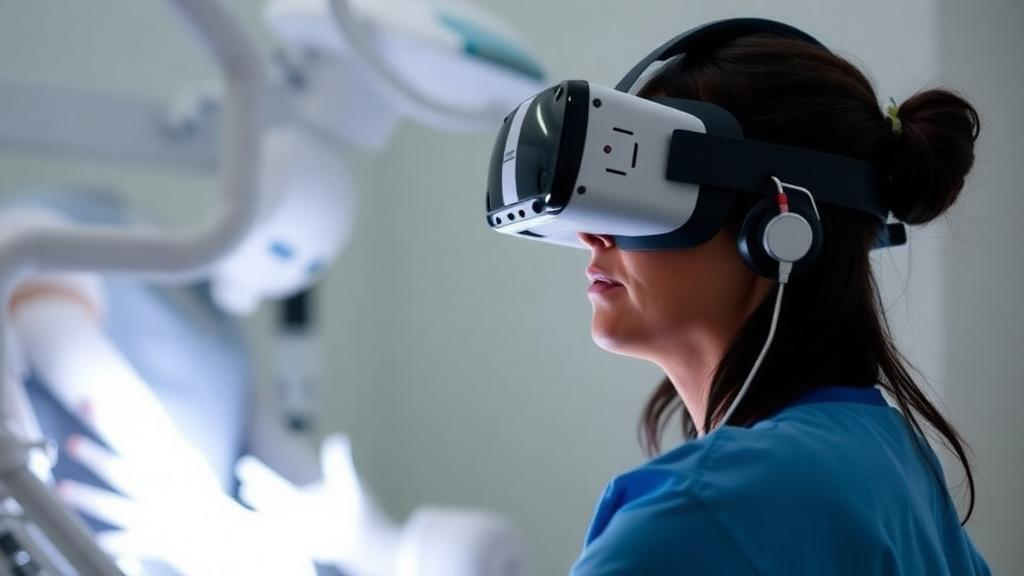
Virtual reality has quietly moved from the realm of science fiction into the operating theater corridor, and a new scoping review published in BMC Medical Education has now mapped exactly how far the technology has traveled in one of medicine’s most technically demanding specialties. The analysis, led by Saman Mohammdi and colleagues at Guilan University of Medical Sciences in Iran, systematically examined the landscape of VR-based orthopedic surgical training and reached a conclusion that is both encouraging and cautionary: the technology is genuinely effective at teaching novice surgeons the fundamentals of their craft, but the evidence that these virtual skills actually translate into better outcomes for real patients remains surprisingly thin. For a field where a single misplaced instrument can damage cartilage, nerves, or bone, that distinction matters enormously.
The review arrives at a moment of explosive growth in surgical simulation. Orthopedic surgery, perhaps more than any other operative discipline, depends on psychomotor skills that are notoriously difficult to acquire through observation alone. Arthroscopic procedures, in which surgeons maneuver a camera and instruments through tiny incisions while watching a monitor, require hand-eye coordination that bears little resemblance to open surgery. Traditionally, trainees developed these skills on cadavers, which are expensive and anatomically variable, or gradually on live patients under supervision, an approach that raises obvious ethical and safety concerns. VR simulators promised a third path: unlimited, consequence-free practice on anatomically realistic virtual joints, complete with haptic feedback that lets the trainee feel the resistance of tissue and the click of a meniscal repair device.
Mohammdi and her coauthors conducted a structured scoping review, following the PRISMA-ScR reporting guidelines, to identify studies investigating VR-based orthopedic education. Rather than pooling data statistically, the team synthesized findings narratively and organized them along several axes: the type of procedure being taught, the simulation modality employed, the training level of the participants, and, crucially, the Kirkpatrick model of educational outcomes. That framework, developed in the late 1950s and still the gold standard for evaluating training programs, grades evidence in ascending tiers, from learner reaction at level one, through knowledge and skill acquisition at level two, behavioral change in real settings at level three, and finally measurable results for patients and institutions at level four. Where studies fall on this ladder tells you almost everything about the maturity of the field.
What the researchers found was a literature that has grown rapidly in recent years but remains heavily concentrated in one anatomical niche. Arthroscopy-based applications dominate the field, with knee and shoulder procedures accounting for the vast majority of published work. This concentration makes sense from a technical standpoint: arthroscopic simulators benefit from well-defined tasks, such as diagnostic knee arthroscopy or meniscal resection, that can be scored objectively using metrics like instrument path length, economy of movement, and time to completion. Platforms typically measure how smoothly a trainee navigates the virtual joint, whether they respect tissue boundaries, and how their performance improves across repeated sessions. Yet the concentration also reveals a blind spot. Fracture fixation, spine surgery, joint arthroplasty, and pediatric orthopedics remain comparatively underrepresented in the simulation literature, leaving large portions of orthopedic practice without equivalent virtual training infrastructure.
The technological picture that emerged from the review is one of pragmatic compromise. Most systems described in the literature were semi-immersive rather than fully immersive, meaning trainees manipulated physical instruments while viewing a computer-generated operative field on a screen, rather than wearing a head-mounted display that surrounds them entirely in a synthetic environment. Semi-immersive arthroscopic simulators have an advantage in that they preserve the physical ergonomics of real surgery, where the surgeon’s hands hold actual instruments while the eyes track a monitor. The participants in most studies were orthopedic residents, the trainees at the stage of training where simulation offers the greatest marginal benefit, since they possess foundational medical knowledge but lack the procedural fluency that only repetition can build.
On the question of effectiveness, the evidence clusters firmly at the lower rungs of the Kirkpatrick ladder. The overwhelming majority of studies assessed simulator-based skill acquisition, corresponding to Kirkpatrick level two, demonstrating that trainees who practice on VR platforms do indeed get better at the tasks those platforms present. Many of these studies also showed that performance gains followed recognizable learning curves, with novices improving rapidly over the first several sessions before plateauing, a pattern that allows educators to define proficiency benchmarks. Some research went further and established construct validity, the demonstration that a simulator can reliably distinguish between experienced surgeons and novices, a prerequisite for using such devices in high-stakes assessment. The reviewers note that immersive VR systems and higher-fidelity platforms showed promising results in skill acquisition and, in a limited number of cases, genuine skill transfer to the clinical environment.
That phrase, limited number of cases, sits at the heart of the review’s central critique. Studies assessing whether simulator-trained skills transfer to actual operating rooms, let alone whether they improve patient outcomes, were relatively few. This is not a trivial gap. Skills psychologists have long documented that expertise acquired in one context can fail to generalize to another, particularly when the simulated environment diverges from clinical reality in subtle ways: the tactile feedback of real tissue, the variability of patient anatomy, the cognitive load of managing a live surgical team, and the consequences of error. A trainee may achieve flawless scores on a virtual knee arthroscopy yet struggle when the camera fogs, the patient bleeds, or the anatomy deviates from the textbook. Without level-three and level-four evidence, the profession cannot say with confidence that hours in the simulator translate into safer, faster, or more successful operations.
Compounding the transfer problem is what the reviewers describe as substantial heterogeneity across the field. Technologies vary widely in fidelity, from basic desktop arthroscopy trainers to sophisticated haptic platforms costing tens of thousands of dollars. Validation methods differ from study to study, outcome measures are inconsistent, and there is no standardized framework that would allow educators to compare one simulator against another or to certify proficiency in a way that carries across institutions. This fragmentation has practical consequences. A hospital investing in simulation technology currently has limited rigorous evidence to guide purchasing decisions, and a residency program designing a VR curriculum must essentially build its own validation study before trusting the results. The authors argue that future research should prioritize standardized validation frameworks, pursuit of higher-level educational outcomes, and deliberate integration of simulation into real surgical practice, rather than accumulating yet more demonstrations that trainees improve on the devices they practice on.
The trajectory of the field nonetheless points toward broader adoption. Declining hardware costs, improvements in graphics rendering and haptic engineering, and the integration of artificial intelligence for automated performance assessment are converging to make VR training more accessible and more informative than ever. The review’s authors also acknowledge the role of modern tools in their own workflow, noting that they used large language models solely for language refinement and readability enhancement, with all content critically appraised and edited by the authors themselves. As simulation programs mature, the realistic near-term vision is a blended curriculum in which residents reach demonstrable proficiency on virtual platforms before ever touching a real joint, with simulators serving as gatekeepers rather than mere supplements. For that vision to be fully credible, however, the field must produce the studies it has so far avoided: longitudinal trials tracking simulator-trained surgeons into their clinical practices, with outcomes measured not in simulator scores but in operative times, complication rates, and patient recovery.
The scoping review thus functions as both a progress report and a challenge. It confirms that virtual reality has earned a legitimate place in early-stage orthopedic training, particularly for arthroscopic skills in the knee and shoulder, where the evidence of educational benefit is now robust enough to inform curriculum design. At the same time, it exposes a profession that has validated its teaching tools without yet proving their ultimate purpose. Surgery is ultimately measured in outcomes for living patients, not scores on a screen, and the next generation of research must cross that bridge. Until it does, virtual reality in orthopedic education remains a powerful rehearsal space, enormously valuable for building competence, but still awaiting its final examination on the stage that matters most.
Subject of Research: Virtual reality simulation for orthopedic surgical education and training
Article Title: Educational applications of virtual reality in orthopedic surgery: a scoping review of effectiveness and future directions
Article References: Mohammdi, S., Abbasnejad-Ardehroudkenari, M., Langari, A. A., Jafari, M., Ghodous, S., Amouzadeh-Lichahi, M., & Haghi, B. P. (2026). Educational applications of virtual reality in orthopedic surgery: a scoping review of effectiveness and future directions. BMC Medical Education. https://doi.org/10.1186/s12909-026-10385-6
Image Credits: AI Generated
DOI: 10.1186/s12909-026-10385-6
Keywords: virtual reality, orthopedic surgery, medical education, surgical simulation, arthroscopy, scoping review, Kirkpatrick model, skill transfer, haptic feedback, residency training, validation frameworks, Educational
Cite Scienmag News
Ophelia Keating. (October 19, 2026). Virtual Reality Transforms Orthopedic Surgery Training, But Key Gaps Remain. Scienmag. https://scienmag.com/virtual-reality-transforms-orthopedic-surgery-training-but-key-gaps-remain/
Ophelia Keating. "Virtual Reality Transforms Orthopedic Surgery Training, But Key Gaps Remain." Scienmag, 19 October 2026, https://scienmag.com/virtual-reality-transforms-orthopedic-surgery-training-but-key-gaps-remain/. Accessed 19 October 2026.
Ophelia Keating. "Virtual Reality Transforms Orthopedic Surgery Training, But Key Gaps Remain." Scienmag. October 19, 2026. https://scienmag.com/virtual-reality-transforms-orthopedic-surgery-training-but-key-gaps-remain/


