


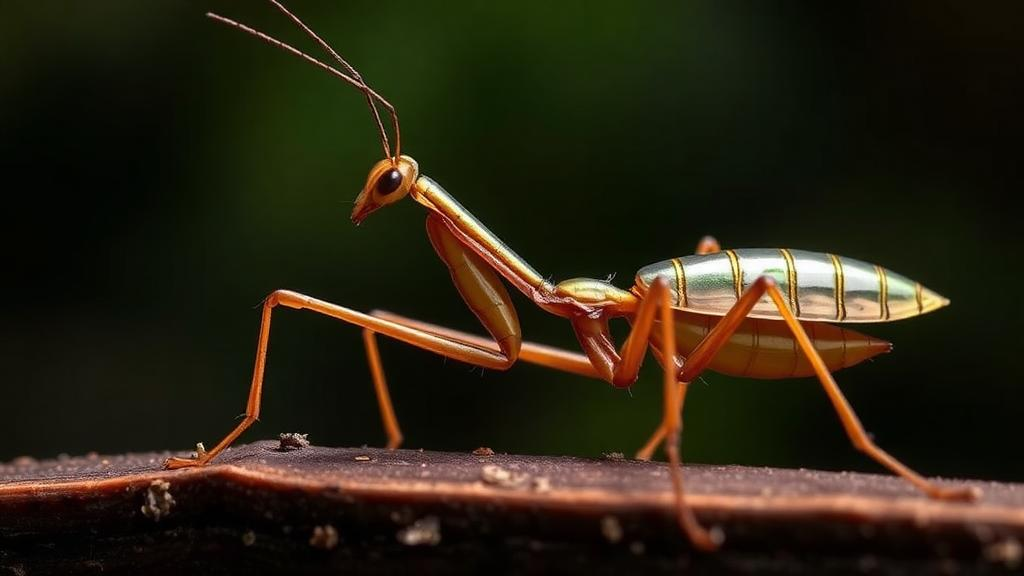
In the quiet corners of European gardens and North American meadows, a silent invasion is unfolding—one that scientists are only now beginning to decode. Giant Asian mantises, charismatic predators that have become increasingly popular in the exotic pet trade, are establishing populations far beyond their native ranges. Two species of the genus Hierodula are now spreading across Europe, while two species of Tenodera have been colonizing North America for over a century. A new study published in the Journal of Orthoptera Research has taken a quantitative look at how these insects are adapting to their new environments, and the results challenge some of the most fundamental assumptions about how terrestrial invasive species behave.
The research, conducted using occurrence records from GBIF and iNaturalist Research-Grade observations combined with bioclimatic variables from WorldClim2, applied the centroid shift, overlap, unfilling, and expansion (COUE) scheme to measure how the climatic niches of these mantises have shifted between their native and alien ranges. This framework, first developed by Broennimann et al. in 2012 and later refined by Petitpierre et al., reduces complex environmental space into two dimensions through principal component analysis and then partitions it into three components: stability, where the species occupies the same climatic space in both ranges; unfilling, where native climatic space remains unoccupied in the alien range; and expansion, where the species colonizes climatic conditions entirely absent from its native distribution.
What the analysis revealed was striking. Overall, the studied mantises showed relatively low overlap between their native and alien climatic niches, paired with high levels of both expansion and unfilling. This pattern suggests that these insects are capable of establishing populations in environments that differ substantially from their native ones, while simultaneously leaving much of their potential alien climatic space unexploited. For the narrow-winged mantis Tenodera angustipennis, the results were particularly dramatic: the niche overlap between native and alien ranges was nearly zero (D ≈ 0.01), with expansion approaching 97 percent and unfilling exceeding 97 percent. The Chinese mantis Tenodera sinensis showed similarly low overlap (D ≈ 0.02) with significant expansion and unfilling, though less extreme than its congener.
These findings are counterintuitive when placed against the general pattern observed in terrestrial ectothermic invasive species. Previous research by Bates et al. and Liu et al. has shown that invasive ectotherms tend to conserve their climatic niches, meaning that species establishing in climates similar to their native ones are more likely to become truly invasive. The mantises in this study appear to violate that expectation, expanding into climatic conditions that bear little resemblance to those they occupy in East Asia. The author suggests that this may be explained by the biotic, abiotic, and movement (BAM) model, which holds that species distributions are constrained by the interplay of biotic interactions, abiotic conditions, and the species’ ability to reach suitable habitats. Species may need greater overlap of these factors in alien environments to become invasive, and the mantises may be exploiting a combination of factors that only partially align with their native requirements.
The situation in Europe with the Hierodula species is complicated by a persistent taxonomic puzzle. The Transcaucasian Giant Mantis Hierodula transcaucasica was officially synonymized with the Giant Asian Mantis Hierodula tenuidentata by Battiston et al. in 2018, based on high morphological similarity. However, this synonymy has not been universally accepted, and the author of the new study found that the ecological overlap between the two potential native ranges is remarkably low (D ≈ 0.091, p < 0.0001). When the European invaders were analyzed as H. transcaucasica sensu stricto, the native-alien niche overlap was moderately high (D ≈ 0.5) with minimal expansion and no unfilling—consistent with the pattern expected for a highly invasive ectotherm. When considered as H. tenuidentata sensu stricto, however, the overlap plummeted (D ≈ 0.119) with high expansion and very high unfilling. When analyzed under the synonymy of Battiston et al., the overlap was intermediate (D ≈ 0.476) with no expansion but substantial unfilling. These radically different inferences from the same occurrence data underscore how taxonomic uncertainty can fundamentally alter our understanding of invasion biology.
The author argues that the higher niche overlap and lack of unfilling observed when the European invaders are considered as H. transcaucasica sensu stricto may hint at a natural range expansion that began in the past, rather than a recent introduction through the pet trade. This hypothesis, also considered by Pintilioaie et al., is supported by the fact that this taxon has been shown to be more widespread in Europe than H. patellifera, potentially due to its superior ability to circumvent movement barriers. However, the author acknowledges that only molecular studies could definitively test whether the population traditionally regarded as H. transcaucasica is indeed the source of the European alien range, and whether the observations of this complex belong to one or more distinct lineages.
When the author compared the alien niches of the congeneric species pairs sharing non-native ranges, the results revealed relatively high overlap between the invaders. The two Hierodula species in Europe showed a Schoener’s D of approximately 0.57, while the two Tenodera species in North America showed even higher overlap (D ≈ 0.665 with the full dataset and D ≈ 0.524 with the trimmed dataset). This high overlap is perhaps unsurprising given that such species potentially share areas in their native ranges as well. However, it also sets the stage for intense competition between the alien congeners. In North America, T. sinensis is known to feed on T. angustipennis and to be more prolific in nymph production, biological factors that may reduce the impact and dispersal of the latter species. This dynamic illustrates how competition between two alien species can shape the distribution of sister taxa in non-native ranges, potentially reducing the overall impact of one of the invaders.
Precipitation variables emerged as critical factors in explaining the differences between native and alien distributions. For the Tenodera species, precipitation of the wettest month (BIO13) and precipitation of the coldest quarter (BIO19) consistently ranked among the most important variables. The author notes that T. sinensis experiences very high rates of nymph mortality in dry conditions, which may constrain its ability to establish populations outside the northeastern United States. Given projections of increased rainfall in some eastern areas of the United States, it is possible that both Tenodera species may expand their non-native ranges in the coming decades. For the Hierodula species in Europe, precipitation of the wettest month was the most important variable explaining the difference between the two non-native species, suggesting that rainfall patterns may be a key factor determining which of the two invaders dominates in a given area.
The study also exposes critical gaps in our understanding of mantis ecology. Despite several mantis species being labeled as invasive in the literature, no Mantodea species is currently listed in the Global Invasive Species Database maintained by the Invasive Species Specialist Group of IUCN. The ecological impact of alien mantises on native biodiversity remains poorly studied, with few investigations evaluating their effects on native taxa within the same order or ecological niche. The author highlights that alien mantises feed on pollinators, herbivores, and intra-guild species, potentially causing secondary ecosystem effects that have never been quantified in most regions where they have established. The author proposes that all the mantises analyzed here should be regarded as invasive non-native species under a recently proposed shared terminology framework, though finding a unified definition among ecologists remains an ongoing challenge.
As these charismatic predators continue their global spread—aided by pet mismanagement, accidental transportation, and increasingly favorable climatic conditions—scientists face an urgent need to clarify the taxonomy of the species involved and to study their biology in both native and non-native environments. The current critical lack of information on mantis ecology, coupled with the taxonomic uncertainties surrounding the H. tenuidentata/transcaucasica complex, means that our understanding of these invasions remains incomplete. What is clear from this analysis is that mantises can establish populations in environments dissimilar to their native ones while simultaneously facing limits in their spread, and that the competitive dynamics between alien sister species may ultimately determine which of these predators comes to dominate the gardens and meadows of a warming world.
Subject of Research: Niche shift analysis of alien Hierodula and Tenodera mantis species
Article Title: Analysis of potential niche shifts in alien pairs of mantis species ( Insecta , Mantodea ) with comments on the current taxonomic and ecological knowledge
Article References: De Vivo, M. (2024). Analysis of potential niche shifts in alien pairs of mantis species (Insecta, Mantodea) with comments on the current taxonomic and ecological knowledge. Journal of Orthoptera Research, 33(2), 217-227. https://doi.org/10.3897/jor.33.111057
Image Credits: AI Generated
Keywords: invasive species, Mantodea, niche shift, ecology, taxonomy, Analysis, potential, niche, shifts, alien, pairs, mantis
Cite Scienmag News
Gavin Prescott. (October 19, 2026). Alien mantises are rewriting the rules of insect invasion. Scienmag. https://scienmag.com/alien-mantises-are-rewriting-the-rules-of-insect-invasion/
Gavin Prescott. "Alien mantises are rewriting the rules of insect invasion." Scienmag, 19 October 2026, https://scienmag.com/alien-mantises-are-rewriting-the-rules-of-insect-invasion/. Accessed 19 October 2026.
Gavin Prescott. "Alien mantises are rewriting the rules of insect invasion." Scienmag. October 19, 2026. https://scienmag.com/alien-mantises-are-rewriting-the-rules-of-insect-invasion/


