


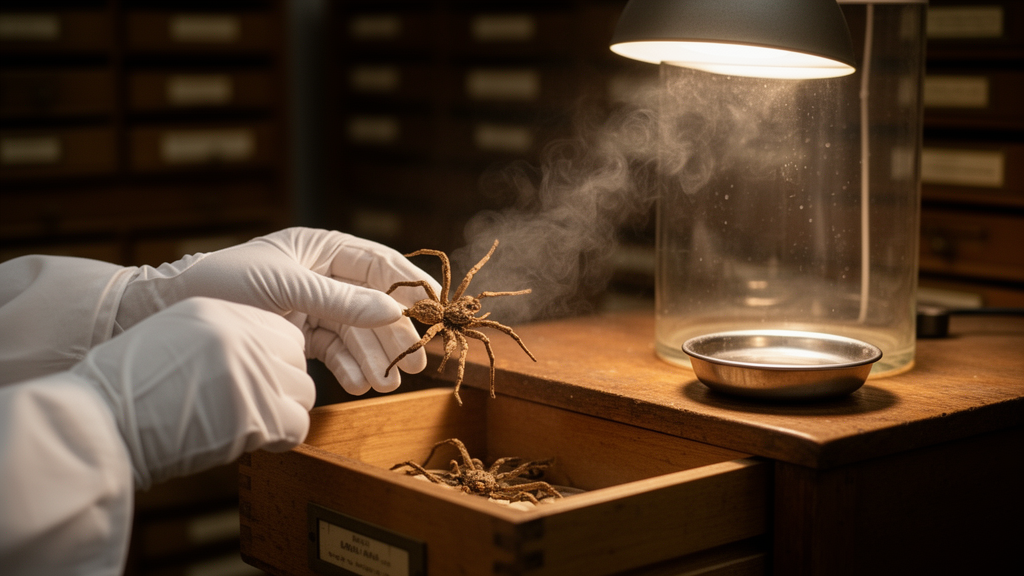
Every natural history museum lives with a quiet, constant anxiety: the slow evaporation of ethanol from its fluid-preserved collections. When a vial’s seal fails, the preservative creeps away and the specimen inside begins to dry out, its tissues shrinking and its DNA fracturing into ever smaller pieces. For soft-bodied arthropods such as spiders, which spend their afterlives submerged in alcohol, desiccation is among the most damaging fates a specimen can suffer. A new study published in Natural History Collections and Museomics has now put two rescue techniques head to head, asking a question that collections managers have long debated without solid evidence: once a spider has dried out, is it better to bring it back slowly with water vapor, or quickly with heat?
The research, carried out on spiders from the Denver Museum of Nature and Science (DMNS), compared a gradual ethanol rehydration approach known as the Step-Up method against a rapid, heat-accelerated treatment the authors call Heat-Rehydration. Both techniques are used in real collections, yet neither had been rigorously evaluated for completely desiccated arachnids, and no previous study had tested how rehydration affects the DNA of dried arthropod specimens. The findings carry practical weight far beyond arachnology, because fluid-preserved invertebrates have become an increasingly valuable genetic resource over the past two decades as extraction and sequencing technologies have improved.
The specimens involved were mature male spiders collected in Minnesota between 2011 and 2013 for an ecological survey, using pitfall traps charged with propylene glycol, a killing and initial preservation agent known to be friendly to DNA. The spiders were later donated to the DMNS Arachnology collection and stored in plastic vials of 75% ethanol. Parafilm had been used to create airtight seals, but the seals broke during accessioning, and in some vials the alcohol simply evaporated. By March 2023, curators discovered a batch of fully dehydrated spiders, and this accidental experiment in neglect became the raw material for a deliberate experiment in restoration.
The team selected thirty-three vials containing desiccated spiders of similar size and condition, identifiable only to family level as members of Lycosidae and Agelenidae. Mature males were chosen deliberately because their enlarged pedipalps, the modified appendages that function as sperm-transfer organs, are critical for taxonomic identification and provide a sensitive structure for scoring damage. Eleven desiccated spiders were set aside as a negative control group that received no rehydration, while eleven never-dehydrated specimens from the same donation served as positive controls for comparison of DNA quality.
The Heat-Rehydration treatment followed the museum’s standard protocol: spiders were placed in fresh glass vials of 75% ethanol and rapidly heated to boiling, approximately 78.3 degrees Celsius, with a heated air gun. Once the ethanol boiled, the vials were removed and allowed to cool, at which point the specimens absorbed fluid and sank. The whole procedure took between one and three minutes. The Step-Up method, adapted from published guidance, was far more demanding. Dehydrated vials were placed, lids removed, inside a sealed chamber containing deionized water treated with thymol crystals as a fungicide, where humid air softened the specimens over seven days. The spiders were then transferred through a graded ethanol series of 20%, 40%, 60%, and finally 75%, with one week at each stage, a process spanning roughly four weeks in total.
To judge the results, the researchers scored abdominal tissue separation, the pulling away of internal tissues from the exoskeleton that has been observed in heated ethanol rehydration, on a scale from zero for fully rehydrated tissue to three for destruction of the specimen. Pedipalps were recorded as intact or damaged. The statistical verdict was clear on the abdomen: a chi-squared test of independence found a significant relationship between rehydration method and tissue separation, with a chi-square value of 63.91 on nine degrees of freedom and p below 0.05. Every desiccated and rehydrated spider showed some degree of tissue separation, but the pattern differed sharply by treatment.
In the Step-Up group, most specimens showed only mild separation, and just one spider broke into pieces. In the Heat-Rehydration group, most specimens showed moderate separation, and two spiders fractured into multiple pieces, one of them so badly that it could not even be sampled for DNA. The positive controls, by contrast, showed no tissue pulling at all. Pedipalp damage told a softer story: one Step-Up male and four Heat-Rehydration males suffered breaks, but the difference across groups was not statistically significant, with a chi-square of 7.16 and p equal to 0.07. Notably, the spiders that did break apart tended to be smaller individuals, suggesting that body size and fragility influence how much punishment a specimen can absorb during rescue.
The genetic results were sobering. Using the widely available DNEasy Blood and Tissue kit, the team dissected a single leg from each spider and quantified extracted DNA with a Qubit 4 fluorometer. Yields were low almost everywhere: the hydrated positive controls averaged 8.55 nanograms per milliliter, the dehydrated negative controls 6.84, while the Step-Up and Heat-Rehydration groups averaged just 1.89 and 1.66 respectively. A one-way ANOVA found a significant overall difference among groups, and a follow-up Tukey HSD test isolated only one significant pairwise contrast, between Step-Up and the hydrated controls, indicating that neither rehydration treatment measurably worsened DNA capture relative to leaving specimens dry. But the gel electrophoresis told the more important story: only the positive controls produced a visible DNA smear on the ethidium bromide gel. The DNA from every desiccated or rehydrated spider, regardless of treatment, was too fragmented to detect, degraded to a degree that may defeat even next-generation sequencing approaches.
The authors are careful about what this means. Rehydration, they stress, is irreversible; it cannot undo the damage caused by the original desiccation, and it may impose new damage of its own. Heat did not appear to be the primary driver of DNA degradation in this study, since the heated specimens fared no worse genetically than the untreated desiccated controls, but the sample sizes and confounding variables inherent to museum material limit how far that conclusion can be pushed. Specialized extraction protocols designed for degraded museum DNA might have recovered more, but they are expensive and involve hazardous reagents that were not feasible here. The practical takeaway for collections managers is a decision framework rather than a single prescription: if a desiccated specimen is fragile, historically significant, or irreplaceable, the gentler Step-Up method is the safer choice, even at the cost of a month of labor; if speed matters and the specimen can tolerate it, heat is faster but risks destroying fragile material outright.
Perhaps the most valuable lesson of the study is the one written into its very origin. The spiders in this experiment dried out because a Parafilm seal failed, a mundane administrative accident with irreversible consequences. Once DNA has degraded past a certain threshold, no rehydration technique can bring it back, and once tissues have pulled away from an exoskeleton, no treatment fully restores them. The authors’ closing recommendation is therefore preventive rather than restorative: devote resources to keeping fluid-preserved specimens properly hydrated in the first place, monitor seals regularly, and treat desiccation as the emergency it truly is. Museum specimens are irreplaceable records of biodiversity, and this study shows that while careful rescue can salvage morphology, the genetic information locked inside a dried spider is likely gone for good.
Subject of Research: Effects of ethanol rehydration techniques on the morphology and DNA integrity of desiccated museum spider specimens
Article Title: Comparing ethanol rehydration techniques: effects on spider morphology and DNA integrity
Article References: Shikak, G. A. K., Anderegg, G. C., & Cushing, P. E. (2025). Comparing ethanol rehydration techniques: effects on spider morphology and DNA integrity. Natural History Collections and Museomics, 2, 1-15. https://doi.org/10.3897/nhcm.2.170431
Image Credits: AI Generated
Keywords: museum collections, ethanol preservation, spiders, rehydration, DNA degradation, arachnology, natural history specimens, tissue separation, pedipalps, collections management, fluid preservation, desiccation
Cite Scienmag News
Margaret Porter. (October 19, 2026). Slow Vapor Beats Heat When Rescuing Desiccated Museum Spiders, Study Finds. Scienmag. https://scienmag.com/slow-vapor-beats-heat-when-rescuing-desiccated-museum-spiders-study-finds/
Margaret Porter. "Slow Vapor Beats Heat When Rescuing Desiccated Museum Spiders, Study Finds." Scienmag, 19 October 2026, https://scienmag.com/slow-vapor-beats-heat-when-rescuing-desiccated-museum-spiders-study-finds/. Accessed 19 October 2026.
Margaret Porter. "Slow Vapor Beats Heat When Rescuing Desiccated Museum Spiders, Study Finds." Scienmag. October 19, 2026. https://scienmag.com/slow-vapor-beats-heat-when-rescuing-desiccated-museum-spiders-study-finds/


