


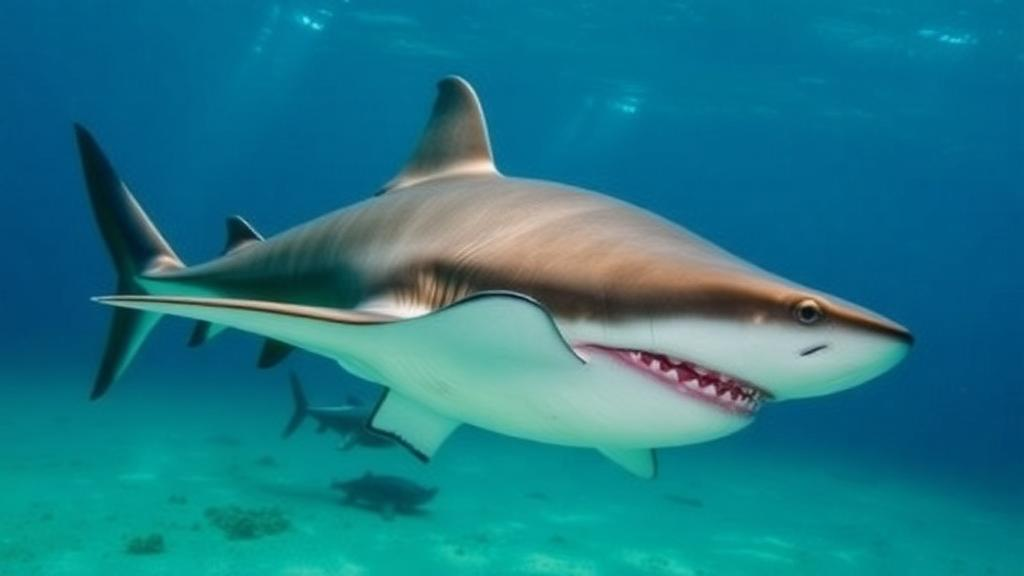
Beneath the muddy waters of the southern Gulf of Mexico, an invisible census has just been completed. Researchers analyzing nearly nine thousand sharks and rays swept up as unintended catch in Mexico’s shrimp trawl fishery have published the first-ever body size equations for four poorly known species, filling a fundamental gap in the biological data needed to protect some of the ocean’s most vulnerable animals. The study, published in Acta Ichthyologica et Piscatoria, transforms thousands of humble tape-measure readings and scale weights into powerful mathematical tools that fisheries managers can use to estimate the weight of a fish simply by knowing its length.
The scale of the undertaking is remarkable. Scientific observers from the Mexican Institute for Sustainable Fisheries and Aquaculture measured and weighed a total of 8852 specimens representing eleven species from eight families of elasmobranchs, the class of cartilaginous fishes that includes all sharks and rays. The animals were captured during 55 trawling hauls conducted by commercial shrimp vessels between April 2013 and August 2017, across the continental shelf stretching from the mouth of the Río Bravo and the coast of Veracruz in the west to the Tabasco–Campeche Basin in the southeast. Each haul, conducted at night at depths between 9.1 and 90 meters, lasted between 1.8 and 7.0 hours as the nets dragged across the seafloor.
Why does such basic measurement work matter so much? Length–weight relationships, or LWRs, are among the most routinely used yet essential elements in fisheries science. They allow scientists to estimate biomass from length data alone, converting the average length of fish in a sample into the average weight, which is far more laborious to measure directly. They also let researchers convert length-based growth equations into weight-based ones and compare the physical condition of the same species across different regions or seasons. In practice, these equations are a critical component of stock assessment models, the analytical engines that determine how many fish can be sustainably harvested and how threatened populations might recover.
The mathematical foundation of the study is elegantly simple. The researchers fitted the classic power model, in which weight equals a constant times length raised to an exponent b, by regressing log-transformed weight against log-transformed length using the least-squares method. The constant a acts as a body shape coefficient, while the exponent b describes the type of somatic growth. When b equals exactly 3, growth is isometric, meaning the animal maintains its proportions as it grows. When b falls below 3, growth is negatively allometric, with the animal becoming more slender as it lengthens; when b exceeds 3, growth is positively allometric and the animal becomes stockier with size. Confidence intervals around b revealed which growth types could be statistically distinguished from isometry.
The results delivered a comprehensive picture of growth patterns across the southern Gulf’s demersal elasmobranch community. The allometric parameter b ranged from 2.5 to 3.2, entirely consistent with the expected range for fishes. Of the 23 estimations reported across pooled and sex-specific analyses, fifteen showed negative allometry, six showed isometry, and only two showed positive allometry: females of the butterfly ray Gymnura lessae and pooled samples of the bonnethead shark Sphyrna tiburo. Coefficients of determination, a measure of how well the model fits the data, exceeded 0.950 for every single species, meaning that weight can be predicted from length with remarkable accuracy.
Among the standout findings were four completely novel length–weight relationships for the lesser electric ray Narcine bancroftii, the skate Dipturus olseni, the roundel skate Rostroraja texana, and the guitarfish Pseudobatos lentiginosus. None of these species had ever had their length–weight relationship published before. In addition, the study provided the first Gulf of Mexico estimates for the southern stingray Hypanus americanus, G. lessae, the cownose ray Rhinoptera bonasus, the Atlantic angel shark Squatina dumeril, and the smooth dogfish Mustelus canis, while extending the known range of estimates for the bonnethead and the Gulf smoothhound Mustelus norrisi from the northern Yucatan Peninsula to the western Gulf.
Perhaps the most biologically intriguing discovery concerns the differences between the sexes. Using analysis of covariance, the researchers tested whether males and females of the six most abundant species followed the same growth curve. Five of the six species showed significant sexual dimorphism: females of R. texana, G. lessae, N. bancroftii, P. lentiginosus, and S. dumeril all carried more weight per unit of length than males, producing higher b parameters. Only the southern stingray bucked the trend, and the authors attribute this anomaly to a sampling quirk rather than biology. Larger female H. americanus exceeding 110 centimeters are less susceptible to shrimp trawling because turtle excluder devices fitted to the fleet’s nets tend to exclude the biggest individuals, blurring the expected pattern in the data.
The trawl fishery itself proved an unlikely but valuable scientific instrument. Because bottom trawls are poorly selective for species and size, especially for dorsoventrally flattened demersal animals like rays, the bycatch provided an unusually broad and representative size range for each species. The data covered eleven of the sixteen elasmobranch species known to occur in the shrimp trawl bycatch, which collectively account for roughly 3 percent of the total catch. Rays dominate this incidental harvest, contributing 82.4 percent of the bycatch biomass and 94.8 percent of its abundance, while sharks make up the smaller remainder. For most species the sample sizes were robust, exceeding 250 individuals, though five rarer species were represented by fewer than 100 specimens each.
Beyond the equations themselves, the study recorded new maximum sizes for two species, with female Rostroraja texana reaching 66.5 centimeters in total length, males 65.0 centimeters, and female Pseudobatos lentiginosus reaching 81.5 centimeters. Such records matter because maximum size constrains the upper bounds of population models and signals the demographic health of a species. The b values obtained for seven of the species were consistent with prior estimates from other parts of the Caribbean, the east coast of the United States, northeastern Brazil, and the Yucatan Peninsula, suggesting that these growth patterns are geographically stable and that the new parameters slot credibly into the broader Atlantic dataset.
The wider significance of this work lies in the conservation crisis facing sharks and rays. Elasmobranchs are among the most vulnerable marine taxa worldwide because their slow life histories, late maturity, and low reproductive rates make them acutely sensitive to fishing mortality. The Western Central Atlantic, including the Gulf of Mexico, has been identified as one of three global hotspots of threat to elasmobranch biodiversity, hampered by insufficient biological information and historical fishery data that lack taxonomic resolution. In Mexico, several of these species support artisanal fisheries, while others die unseen in trawl nets. By supplying the first biometric conversion factors for four species and the first Gulf-wide estimates for five more, the study directly serves Mexico’s research priorities under the Gulf of Mexico Fisheries Management Plan, giving managers the quantitative foundation they need to convert simple length observations into the weight estimates on which every modern stock assessment depends.
Subject of Research: Length–weight relationships of eleven demersal elasmobranch species from shrimp trawl bycatch in the southern Gulf of Mexico
Article Title: Length–weight relationships of eleven demersal ray and shark species ( Elasmobranchii ) from the southern Gulf of Mexico
Article References: Zea-de la Cruz, H., Meiners-Mandujano, C., Tovar-Ávila, J., Jiménez-Badillo, L., & Oviedo-Pérez, J. L. (2025). Length–weight relationships of eleven demersal ray and shark species (Elasmobranchii) from the southern Gulf of Mexico. Acta Ichthyologica et Piscatoria, 55, 191-195. https://doi.org/10.3897/aiep.55.156837
Image Credits: AI Generated
Keywords: elasmobranchs, sharks, rays, Gulf of Mexico, length-weight relationships, fisheries science, shrimp trawl fishery, bycatch, allometric growth, stock assessment, conservation, Mexican fisheries
Cite Scienmag News
Margaret Porter. (October 18, 2026). Hidden Giants of the Gulf: First-Ever Growth Equations Unveiled for Eleven Sharks and Rays. Scienmag. https://scienmag.com/hidden-giants-of-the-gulf-first-ever-growth-equations-unveiled-for-eleven-sharks-and-rays/
Margaret Porter. "Hidden Giants of the Gulf: First-Ever Growth Equations Unveiled for Eleven Sharks and Rays." Scienmag, 18 October 2026, https://scienmag.com/hidden-giants-of-the-gulf-first-ever-growth-equations-unveiled-for-eleven-sharks-and-rays/. Accessed 18 October 2026.
Margaret Porter. "Hidden Giants of the Gulf: First-Ever Growth Equations Unveiled for Eleven Sharks and Rays." Scienmag. October 18, 2026. https://scienmag.com/hidden-giants-of-the-gulf-first-ever-growth-equations-unveiled-for-eleven-sharks-and-rays/


