


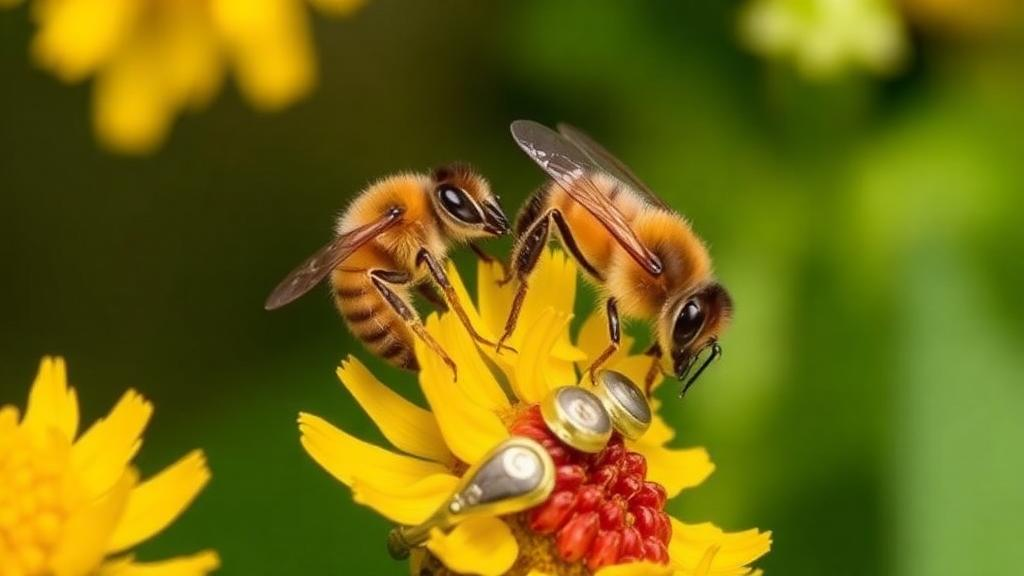
Honeybees in the peri-urban hills of southern Ecuador are carrying a hidden cargo on their bodies: microplastic fibers and fragments picked up as they forage through fields, gardens, and air laced with plastic debris. A new study conducted in the Gualaceo canton of Azuay province has confirmed that wild and managed bees (Apis mellifera) act as living samplers of plastic pollution, and it has delivered one of the clearest statistical demonstrations yet that the closer a beehive sits to an urban center, the more microplastics its bees accumulate. Published in the journal One Ecosystem, the research combined fluorescence microscopy, infrared spectroscopy, and rigorous statistical modeling to map the plastic burden of pollinators across nine apiaries, and its findings carry implications far beyond the Santa Bárbara river valley.
Microplastics, defined as plastic particles smaller than five millimeters, have become one of the most pervasive environmental contaminants on the planet. Generated by the fragmentation of larger plastic waste, they now contaminate soil, water, and air, and they have been detected inside living organisms, including humans, in blood and everyday consumer products. Bees are particularly effective bioindicators of this contamination because their foraging behavior forces them into constant contact with environmental surfaces. As they visit flowers, collect nectar and pollen, and return to the hive, electrostatic charges on their hairy bodies attract and retain airborne and surface-deposited particles, effectively turning each bee into a mobile pollution monitor.
The threat that microplastics pose to pollinators is not merely theoretical. Previous research has documented a spectrum of acute, chronic, and sublethal effects. Ingested particles can obstruct the digestive tract, reduce nutrient absorption, and in severe cases cause death. Fibers and sharp fragments can lodge in respiratory passages or physically damage wings and legs, hindering movement and foraging efficiency. Over the longer term, exposure has been linked to reduced egg laying, lower offspring viability, weakened immune systems, and altered behaviors such as difficulty navigating back to the hive. Because bees pollinate crops and wild plants alike, these effects ripple through agriculture and ecosystem health, and microplastics can bioaccumulate in food chains that include humans.
Earlier studies had already detected microplastics in bees and honey around the world, including in Denmark, where bees from urban, suburban, and rural sites all tested positive, and investigations had suggested that polystyrene ingestion could increase bees’ susceptibility to viral infections by disrupting their gut microbiota. Work in Ecuador itself had found synthetic fragments and fibers in at least 12 percent of commonly consumed beverages, including milk, honey, and beer, and had documented heavy microplastic contamination in the coastal waters of Esmeraldas province. What remained missing was a systematic test, in the southern Ecuadorian highlands, of whether proximity to human settlements actually predicts the plastic load carried by bees.
The research team, working with laboratories at the Salesian Polytechnic University in Cuenca, focused on nine peri-urban apiaries distributed around the city of Gualaceo, an urban core of roughly 13,981 inhabitants located in the Santa Bárbara river valley. The participating apiaries spanned sites to the north, south, east, and west of the city, all within the transitional zone where agricultural and residential land uses blend. With the voluntary collaboration of local beekeepers, the researchers collected approximately 50 dead worker bees from around three hives at each apiary over the course of about a month, repeating the sampling after 15 days. Samples were sealed in glass jars, refrigerated, frozen, and transported to the laboratory for analysis in the penultimate quarter of 2022.
The laboratory protocol was deliberately meticulous to prevent contamination and false positives. In a laminar flow hood, bee bodies were gently agitated for 15 minutes in a solution of ethanol and ultrapure Milli-Q water to dislodge adhered particles. The resulting suspension was vacuum-filtered through 11-micrometer paper, then digested with 33 percent hydrogen peroxide at 60 degrees Celsius for 24 hours to strip away organic matter. Microplastics were then captured on 0.45-micrometer cellulose nitrate membranes and stained with Nile red, a fluorescent dye whose solvatochromic properties make it bind preferentially to hydrophobic plastic particles, allowing rapid visual discrimination of plastics from other debris. A Nikon Eclipse Ti2 inverted fluorescence microscope, operating with green-filter excitation at 430 to 490 nanometers, was used to count and measure fibers and fragments on filters divided into four quadrants.
Chemical confirmation came from Fourier Transform Infrared (FTIR) spectroscopy using attenuated total reflectance with a diamond crystal, scanning wavelengths from 400 to 4000 inverse centimeters and comparing each particle’s spectrum against polymer reference libraries such as the Hummel Polymer and Additives databases. Only matches exceeding 70 percent similarity were accepted. The results were sobering: out of 1269 polymeric particles initially observed across all samples, 583 were fragments and 686 were fibers, yielding an overall average of 24 microplastics per 50 bees. The most contaminated hive averaged 57 particles per 50 bees, while the least contaminated registered 10. Fragment diameters ranged from 5.63 to 1834.69 micrometers, and fiber lengths from 6.65 to 4980.57 micrometers, with fibers making up 54.06 percent of the total load.
FTIR analysis of 341 identified particles revealed a diverse polymer cocktail spanning 23 synthetic types. Poly(4-methylcaprolactam) dominated at 25.29 percent of identified particles, followed by Nylon 12 and polyethylene at 11.73 percent each, ethylene propylene diene monomer at 9.9 percent, polytetrafluoroethylene at 6.45 percent, and polyamide 8 and polycarbonate at 4.4 percent each, with polyethylene terephthalate, better known as PET, appearing at 3.23 percent. These seven polymer types alone accounted for nearly 74 percent of all identified particles. Notably, PET was detected at almost every site, underscoring how thoroughly plastic waste from packaging and textiles has penetrated the peri-urban environment. The authors caution that fluorescence microscopy is more sensitive to very small particles than FTIR, whose lower spatial resolution limits detection, which is why the two techniques were used in complementary fashion to filter out false positives and build a robust picture of contamination.
The statistical core of the study addressed the central hypothesis directly. Because initial data violated the normality assumptions of analysis of variance, the researchers applied a Box-Cox procedure, settling on a logarithmic transformation that normalized residuals and validated the model. A Welch ANOVA then confirmed significant differences in microplastic loads among the nine apiaries, and Games-Howell post hoc tests pinpointed significant contrasts between the most contaminated site and six others. Finally, linear regression against distance from the Gualaceo urban center revealed a statistically significant negative relationship: the fitted equation was logarithm of microplastic concentration equal to 4.34 minus 0.52 times distance. The slope of minus 0.5256 was significantly different from zero, and the model explained approximately 47.6 percent of the variability in contamination levels, a moderate correlation the authors attribute partly to the modest sample size of nine apiaries.
The implications extend well beyond Ecuador. The study confirms that no area, even a small highland city far from industrial mega-centers, is immune to microplastic contamination, and it quantifies how urban centers function as pollution sources whose influence decays with distance. It also raises urgent questions about whether microplastics are being incorporated into honey and other bee products, and what that means for consumers, a question the researchers flag as a priority for future work. The team frames its findings as a call for action at individual and institutional levels alike, arguing that effective environmental policies and engineering solutions for waste management must keep pace with the sheer volume of plastic now fragmenting into the environment. If bees, the sentinels flying at the interface between human landscapes and natural ecosystems, are this heavily contaminated on the outskirts of a mid-sized Andean town, the global scale of the problem becomes difficult to ignore.
Subject of Research: Microplastic contamination of honeybees in relation to distance from urban centers in Ecuador
Article Title: Influence of Geographic Separation Between Urban Centers and Microplastic Burden on Bees ( Apis mellifera )
Article References: Arévalo, P. W., Orellana, V. P., Brito López, P. G., & Cajamarca, X. J. (2024). Influence of Geographic Separation Between Urban Centers and Microplastic Burden on Bees (Apis mellifera). One Ecosystem, 9, Article e127698. https://doi.org/10.3897/oneeco.9.e127698
Image Credits: AI Generated
Keywords: microplastics, honeybees, Apis mellifera, pollinators, Ecuador, urban pollution, bioindicators, FTIR spectroscopy, fluorescence microscopy, plastic pollution, environmental monitoring, Influence
Cite Scienmag News
Reese Ellison. (October 18, 2026). Bees Near Cities Carry More Microplastics, Ecuador Study Finds. Scienmag. https://scienmag.com/bees-near-cities-carry-more-microplastics-ecuador-study-finds/
Reese Ellison. "Bees Near Cities Carry More Microplastics, Ecuador Study Finds." Scienmag, 18 October 2026, https://scienmag.com/bees-near-cities-carry-more-microplastics-ecuador-study-finds/. Accessed 18 October 2026.
Reese Ellison. "Bees Near Cities Carry More Microplastics, Ecuador Study Finds." Scienmag. October 18, 2026. https://scienmag.com/bees-near-cities-carry-more-microplastics-ecuador-study-finds/


