


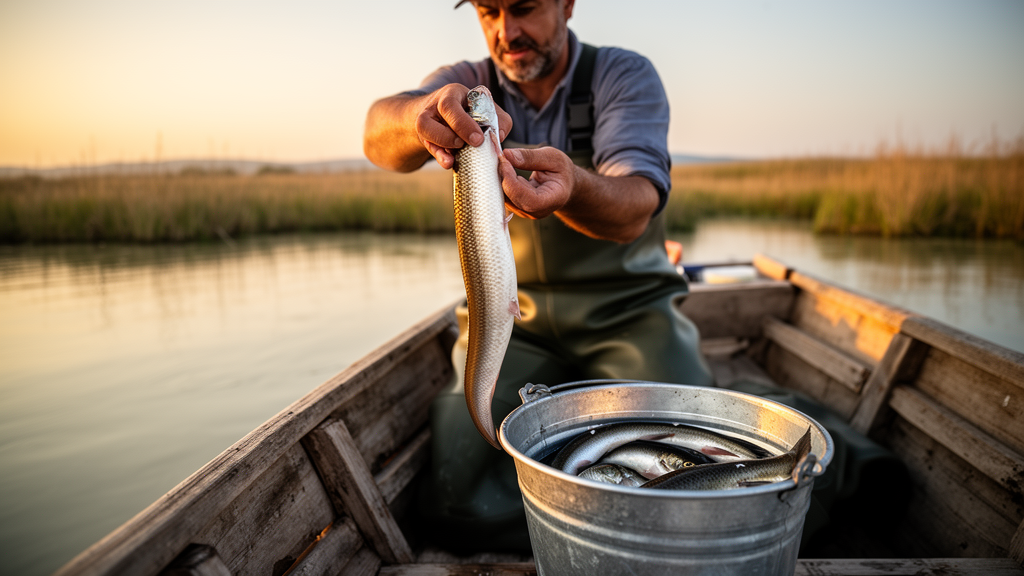
The European eel is one of the most enigmatic and imperiled fish in the world, and every new piece of information about its life history carries real weight for conservation. Now, a three-year study of silver eels leaving Albania’s Karavasta Lagoon has delivered the first detailed picture of age, growth, and health in a southeastern Adriatic eel population, revealing striking differences between the sexes, remarkably fast maturation compared with northern European stocks, and a swim bladder parasite survey that came back completely clean.
The choice of the Karavasta Lagoon as a study site is scientifically significant for reasons that go beyond its status as Albania’s largest eel fishery. Coastal lagoons occupy a distinctive place in the life history of the European eel, functioning as transitional environments where freshwater and marine influences mix, and where growing conditions can differ markedly from those in rivers or lakes. Because eels display remarkable plasticity in growth rate, age at maturity, and size at migration depending on the habitat they occupy, data gathered from a lagoon system cannot simply be borrowed from studies conducted elsewhere. The Karavasta Lagoon, with its shallow basin averaging less than a meter in depth, its salinity that fluctuates widely between roughly 20 and 42 parts per thousand, and its warm annual mean temperature of nearly 20 degrees Celsius, represents a productive but also physiologically demanding environment. Eutrophication peaks in summer, and past episodes of algal blooms have triggered anoxic conditions in parts of the basin, meaning that eels maturing there must cope with episodic oxygen stress as well as warm temperatures, both of which can shape growth and survival.
The sampling design itself deserves attention because it captures eels at a particularly informative moment. By collecting silver eels from commercial fyke nets positioned at the main barrier through which migrating fish must pass, the researchers sampled individuals at the very start of their spawning migration, when their body composition, age, and maturation state reflect the full sum of their growth years in the lagoon and its connected waters. The traps, emptied three times daily across the width of the outlet channel, effectively intercept the migratory cohort with minimal bias, and the random selection of roughly 140 eels per December season from 2022 through 2024 produced a total sample of 435 silver eels. This timing matters biologically as well: silver eels that reach the seaward phase have ceased feeding, their digestive tracts are degenerating, and their energetic reserves are fixed, so measurements taken at this stage provide a clean snapshot of lifetime growth without the confounding effects of recent feeding or seasonal variation in condition.
The age range observed, spanning from four to eleven years, sits toward the younger end of the spectrum documented for European eels across their range. In northern and central Europe, silver eels commonly mature at considerably older ages, sometimes requiring well over a decade or even approaching two decades in cold, low-productivity waters before undertaking their migration to the Sargasso Sea. The comparatively rapid turnover observed in the Karavasta population aligns with a well-established pattern in eel biology: warm, productive southern habitats tend to accelerate growth, and faster-growing eels generally reach the size and energetic thresholds needed for maturation sooner. The mean annual growth in length of about 6.4 centimeters for females and 5.7 centimeters for males reflects this rapid development. Such growth rates have implications for population dynamics modeling, because generation time strongly influences how quickly a population can respond to conservation measures and how vulnerable it is to sustained exploitation of the migrating cohort.
The sexual dimorphism documented in the study fits a broader theme in eel research. Female eels are consistently larger than males across the species’ distribution, a pattern generally interpreted as an adaptation to maximize fecundity, since egg production scales with body size, while males can achieve reproductive success at smaller sizes. The finding that females averaged 7.0 years of age at migration compared with 6.2 years for males, and that females grew faster in length on average, supports the idea that the two sexes follow partly divergent life history strategies within the same lagoon. The sex ratios across the three sampling years, shifting from roughly even in 2022 to female-dominated in 2023 and strongly male-biased in 2024, add another layer of interest. Annual variation in the sex composition of migrating silver eels is documented elsewhere and may reflect differences in cohort strength, environmental conditions during the developmental years, or the plastic determination of sex that characterizes the species, though the three-year window of this study cannot resolve the underlying causes definitively.
The length-weight relationships reported, with exponents of about 2.8 for males and 2.7 for females, indicate negative allometric growth, meaning that as eels grow longer they become proportionally more slender. For silver eels preparing for a transoceanic migration of thousands of kilometers, body shape and energy stores are of direct survival relevance, because the journey to the Sargasso Sea is powered entirely by fat reserves accumulated during the feeding phase. A slender silvering body is part of the normal morphological transformation of eels entering the migratory stage, involving changes in coloration, eye enlargement, and fat deposition, and the values recorded here provide baseline parameters that can be compared with silver eel condition in other Mediterranean and Atlantic populations.
Perhaps the most unexpected health finding was the complete absence of the swim bladder nematode Anguillicola crassus in all 435 eels examined. This invasive parasite, native to East Asian eel species, spread through European eel populations after its introduction in the early 1980s and is now widespread across much of the continent. In heavy infections, the parasite damages the swim bladder wall, causing inflammation, bleeding, and thickening that can impair buoyancy regulation. Because migrating silver eels must maintain precise depth control during their oceanic journey, and because some researchers have proposed that swim bladder damage may reduce spawning success, the parasite has been considered a potential contributor to the species’ decline. Reports from Mediterranean lagoons and southern regions vary, with some areas showing high prevalence and others remaining largely uninvaded, so the clean bill of health in Karavasta documents a population still free of this additional stressor. Whether this reflects the lagoon’s isolation, the pathways of parasite introduction in the region, or ecological conditions unfavorable to the parasite’s intermediate hosts remains an open question, but for now it means Albanian migrating eels face one fewer burden during their spawning migration.
The technique used to age the fish, the cut and burn method applied to sagittal otoliths, is a standard approach that exposes the annual growth increments embedded in these calcium carbonate structures. Otoliths grow by depositing translucent material during summer growth and opaque material during winter, producing readable annual bands much like tree rings. Accurate aging is foundational to everything else in eel population science, because growth rates, age at maturity, and mortality estimates all depend on it, and yet eel aging is notoriously difficult in fast-growing southern populations where increments can be narrow and interpretation requires experience. The verification through multiple independent readings described in the methodology helps ensure the reliability of the age estimates underpinning the growth analyses.
From a conservation management standpoint, the regional character of these data is their chief value. The European eel is considered panmictic, meaning that eels from across the continent mix randomly in the Sargasso Sea and genetically represent a single breeding population, so one might assume that data from any region could serve management everywhere. In practice, however, local life history traits diverge substantially among habitats, and population models built on northern European parameters can misestimate productivity, biomass, and exploitation impacts when applied to southern systems. The European Eel Regulation obliges member states to reduce anthropogenic mortality and restore the species, and while Albania is not an EU member, its lagoons contribute to the shared spawning stock of the species. The Karavasta results give managers concrete local figures for age structure, sex-specific growth, and migration timing that can anchor realistic assessments of how the fishery affects the number and quality of silver eels leaving for the ocean.
The study also fills a genuine geographic gap in the scientific literature. Most silver eel research has historically concentrated in northern Europe, particularly around the Baltic, the North Sea, and the Atlantic coasts, while the southeastern Adriatic had produced only fragmentary information, limited mainly to otolith shape and microchemistry work in Croatian and Montenegrin waters. Establishing that eels from this lagoon mature relatively quickly and depart at ages of four to eleven years adds an important southern reference point for pan-European assessments of eel status and for the refinement of models that estimate the total reproductive output of the species across its range.
Finally, the multi-year structure of the sampling, covering three consecutive December migrations, provides a modest but valuable measure of interannual variability in a population that will face continuing pressures from habitat change, climate warming, and fishing. Interannual variation in sex ratio, age composition, and body size of migrating eels is exactly the kind of information needed to detect trends over time, and the protocols established at Karavasta, including the standardized Durif silvering index, fat scoring, and parasite assessment scales, ensure that future monitoring there can be compared directly both internally and with studies across Europe. In a species whose recovery depends on coordinated action from lagoons like this one to the open Atlantic, such locally grounded, methodologically compatible datasets are among the most practical tools conservation science can provide.
Subject of Research: Age, growth, and parasite status of European eels in the Karavasta Lagoon, Albania
Article Title: Age and growth of European eel, Anguilla anguilla ( Actinopterygii , Anguilliformes , Anguillidae ), in the Karavasta Lagoon, Albania
Article References: Hala, E., Kule, M., Kamberi, E., Bakiu, R., & Simon, J. (2025). Age and growth of European eel, Anguilla anguilla (Actinopterygii, Anguilliformes, Anguillidae), in the Karavasta Lagoon, Albania. Acta Ichthyologica et Piscatoria, 55, 259-271. https://doi.org/10.3897/aiep.55.164842
Image Credits: AI Generated
Keywords: European eel, Anguilla anguilla, Karavasta Lagoon, Albania, Adriatic Sea, silver eels, otoliths, von Bertalanffy growth, Anguillicola crassus, conservation, sexual dimorphism, lagoon ecology
Cite Scienmag News
Gavin Prescott. (October 18, 2026). Silver eels of Albania’s Karavasta Lagoon reveal fast growth and a parasite-free surprise. Scienmag. https://scienmag.com/silver-eels-of-albanias-karavasta-lagoon-reveal-fast-growth-and-a-parasite-free-surprise/
Gavin Prescott. "Silver eels of Albania’s Karavasta Lagoon reveal fast growth and a parasite-free surprise." Scienmag, 18 October 2026, https://scienmag.com/silver-eels-of-albanias-karavasta-lagoon-reveal-fast-growth-and-a-parasite-free-surprise/. Accessed 18 October 2026.
Gavin Prescott. "Silver eels of Albania’s Karavasta Lagoon reveal fast growth and a parasite-free surprise." Scienmag. October 18, 2026. https://scienmag.com/silver-eels-of-albanias-karavasta-lagoon-reveal-fast-growth-and-a-parasite-free-surprise/


