


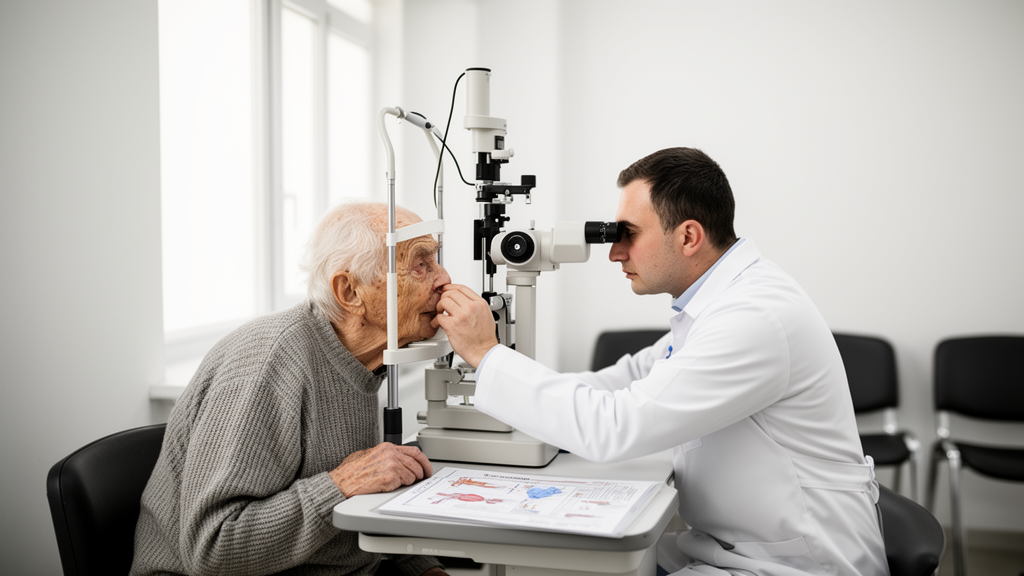
Vision-threatening retinal diseases are quietly draining Bulgaria’s economy at a pace that few public health systems have confronted so directly. New evidence published in the journal Pharmacia synthesizes cost-of-illness analyses and clinical pathway assessments to paint a stark picture: age-related macular degeneration (AMD) and diabetic macular edema (DME) together imposed a socioeconomic burden of €545.7 million on the country between 2017 and 2023, a figure projected to balloon to €1.39 billion by 2032. The findings arrive at a moment when Bulgaria’s rapidly aging population and rising diabetes prevalence are converging to create a perfect storm of avoidable vision loss.
The demographic backdrop is unforgiving. Across the European Union, people aged 65 and older now make up 21.6 percent of the population, but Bulgaria’s older cohort significantly exceeds that average, elevating the risk profile for age-related ocular disease. At the same time, diabetes is expanding across Europe, where roughly 65.6 million adults aged 20 to 79 live with the condition and regional expenditure reached an estimated USD 193 billion in 2024, about 19 percent of global diabetes spending. These two forces feed directly into the prevalence of diabetic retinopathy and its most sight-threatening complication, DME, which is the leading cause of vision loss in type 2 diabetes. An estimated 20 percent of people with type 1 diabetes and 25 percent of those with type 2 diabetes will develop DME, with the highest risk among patients who progress to proliferative diabetic retinopathy.
The scale of visual impairment worldwide underscores why these conditions demand attention. Some 295 million people live with moderate to severe vision impairment and 43 million are blind, with AMD alone responsible for 1.85 million cases of blindness and diabetic retinopathy contributing to 3.28 million cases of moderate to severe impairment. Although more than 90 percent of blindness occurs in low- and middle-income countries, the socioeconomic toll in transition economies such as Bulgaria is often underestimated, partly because reliable national prevalence data remain scarce. Modeling studies help fill the gap: the IQVIA CEE Ophthalmology Ecosystem Study estimates that approximately 32,200 people in Bulgaria live with neovascular AMD, about 0.50 percent of the population, while DME affects roughly 30,900 individuals, or 0.48 percent. A separate study of older Sofia residents found an overall AMD prevalence of 26.1 percent among people aged 65 and older, with late-stage disease affecting 5.6 percent.
What makes the new analysis particularly striking is where the money actually goes. The most comprehensive cost-of-illness evidence comes from a multinational assessment conducted in Bulgaria, Germany, and the United States using a harmonized methodology. In Bulgaria, the average annual cost per patient with neovascular AMD was estimated at €21,722 for those younger than 65 and €18,539 for those 65 and older, figures lower than in Germany and substantially lower than in the United States. Yet the composition of those costs tells a different story. Well-being losses, encompassing reduced physical and mental health, depression, anxiety, low vision, and loss of independence, account for nearly two-thirds of the total burden, amounting to €13,902 per patient annually. Direct medical costs, including diagnostics, imaging, and anti-VEGF pharmacological treatment, represent just 18 percent, or €3,910. Indirect medical costs such as formal care, assistive devices, and expenses related to accidents and falls add another 10 percent, while productivity losses from reduced work capacity or early retirement contribute 8 percent.
At the population level, the annual economic burden of neovascular AMD in Bulgaria is estimated at €228.9 million under a mid-prevalence scenario. Relative to the country’s population size and economic capacity, late-stage AMD imposes a disproportionately high societal burden despite lower per-patient healthcare expenditures than in wealthier nations. Complementary evidence from a socioeconomic burden analysis by the WifOR Institute quantifies the combined impact of AMD and DME from a societal perspective. For 2017 through 2023, the total burden reached €545.7 million, equivalent to 22,983 disability-adjusted life years lost. Unpaid productivity losses alone accounted for approximately 59 percent of that total, a reminder that vision loss devastates households and informal caregiving networks well beyond what formal labor statistics capture.
The projections are sobering. Between 2024 and 2032, total socioeconomic costs are expected to climb to €1.39 billion, with disability-adjusted life years rising to 29,586. Unpaid productivity losses remain the largest single component at 57.4 percent, but paid productivity losses are projected to increase both in absolute terms and as a share of the total, reflecting the growing toll of vision-threatening retinal disease among working-age adults, particularly those affected by DME. A long-term Bulgarian cost analysis using a 24-year horizon reinforces the cumulative picture, estimating mean lifetime costs per patient of between BGN 56,000 and BGN 63,000 for neovascular AMD and between BGN 47,000 and BGN 54,000 for DME, capturing medical and nonmedical resource use alongside productivity losses over the course of disease.
Behind these numbers lies a clinical pathway riddled with attrition. The IQVIA assessment estimates that only about 40 percent of neovascular AMD cases and 20 percent of DME cases in Bulgaria are actually diagnosed. Among those diagnosed, treatment initiation occurs in 80 percent of nAMD patients but just 50 percent of DME patients, and across indications only roughly half of patients receive on-label anti-VEGF therapy. Structural weaknesses compound the problem: Bulgaria lacks a structured national eye care policy and screening programs, relies heavily on private diagnostic and treatment centers, and imposes out-of-pocket payments for treatment administration. Delayed detection means treatment often begins at more advanced disease stages, when baseline clinical status is poorer and progression is faster, leading to inferior visual outcomes including permanent vision loss and greater demand for resource-intensive interventions such as prolonged anti-VEGF regimens, laser procedures, vision rehabilitation, and long-term support for blindness.
The economic case for early detection is among the most compelling findings. A Bulgaria-specific cost-benefit analysis of diabetic retinopathy screening showed that structured screening enables diagnosis at uncomplicated stages, when lower-cost interventions such as laser photocoagulation remain effective, thereby avoiding progression to vision-threatening disease requiring intensive anti-VEGF therapy or surgery. The analysis estimated an average screening cost of approximately BGN 410 per patient while generating net savings of nearly BGN 3,850 per diagnosed case, a benefit-cost ratio of roughly 9 to 1. A recent systematic review of studies published between 2013 and 2024 corroborates this conclusion, confirming that diabetic retinopathy screening is highly cost-effective for preventing visual impairment and blindness, recommending individualized screening intervals based on patient risk, and highlighting the potential of artificial intelligence-based screening to extend access to underserved regions.
The authors of the synthesis are careful to note the limitations of the evidence base. Several underlying analyses, particularly the WifOR socioeconomic burden assessment and the IQVIA ecosystem study, rely on modeling methodologies that integrate heterogeneous sources, including peer-reviewed literature, expert elicitation, and extrapolations necessitated by the scarcity of national real-world data. Estimates of treatment uptake, attrition along the care continuum, and future burden projections should therefore be read as indicative model-based approximations rather than empirically validated observations. Strengthening the evidence will require prospectively collected Bulgarian data to more accurately quantify the burden and rigorously evaluate existing care pathways.
Even with those caveats, the direction of the evidence is unambiguous. AMD and DME constitute a substantial and growing health and socioeconomic burden in Bulgaria, driven by demographic change, rising diabetes prevalence, and persistent gaps in early diagnosis and timely care. Although absolute healthcare expenditures remain lower than in higher-income settings, the societal impact, particularly through productivity losses and reduced quality of life, is considerable and escalating. The analysis points toward a coordinated national eye care program, potentially complemented by a national prevention center responsible for early detection of visual impairment in both pediatric and adult populations, as a strategic pathway to more systematic prevention, earlier intervention, and reduced avoidable vision loss. For a country confronting one of Europe’s steepest demographic curves, the choice between investing in early detection and absorbing a billion-euro societal toll is becoming impossible to defer.
Subject of Research: The socioeconomic burden and clinical care pathways of age-related macular degeneration and diabetic macular edema in Bulgaria
Article Title: The socioeconomic burden of age-related macular degeneration and diabetic macular edema in Bulgaria: Evidence from cost-of-illness analyses and clinical pathway assessment
Article References: Milushewa, P., Dimitrova, M., Nenkova, I., Tachkov, K., Mitkova, Z., & Petrova, G. (2026). The socioeconomic burden of age-related macular degeneration and diabetic macular edema in Bulgaria: Evidence from cost-of-illness analyses and clinical pathway assessment. Pharmacia, 73, Article e205931. https://doi.org/10.3897/pharmacia.73.e205931
Image Credits: AI Generated
DOI: 10.3897/pharmacia.73.e205931
Keywords: age-related macular degeneration, diabetic macular edema, cost-of-illness, Bulgaria, diabetic retinopathy, anti-VEGF therapy, vision loss, health economics, screening, socioeconomic burden, eye care policy, disability-adjusted life years
Cite Scienmag News
Beatrice Stafford. (October 18, 2026). Bulgaria Faces Soaring €1.39 Billion Burden from Age-Related Macular Degeneration and Diabetic Macular Edema. Scienmag. https://scienmag.com/bulgaria-faces-soaring-e1-39-billion-burden-from-age-related-macular-degeneration-and-diabetic-macular-edema/
Beatrice Stafford. "Bulgaria Faces Soaring €1.39 Billion Burden from Age-Related Macular Degeneration and Diabetic Macular Edema." Scienmag, 18 October 2026, https://scienmag.com/bulgaria-faces-soaring-e1-39-billion-burden-from-age-related-macular-degeneration-and-diabetic-macular-edema/. Accessed 18 October 2026.
Beatrice Stafford. "Bulgaria Faces Soaring €1.39 Billion Burden from Age-Related Macular Degeneration and Diabetic Macular Edema." Scienmag. October 18, 2026. https://scienmag.com/bulgaria-faces-soaring-e1-39-billion-burden-from-age-related-macular-degeneration-and-diabetic-macular-edema/


