


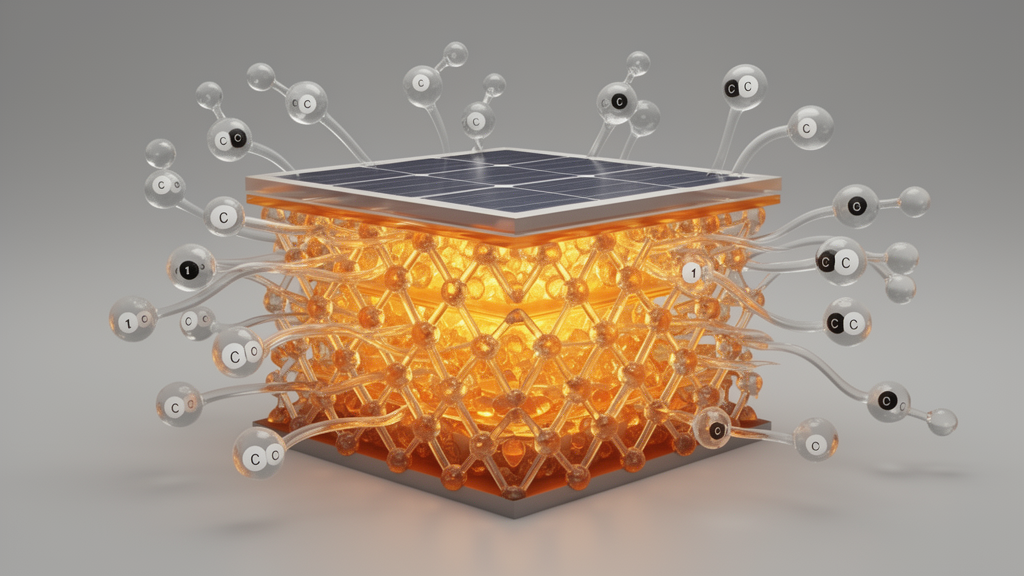
Perovskite solar cells have stunned the energy world with their meteoric rise in efficiency, but a new review published in the Journal of Materials Science argues that the next leap forward may come not from the perovskite itself, but from a class of designer salts known as ionic liquids. The review, led by Zhiyan Sun and colleagues at Liaoning Petrochemical College in China, systematically connects the molecular architecture of ionic liquids to the performance and durability of perovskite devices, offering a blueprint for rational additive design rather than trial-and-error chemistry.
Perovskite solar cells owe their appeal to a rare combination of traits: power conversion efficiencies that now rival established silicon technology, and a manufacturing route based on low-cost solution processing that can be printed, coated, or spin-cast at temperatures far below those needed for silicon wafer fabrication. Yet the technology remains haunted by stubborn bottlenecks. Devices degrade under sustained illumination, heat, and humidity; non-radiative recombination losses drain voltage; energy levels at interfaces misalign in ways that waste charge carriers; and producing large, uniform films across square meters of module area remains notoriously difficult. These problems, the review argues, share a common root in the delicate chemistry of the perovskite layer itself.
Ionic liquids, salts that remain liquid at or near room temperature, have emerged as one of the most versatile tools for addressing these weaknesses. Composed of bulky organic cations paired with organic or inorganic anions, they are essentially non-volatile, thermally robust, and electrically conductive. Crucially for perovskite researchers, both halves of the molecule can be tuned independently. The review emphasizes that this structural modularity is the key to their effectiveness: the cation backbone, the length of alkyl side chains, the type of functional substituents, and the coordination behavior of the anion collectively determine how, and how strongly, an ionic liquid interacts with the perovskite components.
The first major mechanism the authors dissect is crystallization control. Perovskite films form from solution, and the speed and orderliness of crystal growth determine whether the final film is riddled with grain boundaries and voids or dense and well-oriented. Ionic liquids can coordinate with lead ions and intermediate phases during deposition, slowing nucleation and guiding the formation of larger, more uniform grains. The review highlights work showing that ionic liquid additives enable high-quality crystallization even in air atmosphere, a significant practical advantage since perovskite processing has traditionally demanded inert-glovebox conditions. Viscosity effects, noted in earlier studies of ionic-liquid-assisted growth, also modulate how nanoparticles assemble into the final film.
Defect passivation is the second pillar. The surfaces and grain boundaries of perovskite crystals are littered with undercoordinated lead atoms and halide vacancies that act as traps for charge carriers, sapping efficiency through non-radiative recombination. Ionic liquids attack this problem from both ends of the molecule: the anion, whether a halide, pseudohalide, acetate, or fluorinated species, can bond to exposed lead sites, while cations such as imidazolium, pyrrolidinium, and pyridinium derivatives interact with the halide-rich side of the lattice. The review catalogs studies in which such dual-action passivation pushed fill factors above 83 percent in cesium-based cells and lifted efficiencies beyond 23 and even 25 percent, including air-fabricated devices reaching 25.11 percent efficiency.
Interfacial energetics form the third mechanism. A solar cell is a stack of dissimilar materials, and every junction between the perovskite and its transport layers can either help or hinder the flow of electrons and holes. Ionic liquids, with their permanent dipoles and tunable work functions, can realign energy levels at these buried interfaces, reducing voltage losses. The review describes strategies ranging from ionic liquid optimization of the interface between spray-coated nickel oxide and the perovskite, to hybrids of self-assembled monolayers and ionic liquids for buried interface modulation in tandem devices, to ionic liquid engineering that strengthens the perovskite/self-assembled-monolayer heterointerface itself.
Moisture resistance and long-term stability round out the picture. Water ingress is a primary degradation pathway for perovskites, and the hygroscopic character of ionic liquids is a double-edged sword that the review examines carefully. Some ionic liquids form protective encapsulating layers or stabilize one-dimensional perovskite phases at the surface that shield the underlying three-dimensional absorber. A landmark study cited in the review demonstrated that ionic liquids can dramatically improve the long-term operational stability of perovskite solar cells, and related work showed modules stabilized with ionic liquids exceeding 20 percent power conversion efficiency. The review also notes that in situ oligomerization of ionic liquids has produced robust encapsulation even in perovskite single crystals for X-ray detection, hinting that the same chemistry could harden photovoltaic devices.
The review’s most distinctive contribution is its insistence on structure-property relationships. Rather than treating ionic liquids as interchangeable additives, it categorizes them by chemical family, imidazolium, pyrrolidinium, ammonium, pyridinium, and protic variants among them, and links each family’s behavior to its molecular features. Alkyl chain length governs hydrophobicity and how deeply the cation inserts into the lattice; functional groups such as sulfonates, fluorine atoms, and Lewis base sites dictate coordination strength and passivation mode; and anion identity determines whether the additive manages iodine, moderates strain, or forms low-dimensional surface phases. This framework explains why, for example, a piperidinium salt famously stabilized high-efficiency perovskite cells in work published in Science, and why acetate-based ionic liquids excel at crystallization regulation in inorganic compositions.
The implications extend well beyond the laboratory. Ionic liquids have enabled printable mesoscopic cells exceeding 20 percent efficiency, improved the humidity tolerance of vacuum-deposited large-area modules, and even accelerated the oxidation of the widely used hole transport material Spiro-OMeTAD for more reproducible devices. They are also opening a greener processing route: protic ionic liquids have allowed researchers to formulate perovskite inks from water and alcohols for slot-die coating, moving the field away from toxic solvents. Machine learning is now being deployed to accelerate the search for optimal ionic liquid formulations, a development the review flags as a coming inflection point for the field.
Challenges remain before ionic liquid engineering becomes standard practice. The review acknowledges that the sheer diversity of possible cation-anion combinations makes systematic optimization difficult, that the long-term behavior of some additives under real-world operating conditions needs further scrutiny, and that the green credentials of ionic liquids themselves deserve honest reassessment rather than assumption. Still, the authors argue that the correlations they have mapped between molecular design and device performance provide the theoretical foundation needed to move from empirical discovery to deliberate engineering. If perovskite solar cells are to graduate from record-breaking lab curiosities to durable, bankable products on rooftops and solar farms, the humble ionic liquid, they suggest, may be one of the decisive ingredients.
Subject of Research: The role of ionic liquid molecular design in improving the efficiency and stability of perovskite solar cells
Article Title: Ionic liquids for perovskite solar cells: from molecular design to device performance
Article References: Sun, Z., Yang, L., Du, F., Wang, H., & Li, Z. (2026). Ionic liquids for perovskite solar cells: from molecular design to device performance. Journal of Materials Science. https://doi.org/10.1007/s10853-026-13946-8
Image Credits: AI Generated
DOI: 10.1007/s10853-026-13946-8
Keywords: perovskite solar cells, ionic liquids, defect passivation, crystallization, photovoltaics, interface engineering, device stability, molecular design, thin films, renewable energy, Ionic, liquids
Cite Scienmag News
Denise Maddox. (October 18, 2026). Ionic Liquids: The Molecular Key to Tougher, More Efficient Perovskite Solar Cells. Scienmag. https://scienmag.com/ionic-liquids-the-molecular-key-to-tougher-more-efficient-perovskite-solar-cells/
Denise Maddox. "Ionic Liquids: The Molecular Key to Tougher, More Efficient Perovskite Solar Cells." Scienmag, 18 October 2026, https://scienmag.com/ionic-liquids-the-molecular-key-to-tougher-more-efficient-perovskite-solar-cells/. Accessed 18 October 2026.
Denise Maddox. "Ionic Liquids: The Molecular Key to Tougher, More Efficient Perovskite Solar Cells." Scienmag. October 18, 2026. https://scienmag.com/ionic-liquids-the-molecular-key-to-tougher-more-efficient-perovskite-solar-cells/


