


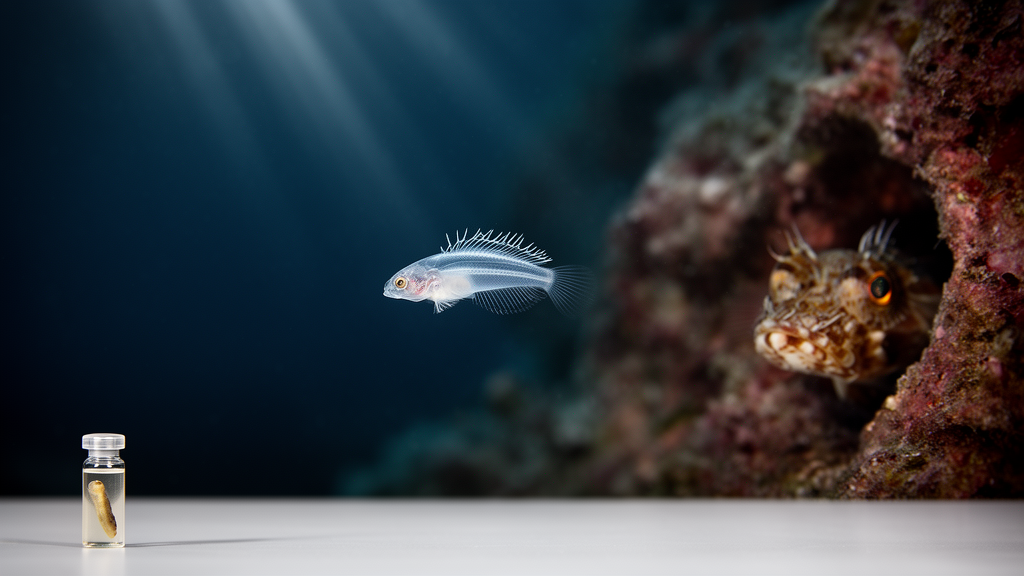
For nearly four decades, the fringehead blenny Neoclinus chihiroe has been known only from its adult form, a small benthic fish lurking among rocky nearshore habitats of Korea and Japan. Now, researchers have finally put a face to its earliest life stage. A single larval specimen, collected in June 2016 from waters off Ulleung Island in the East Sea, has been identified as N. chihiroe through a combination of DNA barcoding and careful morphological analysis, marking the first time anywhere in the world that the larva of this species has been formally documented. The finding, published in the journal Acta Ichthyologica et Piscatoria, fills a conspicuous gap in our understanding of a genus famous for its territorial, big-mouthed adults.
Identifying fish larvae is notoriously difficult. Early-stage fishes often lack the distinctive morphological features that make adult identification straightforward, and for many species the shape and appearance of juvenile and larval stages remain entirely unknown. This challenge is especially acute within closely related groups, where even well-preserved specimens can defy visual classification. To overcome this barrier, modern ichthyology increasingly pairs traditional anatomical description with molecular tools, most notably DNA barcoding of the mitochondrial cytochrome oxidase subunit I (COI) gene, which acts as a genetic fingerprint capable of matching a mystery larva to its adult counterpart.
The specimen at the heart of this study was collected near Juk Island, a small islet off the eastern coast of Ulleung Island, and preserved whole in 99 percent ethanol. Measuring 16.0 millimeters in standard length, the larva was examined under a stereomicroscope with associated imaging software, with all counts and measurements taken to the nearest 0.1 millimeter following standard larval fish methodology. The specimen is now deposited at the National Marine Biodiversity Institute of Korea, where it serves as the physical voucher for this first-ever record.
For the molecular work, genomic DNA was extracted from the right eye of the specimen, and a 537-base-pair segment of the COI gene was amplified using a universal fish primer set. The resulting sequence was compared against reference sequences from five Neoclinus species, including adults of N. bryope from Jeju Island, N. nudus and N. okazakii from Hachijo-jima Island in Japan, N. lacunicola from Ulleung Island, and an adult N. chihiroe previously collected at Dokdo, Korea. All sequences were deposited in the DDBJ/EMBL/GenBank databases under accession numbers PV715913 through PV715918, with an outgroup species included to root the analysis.
The genetic results were unambiguous. The larval specimen matched the adult N. chihiroe from Dokdo at a genetic distance of just 0.002, effectively confirming they are the same species. In contrast, the larva differed from the other four Neoclinus species by genetic distances ranging from 0.138 to 0.197, a substantial gap that clearly separates it from its closest relatives. A neighbor-joining tree constructed from these sequences placed the larva in a tight cluster with the adult N. chihiroe, a relationship supported by high bootstrap values across 10,000 replicates. This molecular evidence settled a question that morphology alone could not answer.
With the species identity confirmed, the team turned to a detailed morphological description. The larva has a slender, elongated, and compressed body with a slightly pointed head, a short blunt snout, and a terminal mouth of moderate size. The posterior tip of the maxilla reaches vertically to the middle of the large eye, and two multifid cirri are present on the orbit, small fringed appendages that are characteristic of the genus. The dorsal fin contains 13 spines and 15 soft rays, the anal fin has 2 spines and 27 soft rays, and the pectoral fin bears 13 rays. The anus sits in front of the middle of the body, and the caudal fin is truncate, separated from the posterior ends of the dorsal and anal fins.
Pigmentation proved equally diagnostic. In ethanol preservation, the head and body appear opaque yellowish white, punctuated by melanophores of varying sizes around the eye, cheek, jaws, and gill regions. Three pairs of asterisk-shaped melanophores mark the top of the head, one pair in each of the interorbital, occipital, and nape regions, while several melanophores run in a row from the isthmus to the anus along the ventral side. Six large pale melanophores are sparsely distributed on both sides of the dorsal contour, and many dark melanophores line the ventral contour along the base of the anal fin. All fins are semi-transparent. This specific pattern of pigment placement distinguishes N. chihiroe larvae from those of related species.
Comparative analysis reveals that while the larvae of N. chihiroe, N. bryope, and N. okazakii share a broadly similar body plan, they can be told apart by the distribution of melanophores along the midlateral region of the posterior body. N. chihiroe carries one or two pale melanophores in this area, N. bryope displays many small ones, and N. okazakii shows several large ones. Fin-ray counts, though similar across the genus, also provide a useful diagnostic combination: the larval N. chihiroe’s dorsal fin formula of 23 spines and 15 soft rays, together with its anal and pectoral fin counts, separates it from the seven other western Pacific species of Neoclinus.
The geographic context of the discovery adds ecological weight to the finding. The adult N. chihiroe previously reported from Korea was collected at Dokdo, a remote islet group in the East Sea, while the larva described here came from Ulleung Island, another isolated landmass far from the Korean peninsula. Both locations harbor unique environmental and biological characteristics shaped by their oceanic isolation. The co-occurrence of adults and larvae of this coastal fish on islands distant from the mainland suggests that N. chihiroe is not merely a transient visitor but a species genuinely adapted to and settled in these waters, completing its life cycle in the region.
This first report of a N. chihiroe larva opens a small but meaningful window into the early life history of a genus that remains poorly understood at its most vulnerable stage. Of the eleven recognized Neoclinus species distributed across the Pacific Ocean, only a handful have had their larvae described at all, and the early life stages of most remain entirely unknown. By combining molecular identification with morphological characterization, this study provides a template for future work on the genus and underscores the value of DNA barcoding in resolving the identities of larval fishes that would otherwise remain nameless. As biodiversity research increasingly depends on understanding not just where species live but how they reproduce and disperse, records like this one become essential building blocks for marine conservation in the East Sea and beyond.
Subject of Research: First molecular and morphological identification of a Neoclinus chihiroe larva from the East Sea, Korea
Article Title: Molecular identification and morphological description of a Neoclinus chihiroe ( Actinopterygii , Blenniiformes , Chaenopsidae ) larva from the East Sea, Korea
Article References: Kwun, H. J. (2025). Molecular identification and morphological description of a Neoclinus chihiroe (Actinopterygii, Blenniiformes, Chaenopsidae) larva from the East Sea, Korea. Acta Ichthyologica et Piscatoria, 55, 291-295. https://doi.org/10.3897/aiep.55.166777
Image Credits: AI Generated
Keywords: Neoclinus chihiroe, Chaenopsidae, fish larvae, DNA barcoding, COI gene, Ulleung Island, East Sea, marine biodiversity, ichthyology, morphology, Korea, blenny
Cite Scienmag News
Juliet Wilcox. (October 18, 2026). DNA Barcoding Reveals First Ever Larva of the Fringehead Fish Neoclinus chihiroe. Scienmag. https://scienmag.com/dna-barcoding-reveals-first-ever-larva-of-the-fringehead-fish-neoclinus-chihiroe/
Juliet Wilcox. "DNA Barcoding Reveals First Ever Larva of the Fringehead Fish Neoclinus chihiroe." Scienmag, 18 October 2026, https://scienmag.com/dna-barcoding-reveals-first-ever-larva-of-the-fringehead-fish-neoclinus-chihiroe/. Accessed 18 October 2026.
Juliet Wilcox. "DNA Barcoding Reveals First Ever Larva of the Fringehead Fish Neoclinus chihiroe." Scienmag. October 18, 2026. https://scienmag.com/dna-barcoding-reveals-first-ever-larva-of-the-fringehead-fish-neoclinus-chihiroe/


