


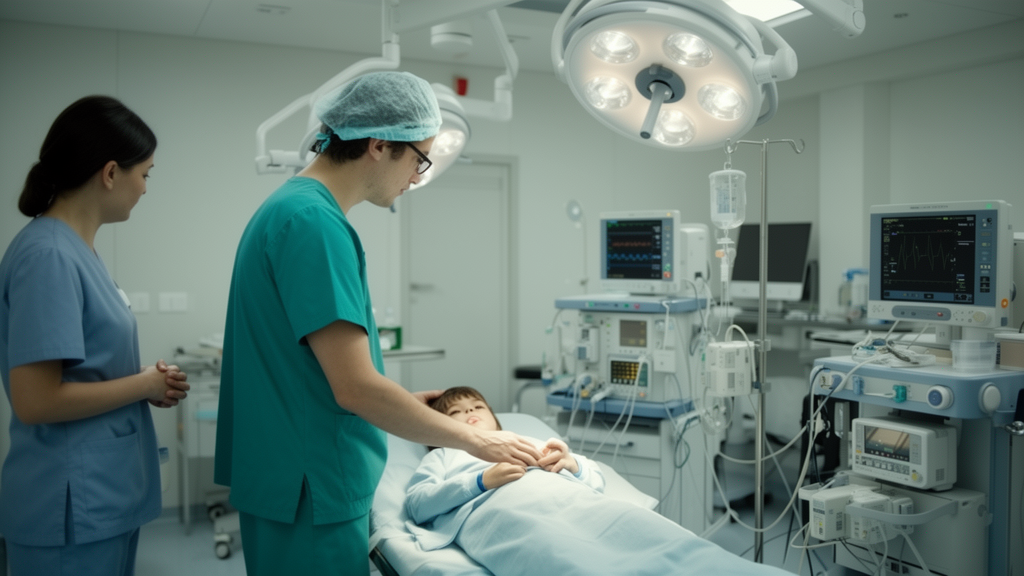
When a child stops breathing unexpectedly on the operating table, the difference between a near miss and a tragedy often comes down to seconds of attention. Now a team of anaesthesiologists in Malaysia reports that a deliberately simple teaching routine built around four words—Look, Observe, Orient and Prepare—was associated with a dramatic drop in critical incidents during paediatric anaesthesia at their hospital, suggesting that structured situational awareness training may be one of the most cost-effective safety interventions available to surgical teams.
The study, published in BMC Medical Education by researchers at Universiti Malaya and Universiti Malaya Medical Centre in Kuala Lumpur, analysed 3,431 paediatric anaesthesia cases spanning January 2023 to July 2025. Before the LOOP framework was introduced as a routine departmental teaching activity, critical incidents occurred at a certain baseline rate; after implementation, the incident rate fell to roughly 39 percent of its previous level, a reduction of more than sixty percent. The statistical analysis, which used time-series summaries and regression models to compare rates before and after the intervention, found an incident rate ratio of 0.386 with a 95 percent confidence interval of 0.220 to 0.676, and a p-value below 0.001. In practical terms, the odds of a case experiencing one or more critical incidents dropped by about 65 percent, with an odds ratio of 0.350.
What makes LOOP distinctive is not technological sophistication but conceptual clarity. The framework is structured around situational awareness, a concept borrowed from human factors research and aviation safety, where it has long been recognised that most accidents stem not from a lack of technical skill but from a failure to notice, interpret, and project what is happening in a dynamic environment. Each letter of LOOP corresponds to a cognitive step. Look directs the trainee to actively scan the patient, the monitors, and the surgical field rather than passively waiting for an alarm. Observe asks the trainee to register what has actually changed. Orient requires the trainee to place those observations in context, asking what they mean for this particular child at this particular moment. Prepare prompts the trainee to anticipate what could go wrong next and to ready equipment, drugs, and assistance before problems escalate.
The researchers embedded LOOP as a routine departmental teaching activity rather than a one-off lecture or simulation exercise. This matters because educational interventions in anaesthesia training often struggle to move beyond the classroom. Traditional morbidity and mortality conferences, which review adverse events after the fact, are valuable but inherently reactive. LOOP was designed to be prospective, giving trainees a repeatable mental checklist they could apply during every case, not just those that had already gone wrong. By pairing the framework with the department’s existing critical incident reporting system, the team created a feedback loop: incidents were logged, trends were analysed, and the teaching activity was continuously reinforced as part of normal departmental life.
The study was designed as a retrospective observational analysis of audit data, which means it captures real-world clinical practice rather than a controlled laboratory setting. The researchers examined incident rates over time using a time-series summary and regression models, adjusting for the possibility that other changes in practice might have contributed to the observed decline. They also surveyed recent trainee cohorts to evaluate whether the teaching activity was acceptable, appropriate, and feasible in the eyes of the people actually using it. All 13 eligible trainees responded, giving mean scores of 4.55 for acceptability, 4.62 for appropriateness, and 4.29 for feasibility on a five-point Likert scale—strongly positive across all three dimensions.
Paediatric anaesthesia is an especially demanding domain for situational awareness. Children differ from adults in airway anatomy, drug dosing, cardiovascular reserve, and the speed at which physiological derangements progress. A small error in drug calculation or a delayed response to a dropped oxygen saturation can escalate far faster in a toddler than in an adult. Trainees rotating through paediatric anaesthesia must therefore master not only the technical skills of airway management and haemodynamic control but also the cognitive discipline of maintaining a continuously updated mental model of the patient’s state. The LOOP framework addresses this cognitive dimension directly, giving trainees a shared vocabulary and a shared mental routine that can be rehearsed and reinforced across every case they encounter.
The critical incident reporting system that provided the outcome data is itself a cornerstone of modern patient safety practice. By systematically logging events that did or could have caused harm—whether a difficult airway, an unexpected drug reaction, a equipment malfunction, or a communication breakdown—departments can identify patterns that individual clinicians might never perceive. But reporting alone does not prevent harm. The value of a report lies in what the department does with it, and this is where many institutions fall short. Reports accumulate, meetings are held, and yet the underlying behaviours that produced the incidents remain unchanged. The Kuala Lumpur team’s insight was to connect the reporting system to an educational framework that changed what trainees actually did in the moment, rather than merely documenting what had already happened.
The study has limitations that the authors acknowledge. As a retrospective, single-centre observational analysis, it cannot prove causation with the certainty of a randomised trial. Other factors—changes in staffing, case mix, equipment, or concurrent safety initiatives—could have contributed to the decline in incident rates. The perception survey involved only 13 trainees, a small sample that limits the generalisability of the acceptability findings. The study was conducted at a single tertiary hospital in Malaysia, and whether LOOP would produce similar results in institutions with different training structures, resources, or patient populations remains to be demonstrated. Nevertheless, the magnitude of the observed effect, its statistical significance, and the strong trainee endorsement combine to make a compelling case for further evaluation.
The implications extend well beyond paediatric anaesthesia. The World Federation of Societies of Anaesthesiologists has long emphasised that anaesthesia-related mortality in low- and middle-income settings remains substantially higher than in high-income countries, often due to gaps in training, equipment, and systematic safety practices rather than a lack of individual skill. A framework like LOOP, which requires no new equipment, no additional staffing, and no significant financial investment, could be particularly valuable in resource-constrained environments where the marginal cost of implementation is essentially zero. The authors describe LOOP as a potentially scalable educational tool for anaesthesia training programmes with relevance to patient safety education more broadly.
What the study ultimately demonstrates is that the boundary between education and safety is thinner than many institutions assume. Teaching trainees how to think—not just what to do—can produce measurable changes in clinical outcomes. The LOOP framework turns abstract concepts from human factors research into a concrete, repeatable routine that fits within the rhythm of departmental teaching. If the findings hold up in broader settings, the lesson for medical educators and patient safety advocates alike is clear: the most powerful safety interventions may not be new machines or new protocols, but new habits of mind, deliberately cultivated and consistently practised, one case at a time.
Subject of Research: Implementation of the LOOP situational awareness teaching framework and its association with critical incident rates in paediatric anaesthesia training
Article Title: From critical incident reporting to safer practice: implementing the LOOP learning framework in paediatric anaesthesia at a tertiary hospital
Article References: Francis, V. P., A. R., N. I., Mok, C. S., Elias, A. F., Yeap, C. H., Wong, Y. X., Chaw, S. H., & Shariffuddin, I. I. (2026). From critical incident reporting to safer practice: implementing the LOOP learning framework in paediatric anaesthesia at a tertiary hospital. BMC Medical Education. https://doi.org/10.1186/s12909-026-10383-8
Image Credits: AI Generated
DOI: 10.1186/s12909-026-10383-8
Keywords: paediatric anaesthesia, LOOP framework, situational awareness, critical incident reporting, patient safety, anaesthesia training, medical education, quality improvement, human factors, Universiti Malaya, incident rate reduction, trainee perception survey
Cite Scienmag News
Harold Sullivan. (October 18, 2026). Simple Four-Step Teaching Framework Cuts Critical Incidents in Paediatric Anaesthesia by More Than Sixty Percent. Scienmag. https://scienmag.com/simple-four-step-teaching-framework-cuts-critical-incidents-in-paediatric-anaesthesia-by-more-than-sixty-percent/
Harold Sullivan. "Simple Four-Step Teaching Framework Cuts Critical Incidents in Paediatric Anaesthesia by More Than Sixty Percent." Scienmag, 18 October 2026, https://scienmag.com/simple-four-step-teaching-framework-cuts-critical-incidents-in-paediatric-anaesthesia-by-more-than-sixty-percent/. Accessed 18 October 2026.
Harold Sullivan. "Simple Four-Step Teaching Framework Cuts Critical Incidents in Paediatric Anaesthesia by More Than Sixty Percent." Scienmag. October 18, 2026. https://scienmag.com/simple-four-step-teaching-framework-cuts-critical-incidents-in-paediatric-anaesthesia-by-more-than-sixty-percent/


