


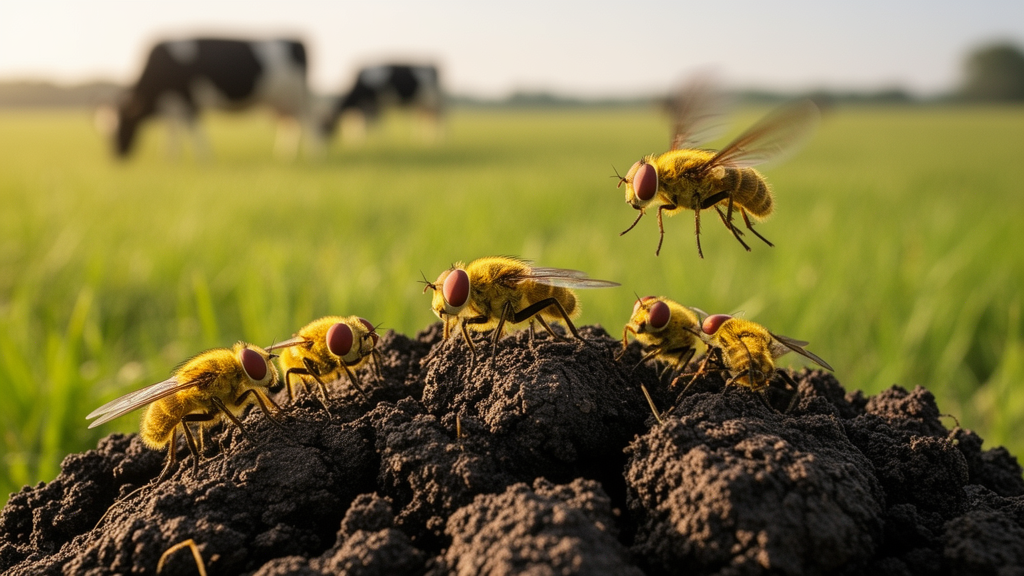
The yellow dung fly, Scathophaga stercoraria, is one of the most familiar insects on European pastures, swarming around fresh cow pats from lowland meadows to alpine grasslands nearly 2,000 meters above sea level. Its constant association with domesticated cattle has long led scientists to suspect that it might be a cow dung specialist, an insect so tightly adapted to livestock that it can barely survive anywhere else. A new laboratory study from Switzerland, published in Alpine Entomology, puts that suspicion to a rigorous experimental test and reaches a surprising verdict: the yellow dung fly is not a domesticated cow dung specialist at all, but a flexible generalist that thrives on the dung of wild and domestic mammals alike.
The question matters because dung-eating insects perform an ecological service that modern agriculture quietly depends on. Coprophagous beetle and fly larvae decompose vertebrate dung, recycling nutrients back into managed grasslands and preventing pastures from being buried under accumulating excrement. The importance of this service became vividly clear when cattle were introduced to Australia, where no co-evolved dung fauna existed to break down the proliferating pats. Dung beetles from southern Europe had to be imported deliberately to control the problem. Understanding whether a given decomposer is locked onto one dung type or can exploit many therefore has direct consequences for how nutrient cycling works across agricultural landscapes.
The theory of niche differentiation predicts that species sharing a habitat should differentiate with regard to their key resources, notably food, with physiological adaptations driving specialization over evolutionary time. Yet in nature, many coprophagous insects coexist on roughly the same resource, forming a continuum from extreme specialists that exploit only a single vertebrate’s dung to broad generalists that thrive on whatever they find. Because the nutritional components of dung, from fibrous plant matter to the bacteria and fungi growing within it, may be broadly similar depending on whether the producer is a herbivore, carnivore, or omnivore, researchers had long hypothesized that dung feeders should tend toward generalism rather than extreme specialization. That hypothesis, however, had never been systematically tested for yellow dung fly larvae, whose success on diverse dung types remained an open question despite decades of intensive study of the species’ mating behavior.
The yellow dung fly is an unusual insect in several respects. Approaching the size of a honey bee, it is among the largest and most abundant dung decomposers in cold-temperate regions across the entire northern hemisphere. Unlike most insects, which favor warmth, this fly actually prefers cooler climates, having invaded arctic regions of both the Old and New Worlds and colonized high-altitude habitats such as the Alps. In Switzerland, where cows for milk, cheese, and beef production range from lowland farms to alpine pastures beyond the treeline, the species is essentially omnipresent. Females lay their eggs into fresh vertebrate dung, which the larvae consume and recycle before pupating in the soil nearby. Adults sip nectar for energy but also require small insect prey to reproduce, a nutritional strategy known as anautogeny, and mating takes place around the fresh dung pat, where males abound to intercept incoming females.
To test whether this fly is truly a cow dung specialist, the research team raised yellow dung fly larvae on dung from four large mammals common in Switzerland: domesticated cow and horse, both herbivores, and wild boar, an omnivore, and wild red deer, another herbivore. Cow and horse dung was collected from farms near Zürich, wild boar dung from Wildpark Langenberg, and red deer dung from Tierpark Goldau. In every case, freshly collected dung from many individuals was mixed thoroughly and frozen at minus 80 degrees Celsius for at least two weeks to kill all arthropods within it, ensuring that any differences in larval performance reflected dung quality rather than the presence of other dung inhabitants. The flies themselves came from a laboratory stock originally caught in Fehraltorf, Switzerland, and maintained on defrosted cow dung for several generations.
The experimental design was carefully controlled. Single-held females were allowed to copulate with a random male in glass vials containing water, sugar, and Drosophila prey, and then laid egg clutches into a smear of cow dung on filter paper. Using a split-brood design, the researchers transferred typically ten eggs from each clutch into small plastic containers with overabundant dung of one of the four types, more than two grams per egg, so that food quantity was never limiting. The containers were placed in a climate chamber set at 19 degrees Celsius, 60 percent relative humidity, and a 13-hour light period. The team then scored survivorship as the proportion of individuals that emerged as adults, recorded sex-specific egg-to-adult development time, and measured hind tibia length as a reliable index of final structural body size, calculating growth rate as tibia length divided by development time in days.
The results were striking in their consistency. Larva-to-adult survival did not vary significantly among the four dung types, hovering around an overall mean of 80 percent, a value typical for cow dung in long-term laboratory studies. Survival was somewhat lower in boar dung, at roughly 73 percent, and somewhat higher in red deer dung, at roughly 93 percent, but the planned comparison between domestic and wild mammal dung showed no overall difference. Development time, body size, and growth rate did vary somewhat among dung types, with development longest in cow dung yet producing the largest adults, while growth rate was fastest in wild boar dung but yielded relatively small flies. The researchers judged this variation minor relative to that typically induced by other environmental stressors such as dung limitation, heat, and drought, and importantly, not in accordance with the main hypotheses being tested.
The finer-scale differences in performance most likely reflect variation in dung consistency, water content, and the nutritional value of the dung microbiome of the different mammals. Previous estimates showed that cow dung contains about 81 percent water, horse dung about 77 percent, red deer dung about 69 percent, and wild boar dung about 71 percent, differences that likely affect the ability of larvae to move through and digest their food. The researchers also noted that the significant sex-by-dung type interactions observed across all performance variables mainly reflect size scaling in this strongly sexually dimorphic species, in which males are larger, rather than differential physiological responses to the food source. A next step, they suggest, would be testing oviposition preferences of gravid females in choice experiments, which should correlate with the performance ranking revealed by the life history traits measured here.
The broader implication is that yellow dung flies are opportunistic in their choice of dung, reproducing on deer or boar dung when in the forest and switching readily to cow, horse, or sheep dung when in grasslands, depending on site and weather. In Swiss lowland pastures interspersed with agricultural areas and forests, more alternative livestock substrates are available than in highland grasslands, while in the Alps, where cows and sheep abound up to the treeline, wild animal dung from deer, ibex, and mountain goats becomes relatively more abundant, again permitting easy switching between dung types. Because the species is cold-adapted in general, longer winters in the Alps shorten the growing season and extend winter diapause of pupae but should not strongly reduce fly mortality or population density.
The study concludes that yellow dung flies can reproduce successfully on multiple types of mammal dung, wild or domestic, herbivore or omnivore, and likely also carnivore, with reproductive fitness that does not strongly deviate from that observed in cattle dung. The species is widespread, the researchers argue, because it could plastically shift to the dung of common herbivorous livestock after domestication without losing the ability to reproduce on the dung of common wild mammals. In this respect, the yellow dung fly belongs to the minority of insect taxa that benefit from humanity’s agricultural activities rather than suffering from them, and is therefore not of special conservation concern. Far from being a domesticated cow dung specialist, this familiar pasture fly turns out to be an evolutionary opportunist that simply followed livestock around the world while keeping its options open.
Subject of Research: Ecology and evolutionary biology of dung-feeding insects
Article Title: Are yellow dung flies domesticated cow dung specialists?
Article References: Blanckenhorn, W. U., & Burkhard, D. (2023). Are yellow dung flies domesticated cow dung specialists?. Alpine Entomology, 7, 135-141. https://doi.org/10.3897/alpento.7.107649
Image Credits: AI Generated
Keywords: yellow dung fly, dung decomposition, niche differentiation, coprophagous insects, livestock pastures, Switzerland, Scathophaga stercoraria, dung generalists, entomology, life history traits, yellow, dung
Cite Scienmag News
William Thompson. (October 18, 2026). Yellow Dung Flies Are Dung Generalists, Not Cow Dung Specialists. Scienmag. https://scienmag.com/yellow-dung-flies-are-dung-generalists-not-cow-dung-specialists/
William Thompson. "Yellow Dung Flies Are Dung Generalists, Not Cow Dung Specialists." Scienmag, 18 October 2026, https://scienmag.com/yellow-dung-flies-are-dung-generalists-not-cow-dung-specialists/. Accessed 18 October 2026.
William Thompson. "Yellow Dung Flies Are Dung Generalists, Not Cow Dung Specialists." Scienmag. October 18, 2026. https://scienmag.com/yellow-dung-flies-are-dung-generalists-not-cow-dung-specialists/


