


Ceria, or cerium dioxide, is one of the most quietly important materials in modern energy and environmental technology. Its value comes from a peculiar atomic talent: it can absorb, store, and release oxygen on demand, shuttling between its Ce4+ and Ce3+ states without falling apart. That oxygen storage and release capacity, combined with a high density of tunable surface defects, makes nanostructured ceria a workhorse in catalytic converters, soot combustion catalysts, CO2 conversion systems, and a growing list of carbon-neutrality applications. But ceria has a fatal weakness that has frustrated materials scientists for decades. Heat it up, and the very nanostructure that gives it power simply melts away.
The problem is sintering. At elevated temperatures, tiny ceria crystallites grow into large ones, and adjacent crystallites agglomerate into dense aggregates. The enormous surface area that made the material so reactive collapses, oxygen vacancies vanish, and the oxygen storage capacity that defines ceria’s usefulness drains away. In automotive exhaust systems, where catalysts routinely face 850 degrees Celsius, this degradation is not a hypothetical risk but a daily reality. Researchers have long tried to stabilize ceria by doping it with zirconium, lanthanum, or other rare-earth elements, or by anchoring it to oxide supports. These approaches help, but they often trade off one property against another, and none has fully solved the twin problems of crystallite growth and agglomeration.
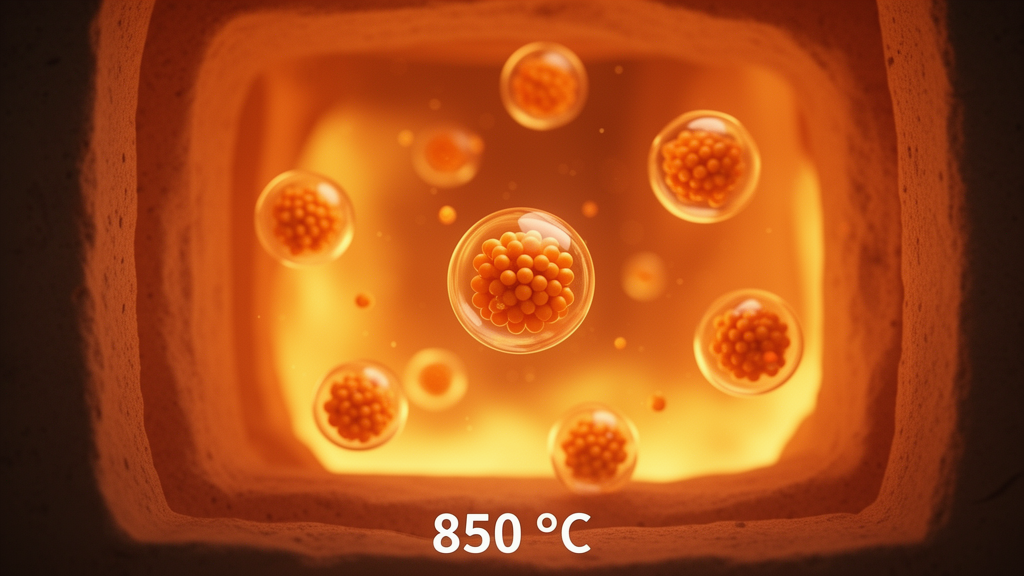
Now a team at Sichuan University led by Yang Wu, Xiayu Zheng, Kuan Wei, Hengqin Dai, Haidi Xu, Jianli Wang, and Yaoqiang Chen has reported a strikingly simple and effective strategy in the Journal of Materials Science. Their approach partially transforms the surface of ceria into amorphous silicates, creating what amounts to a nanoscale armor layer. The results are dramatic. After calcination at 850 degrees Celsius, silicate-modified ceria retained a small crystallite size of 7.1 nanometers. Unmodified ceria, subjected to the same thermal treatment, ballooned to 151.2 nanometers. That is a difference of more than twentyfold, achieved not by exotic dopants but by a surface chemistry trick that any competent materials lab could reproduce.
The silicate layer works through a dual mechanism that the authors describe in careful detail. First, Si–O–Ce bonding at the ceria surface suppresses the migration of cerium atoms. In unmodified ceria, individual cerium and oxygen atoms hop across surfaces and grain boundaries at high temperature, allowing small crystallites to feed larger ones in the classic Ostwald ripening process. The Si–O–Ce bonds anchor these atoms in place, retarding crystallite growth from the inside out. Second, the amorphous silicate phase acts as a physical barrier between adjacent crystallites. Even if individual crystallites remain stable, they can still fuse together when they touch. The silicate coating prevents that contact, inhibiting agglomeration the way a layer of packing foam prevents objects from scratching each other in transit.
The consequences for surface area are equally striking. Unmodified ceria, after thermal treatment, had a specific surface area of just 1.1 square meters per gram. The silicate-modified version reached 67.4 square meters per gram, a more than sixtyfold increase. This is not merely a cosmetic improvement. Surface area is the currency of heterogeneous catalysis, and ceria’s oxygen storage capacity depends directly on how much reactive surface is available to exchange oxygen with the surrounding gas phase. A material that keeps its surface area at high temperature keeps its catalytic power.
But the silicate modification does something more subtle than just preserving surface area. By keeping the crystallites small, it also increases the concentration of oxygen vacancies, the atomic-scale defects where oxygen atoms are missing from the ceria lattice. These vacancies are the active sites for oxygen storage and release, and their concentration scales inversely with crystallite size. Smaller crystallites mean more surface, more grain boundaries, and more vacancies, which in turn enhances the mobility of oxygen ions through the material. The redox performance of the silicate-ceria composite was correspondingly enhanced, with the low-temperature oxygen storage capacity increasing 26-fold compared to the unmodified sample.
This last point deserves emphasis because it addresses a persistent trade-off in ceria research. Stabilizing ceria thermally often means making it more rigid, more crystalline, and less defective, which reduces its oxygen storage capacity. The silicate approach breaks that trade-off. It stabilizes the nanostructure without sacrificing the defect chemistry that makes ceria valuable. The authors argue that their findings establish a generalizable approach for designing ceria-based nanomaterials with outstanding thermal stability and enhanced redox functionality, and the mechanism they describe, surface silicate suppression of atomic migration and crystallite agglomeration, could plausibly be applied to other oxide nanomaterials that suffer from the same thermal fragility.
The broader implications reach into several domains. In automotive catalysis, ceria-based oxygen storage materials are essential components of three-way catalysts, and their thermal degradation is a major contributor to catalyst aging. A ceria that survives 850 degrees Celsius with its nanostructure intact could extend catalyst lifetimes and reduce the amount of precious metal needed. In CO2 conversion and soot combustion, where ceria’s oxygen vacancies play a central role, the ability to maintain high vacancy concentrations at operating temperatures could improve conversion efficiency. And in emerging applications such as chemical looping and thermochemical energy storage, where ceria cycles between oxidized and reduced states at extreme temperatures, thermal stability is the defining constraint.
What makes this work particularly compelling is its elegance. Rather than adding new elements to the ceria lattice or building complex composite architectures, the researchers simply modified the surface chemistry. The silicate layer is amorphous, meaning it lacks the ordered atomic structure of a crystal, and it is enriched at the surface rather than distributed throughout the bulk. This surface enrichment means the modification uses minimal material and does not disrupt the ceria lattice itself. The Si–O–Ce bonds form naturally at the interface between the amorphous silicate and the crystalline ceria, creating a seamless transition between two phases with very different properties. The result is a material that behaves like a nanoscale composite, combining the thermal resilience of a glassy silicate with the redox activity of ceria.
The work was supported by the National Natural Science Foundation of China under grant number 22572135, with analytical support from the Analytical and Testing Center of Sichuan University. As energy and environmental technologies push toward higher operating temperatures and more demanding reaction conditions, materials that can hold their nanostructure under thermal assault will become increasingly valuable. This study offers a clear, mechanistically grounded path toward that goal, one that transforms a stubborn surface chemistry problem into a solution.
Subject of Research: Materials Science
Article Title: Thermally stable nanoceria enabled by surface silicate suppression of atomic migration and crystallite agglomeration
Article References: Wu, Y., Zheng, X., Wei, K., Dai, H., Xu, H., Wang, J., & Chen, Y. (2026). Thermally stable nanoceria enabled by surface silicate suppression of atomic migration and crystallite agglomeration. Journal of Materials Science, 61(42), 32640-32655. https://doi.org/10.1007/s10853-026-13719-3
Image Credits: AI Generated
DOI: 10.1007/s10853-026-13719-3
Keywords: ceria, cerium dioxide, nanoceria, silicate, thermal stability, sintering, oxygen storage capacity, oxygen vacancies, catalysis, surface area, Journal of Materials Science, Sichuan University
Cite Scienmag News
Denise Maddox. (October 18, 2026). Silicate Armor Keeps Nanoceria Small and Stable at 850 Degrees Celsius. Scienmag. https://scienmag.com/silicate-armor-keeps-nanoceria-small-and-stable-at-850-degrees-celsius/
Denise Maddox. "Silicate Armor Keeps Nanoceria Small and Stable at 850 Degrees Celsius." Scienmag, 18 October 2026, https://scienmag.com/silicate-armor-keeps-nanoceria-small-and-stable-at-850-degrees-celsius/. Accessed 18 October 2026.
Denise Maddox. "Silicate Armor Keeps Nanoceria Small and Stable at 850 Degrees Celsius." Scienmag. October 18, 2026. https://scienmag.com/silicate-armor-keeps-nanoceria-small-and-stable-at-850-degrees-celsius/


