


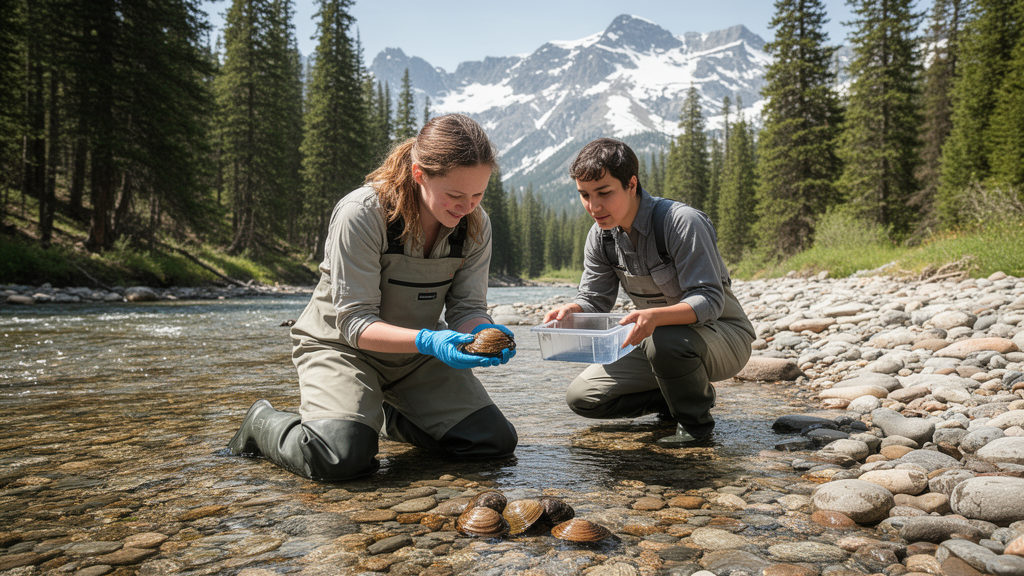
A single photograph posted to an online citizen science platform has fundamentally altered the known distribution of one of Canada’s most threatened freshwater species. The Rocky Mountain Ridged Mussel, a large and distinct bivalve long thought to be confined to the Okanagan watershed in British Columbia, has now been confirmed living in the Fraser River watershed. This discovery represents a significant range extension for the species, which is currently assessed as endangered by the Committee on the Status of Endangered Wildlife in Canada. The finding opens new avenues for conservation research and highlights the critical role of public engagement in modern biodiversity monitoring.
The species, scientifically known as Gonidea angulata, is the only extant member of its genus and is easily identifiable by its thick-walled trapezoidal shell and prominent dorsal ridge. Its global range spans western North America, from British Columbia south to central California and east through Nevada and Idaho. In Canada, however, the mussel’s presence was previously restricted to the Okanagan watershed, a region of approximately 8,000 square kilometers that includes several connected lakes and rivers. Historical records from other parts of the province were vague and unverified, leaving the Fraser River watershed, the largest in British Columbia, seemingly devoid of this species.
The turning point came in 2023 when a user posted images of a mussel shell to iNaturalist, a popular platform for sharing nature observations. The shell was found at the confluence of the Pitt and Fraser rivers in the lower Fraser Valley. Because the Fraser River watershed has no direct aquatic link to the Okanagan system, the observation raised immediate questions about whether the shell was a local find or had been transported from elsewhere. Researchers recognized that the presence of a shell alone was insufficient to confirm a resident population, as shells can be moved by boats or other human activities.
To resolve this uncertainty, a team of scientists conducted targeted field surveys in 2023, 2024, and 2025. These surveys were challenging due to the tidal nature of the Fraser River system, which causes significant fluctuations in water levels. The researchers employed a combination of beach walking, wading, and snorkeling to search for live mussels in the Pitt River. They had to carefully time their efforts to coincide with low tides, when muddy foreshore flats and deeper pools were exposed, allowing for safe and effective inspection of the riverbed.
The surveys yielded a definitive result: a subpopulation of live Rocky Mountain Ridged Mussels was confirmed approximately 5.4 kilometers upstream from the original shell discovery site. A total of 81 live mussels were recorded during the study period, with the majority found in deep pools that become isolated from the main river flow during low tide. The mussels were observed in various positions, either lying flat on the substrate or partially embedded in the mud and silt. This confirmed that the population is not merely a collection of discarded shells but a living community of mussels inhabiting the Fraser River system.
The physical characteristics of the mussels provided further insight into their biology. The average length of the specimens was 89.7 millimeters, with a width of 47.3 millimeters and a height of 29.6 millimeters. All observed mussels were considered adults, as there is currently no established size threshold to distinguish juveniles from adults in this species. The absence of detected juveniles may be due to survey limitations, as young mussels often burrow deeper into the substrate or inhabit cooler, deeper parts of the river that are difficult to access. This lack of juvenile data remains a gap in understanding the population’s reproductive health and long-term viability.
Water quality measurements at the survey sites indicated conditions generally suitable for freshwater mussel survival. The average pH was 7.8, which is within the optimal range for most freshwater bivalves. However, the electrical conductivity was notably low at 76.3 microsiemens per centimeter, suggesting water with low mineral content. While this indicates clean water, it may also limit calcium availability, which is essential for shell growth and physiological functions. The water temperature at the time of survey was 20.4 degrees Celsius, which is at the upper end of the expected range for this species. Long-term monitoring will be necessary to understand how seasonal temperature variations affect the mussels in this new habitat.
The conservation implications of this discovery are complex. While the identification of a new subpopulation expands the known range of the species, it does not necessarily reduce the overall conservation concern. The Fraser River population is hydrologically isolated from the Okanagan population, meaning there is no natural gene flow between the two groups. This isolation could lead to genetic distinctiveness, making the Fraser population a unique designatable unit. However, the unknown size of the population and the potential threats from shoreline development and invasive species, such as zebra and quagga mussels, remain significant concerns for its long-term survival.
This case underscores the power of citizen science in uncovering hidden biodiversity. The initial observation on iNaturalist triggered a rigorous scientific response that would not have occurred otherwise. The ease with which the Rocky Mountain Ridged Mussel can be identified from photographs makes it an ideal candidate for public monitoring. As a result, this discovery has already sparked interest in community-based stewardship and public engagement in freshwater conservation efforts in British Columbia. The collaboration between scientists and the public is now essential for improving understanding of this newly documented subpopulation.
Future research will focus on determining whether the Pitt River subpopulation is genetically distinct from those in the Okanagan or the Chehalis River in Washington State. This information will be crucial for developing targeted conservation strategies. Continued monitoring of water quality, population size, and habitat conditions will be vital to ensure the survival of this endangered species in its new, unexpected home. The discovery serves as a reminder that even well-studied species can hold surprises, and that the eyes of the public are an invaluable tool in the fight to protect biodiversity.
Subject of Research: Range extension and natural history of the Rocky Mountain Ridged Mussel in Canada
Article Title: Range extension and natural history notes on Rocky Mountain Ridged Mussel Gonidea angulata (Lea, 1838) ( Mollusca , Unionidae ) in Canada
Article References: Heron, J., Jessome, R., Yoon-Henderson, K., & Achal, S. (2026). Range extension and natural history notes on Rocky Mountain Ridged Mussel Gonidea angulata (Lea, 1838) (Mollusca, Unionidae) in Canada. Biodiversity Data Journal, 14, Article e191607. https://doi.org/10.3897/bdj.14.e191607
Image Credits: AI Generated
Keywords: Rocky Mountain Ridged Mussel, Gonidea angulata, Freshwater Bivalves, Citizen Science, iNaturalist, Fraser River, British Columbia, Conservation Biology, Range Extension, Endangered Species, Range, extension
Cite Scienmag News
Margaret Porter. (October 18, 2026). Citizen Science Reveals New Rocky Mountain Mussel Population. Scienmag. https://scienmag.com/citizen-science-reveals-new-rocky-mountain-mussel-population/
Margaret Porter. "Citizen Science Reveals New Rocky Mountain Mussel Population." Scienmag, 18 October 2026, https://scienmag.com/citizen-science-reveals-new-rocky-mountain-mussel-population/. Accessed 18 October 2026.
Margaret Porter. "Citizen Science Reveals New Rocky Mountain Mussel Population." Scienmag. October 18, 2026. https://scienmag.com/citizen-science-reveals-new-rocky-mountain-mussel-population/


