


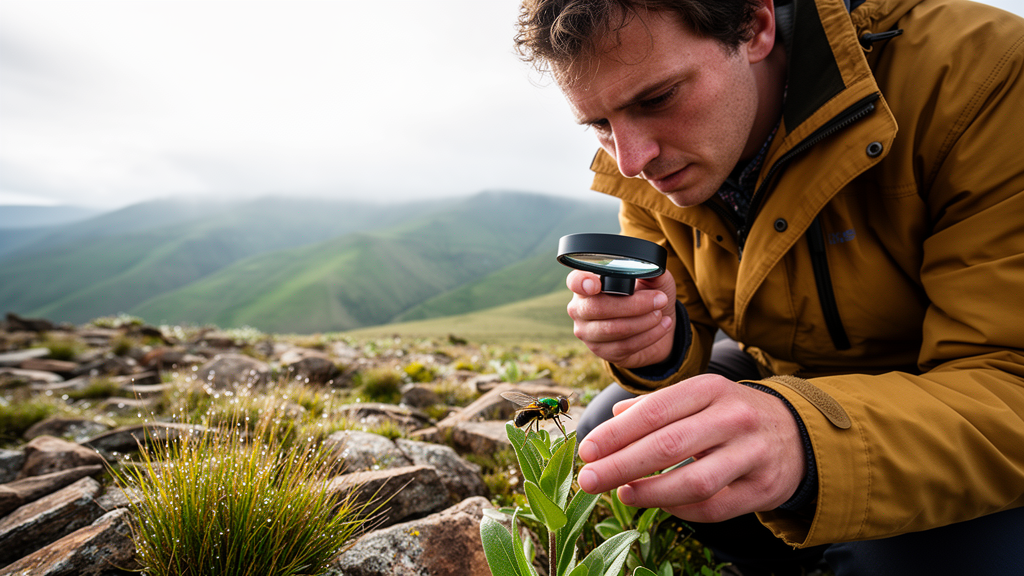
High above the grasslands of South Africa, the small mountain kingdom of Lesotho has been hiding one of Africa’s least-documented insect faunas. Now, a landmark new paper in the journal African Invertebrates has pulled back the curtain on the flies of this entirely landlocked country, summarising more than seven decades of collecting history and launching an ambitious series of studies that researchers hope will transform our understanding of Afrotropical fly diversity. The work, led by a team of dipterists who mounted three expeditions to Lesotho between 2021 and 2023, reveals a landscape shaped by extreme altitude, fragile alpine vegetation, and mounting environmental pressures that make its insect life both scientifically precious and increasingly vulnerable.
Lesotho is a country defined by elevation. At roughly 30,355 square kilometres, it is entirely surrounded by South Africa and shares many of its geological formations and vegetation types, yet its average altitude sits approximately 900 metres higher than its neighbour. This difference matters enormously for biodiversity. While South Africa boasts 466 distinct vegetation types spread across nine biomes, Lesotho contains just 13 vegetation types, all confined to the grassland biome. But what the country lacks in variety it compensates for in extent: alpine vegetation such as Drakensberg Afroalpine Heathland stretches across vast highland areas, offering habitats for cold-adapted species that are far more limited on the South African side of the border. The eastern boundary is formed by the dramatic Drakensberg escarpment, which plunges rapidly into KwaZulu-Natal and the Eastern Cape, creating a sharp ecological transition that has likely driven unique evolutionary pathways among the insects living on these high plateaus.
Geologically, Lesotho is similarly restricted, composed almost entirely of Karoo Supergroup strata, predominantly Drakensberg formation basalts with some exposed sedimentary rocks of the Elliot and Tarkastad formations and Karoo Dolerite in the western lowlands. These four geological types stand in stark contrast to the 119 lithographies found across South Africa, and the country contains just two geomorphic provinces compared to South Africa’s 43. This combination of regionally rare alpine habitats and comparatively limited geological diversity creates an exceptional opportunity for entomological research, particularly for the order Diptera, the true flies, which rank among the most species-rich insect groups on Earth yet remain poorly documented across much of the African continent.
The history of fly collecting in Lesotho is a story of scattered expeditions and dedicated individuals rather than sustained systematic survey. One of the earliest major efforts was the Lund University Swedish South African Expedition of 1950–51, which entered Basutoland, as Lesotho was then known, twice during its journey through southern Africa. The expedition collected at Qacha’s Nek before re-entering near Quthing, where it was based for ten days, and later moved by air to Mokhotlong, where collections were made in the high mountains on horseback. Remarkably, this single expedition yielded 25 undescribed fly species from Lesotho, including six species of robber flies in the family Asilidae, four empidid dance flies, and three crane flies in the family Tipulidae, all subsequently published in the South African Animal Life series.
Following the Lund expedition, several South African collectors made significant contributions. A.L. Bevis of the Durban Natural Science Museum travelled to Lesotho multiple times during his tenure, accumulating roughly 770 specimens during multidisciplinary trips that were not focused exclusively on Diptera but still resulted in the discovery of undescribed species. Brian and Pamela Stuckenberg collected at seven sites in 1963 and 1964, generating 884 specimens, most from western Lesotho but also from God Help Me Pass and Blue Mountain Pass. Charles Jacot-Guillarmod, an entomologist at the Albany Museum whose parents ran a trading post at Ha-Masupha, collected approximately 1,500 fly specimens while visiting the area. Together, these historic efforts built a foundation of knowledge, yet published information on Lesotho’s Diptera remains fragmented and sporadic, scattered across decades of literature with no consolidated checklist for the country.
Recognising this gap, the research team mounted three targeted expeditions: the first from 3 to 14 December 2021, the second from 21 November to 1 December 2022, and the third from 21 to 30 January 2023. The team visited six sites in 2021, seventeen in 2022, and seven in 2023, concentrating their efforts on the eastern highlands for two strategic reasons. First, the eastern regions are more extensively covered in alpine vegetation elements, making them the most likely to harbour unique fly communities. Second, western Lesotho is more densely populated and faces more intense agricultural pressure, meaning that undisturbed habitat is scarcer. Collecting methods combined sweep netting and hand collecting with Malaise trapping, using both Gressitt-and-Gressitt and Townes-style trap designs depending on site conditions. In total, the three expeditions yielded 7,144 specimens.
The collecting sites themselves tell a story of a landscape under pressure. At Afriski Mountain Lodge in the Butha-Buthe district, the team sampled areas ranging from degraded to relatively pristine, with grazing evident in places and localised building rubble and litter scattered across the terrain. The valley around a tributary of the Malibamatšo River was relatively pristine, though some grazing was present. Moteng Pass offered drier conditions on high basalt grassland. In contrast, the roadside drainage gully at Khukhune village was badly degraded, with evidence of grazing, alien vegetation including black wattle, eucalyptus, and firethorn, and multiple habitat modifications. At Sehlabathebe National Park in Qacha’s Nek, the team found pristine grassland with minimal impact from grazing or alien species, representing some of the least disturbed habitat sampled during the expeditions.
Environmental degradation emerged as a consistent theme across many sites. The greatest threats in all regions of Lesotho are overgrazing and agriculture in or very close to riparian zones, both of which lead to soil erosion. At Letšeng-la-Letsie, the team observed high grazing density with cattle, sheep, goats, horses, and donkeys all present, while deep erosion gullies at Koro-Koro were traced to poor agricultural practices such as ploughing fields in the riparian zone. Mining activities also pose significant threats, though these are generally less extensive than agricultural impacts; however, pollution from mining may be carried further by streams and rivers. Alien plant species such as Pyracantha koidzumii were observed attracting flies and disrupting indigenous pollination networks, adding another layer of ecological concern to the conservation picture.
Combining historic South African collections with the recent expeditions, the researchers have now assembled approximately 10,580 fly specimens from Lesotho, excluding material from the Lund expedition. The specimens represent an extraordinary diversity of families, from predatory robber flies and bee flies to hoverflies, long-legged flies, and muscid flies, with the recent collections alone accounting for 7,144 specimens across dozens of families. The most abundant family in the combined collection is Muscidae, with 2,164 specimens, followed by Syrphidae with 808 and Asilidae with 574. Despite this wealth of material, published knowledge of Lesotho’s Diptera remains limited, mostly confined to the South African Animal Life series based on the Lund expedition, with other publications fragmented and sporadic.
The new paper serves as the introduction to a Topical Collection in African Invertebrates designed to bring this scattered information together in one accessible series. Rather than publishing a special issue, the team chose a collection format that allows family accounts to be published as they are completed, making knowledge available more rapidly. The researchers describe the effort as a starting point for future research in Lesotho, acknowledging that some groups were inevitably sampled more thoroughly than others. Yet even as a first attempt, the consolidated checklist and detailed site descriptions represent a significant resource for conservation practitioners in the region, providing the foundation for protecting a unique alpine fly fauna before habitat loss and environmental degradation erase it forever. The team hopes the collection will stimulate more research on Afrotropical Diptera and improve their conservation in Lesotho in particular, turning specimens into published knowledge and promoting the protection of a mountain kingdom whose insect life has waited far too long for the scientific spotlight.
Subject of Research: The Diptera of Lesotho: a history of collecting in the Mountain Kingdom, summary of recent collecting sites and introduction to the topical collection in African Invertebrates
Article Title: The Diptera of Lesotho: a history of collecting in the Mountain Kingdom, summary of recent collecting sites and introduction to the topical collection in African Invertebrates
Article References: Midgley, J. M., Muller, B. S., Theron, G. L., Phoofolo, M., Bellingan, T. A., & Jordaens, K. (2023). The Diptera of Lesotho: a history of collecting in the Mountain Kingdom, summary of recent collecting sites and introduction to the topical collection in African Invertebrates. African Invertebrates, 64(3), 207-220. https://doi.org/10.3897/afrinvertebr.64.108525
Image Credits: AI Generated
DOI: 10.3897/afrinvertebr.64.108525
Keywords: Diptera, Lesotho, history, collecting, Mountain, Kingdom, summary, recent, sites, introduction, topical, collection
Cite Scienmag News
Gavin Prescott. (October 18, 2026). Hidden Fly Kingdom: Lesotho’s Alpine Insects Finally Get Their Scientific Spotlight. Scienmag. https://scienmag.com/hidden-fly-kingdom-lesothos-alpine-insects-finally-get-their-scientific-spotlight/
Gavin Prescott. "Hidden Fly Kingdom: Lesotho’s Alpine Insects Finally Get Their Scientific Spotlight." Scienmag, 18 October 2026, https://scienmag.com/hidden-fly-kingdom-lesothos-alpine-insects-finally-get-their-scientific-spotlight/. Accessed 18 October 2026.
Gavin Prescott. "Hidden Fly Kingdom: Lesotho’s Alpine Insects Finally Get Their Scientific Spotlight." Scienmag. October 18, 2026. https://scienmag.com/hidden-fly-kingdom-lesothos-alpine-insects-finally-get-their-scientific-spotlight/


