


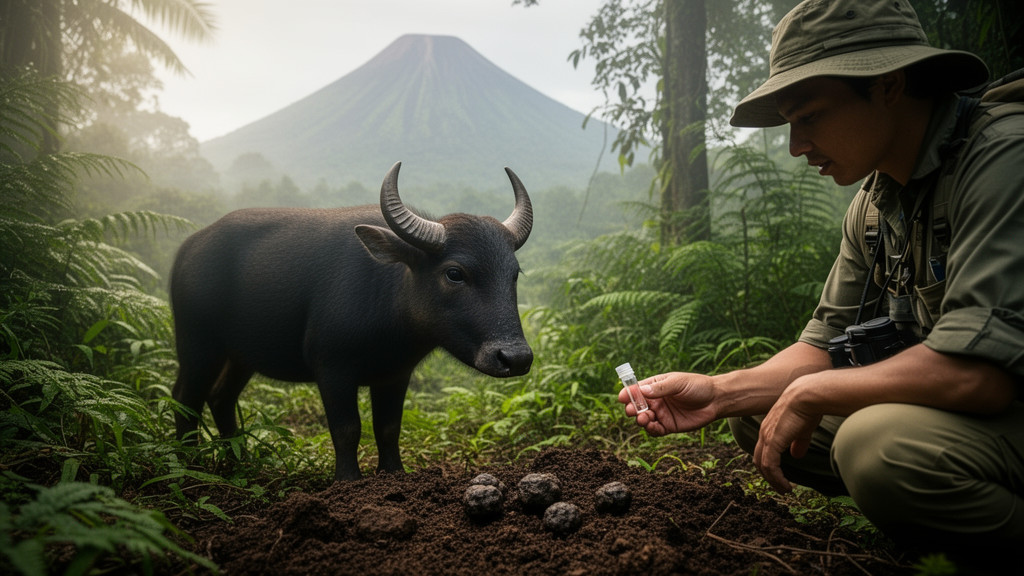
Deep in the mountain forests and lowland jungles of Sulawesi lives one of the world’s most mysterious cattle: the Anoa, a miniature buffalo barely a meter tall that has been shrinking in isolation for more than a million years. Now classified as endangered by the IUCN, with fewer than 2,500 individuals of each species believed to survive, these dwarf bovines have long puzzled scientists. A new study published in Evolutionary Systematics has finally traced their family tree using mitochondrial DNA, and the results settle a century-old debate about how they reached their island home.
The Anoa comprise two currently recognized species: the Mountain Anoa (Bubalus quarlesi) and the Lowland Anoa (Bubalus depressicornis), grouped together in their own subgenus, Anoa, within the buffalo genus Bubalus. Both are endemic to Sulawesi, an Indonesian island famous for its extraordinary endemism. Their small stature is a textbook example of insular dwarfism, the phenomenon in which large mammals isolated on islands evolve smaller bodies under limited resources, reduced predation pressure, and ecological niches that favor compact forms. Sulawesi’s prehistoric elephants and stegodons underwent the same transformation, making the Anoa part of a broader evolutionary pattern on the island.
For decades, researchers have proposed two competing hypotheses to explain how large mammals colonized Southeast Asia’s islands. The land-bridge hypothesis holds that during Pleistocene glacial phases, when sea levels dropped by 40 to 120 meters, dry corridors emerged connecting mainland Asia to Borneo, Java, and eventually Sulawesi. The insular route hypothesis, championed by paleontologist von Koenigswald in the 1930s, instead proposes that mammals migrated through the Philippines, hopping from island to island. The new study set out to test these routes directly using molecular phylogeny, reconstructing the ancestral geographic ranges of the Anoa and their relatives.
The research team, working from the Anoa Breeding Center in Manado and the Bontomarannu Education Park, collected 14 fecal samples from Anoa in October 2020, eight from lowland animals and six from mountain animals, along with six water buffalo samples for comparison. Fecal DNA extraction is a non-invasive technique that avoids stressing endangered animals, and the team used the QIAamp Fast DNA Stool Mini Kit to recover genomic DNA. They then amplified two mitochondrial markers: the cytochrome b gene, a 906-base-pair fragment, and the control region, a 696-base-pair fragment, using species-specific primers designed with Primer3 software. Sequencing was performed in both forward and reverse directions to ensure nucleotide integrity.
The phylogenetic analysis drew on a total of 71 mitochondrial sequences, combining the new data with publicly available sequences from GenBank covering other Bubalus species, including the wild water buffalo Bubalus arnee, the tamaraw Bubalus mindorensis from the Philippines, and the extinct Cebu buffalo Bubalus cebuensis. The team constructed Bayesian inference trees using BEAST 2.4 software with the best-fit HKY+G substitution model selected by the Akaike information criterion. Markov Chain Monte Carlo iterations ran for up to 10 million generations, and branches with posterior probability below 0.5 were collapsed. Boselaphus tragocamelus, the nilgai, served as an outgroup to root the tree and clarify relationships within the Bovidae family.
The resulting phylogeny revealed two main clades with strong statistical support. Clade I contained all the Anoa, with mountain and lowland species forming a monophyletic sister group supported by a posterior probability of 0.99 and a bootstrap value of 100. Clade II comprised the water buffalo and the tamaraw. This topology confirms that the Anoa belong within the genus Bubalus as a distinct subgenus, rather than being more closely related to Boselaphus as some earlier studies with very small sample sizes had suggested. The separation of the Anoa clade from other buffalo species highlights their unique evolutionary trajectory compared to mainland relatives.
Divergence time estimation using a Bayesian relaxed molecular clock, calibrated with three fossil-based time constraints, showed that the genus Bubalus diverged during the Early to Middle Pleistocene around 1.6 million years ago. The subgenus Anoa itself split into mountain and lowland species during the Middle Pleistocene, approximately 1.42 million years ago, with a highest posterior density interval of 1.14 to 1.71 million years ago. The subgenus Bubalus, containing the water buffalo and tamaraw, diverged slightly earlier at 1.35 million years ago. These dates align well with the fossil record, which places the earliest water buffalo ancestors in Sundaland during the Pleistocene.
The biogeographic reconstruction, performed with Reconstruct Ancestral State in Phylogenies (RASP) software using statistical Dispersal Vicariance Analysis in a Bayesian framework, produced a decisive answer about colonization routes. Sundaland, comprising Borneo and Java, emerged as the most probable ancestral area for the genus Bubalus in the Indonesian archipelago with a probability exceeding 0.7. For the Anoa ancestor specifically, the analysis assigned the highest probabilities to Sulawesi’s mountain and lowland areas, with only a minor proportion attributed to Sundaland and none to the Philippines. This pattern strongly supports the land-bridge hypothesis over the insular route through the Philippine archipelago.
Geological and fossil evidence reinforces this conclusion. During Pleistocene glacial maxima, sea levels dropped by 40 to 50 meters, connecting the Malay Peninsula to Java and Borneo across the Sunda Shelf. A drop of 120 meters extended dry land further, and the Makassar Strait separating Borneo from South Sulawesi narrowed to roughly 50 kilometers, allowing dispersal corridors. The fossil ancestor Bubalus palaeokerabau has been recovered from Cisaat in Java, and prehistoric rock art in Gua Batti, South Sulawesi, appears to depict Anoa. Other Sulawesi mammals, including babirusa, macaques, and tarsiers, show similar colonization patterns from Sundaland, consistent with the molecular findings.
The implications for conservation are urgent. Anoa populations have declined by 90 percent over the past 16 years, and both species are listed on CITES Appendix I, prohibiting international trade. Habitat fragmentation and deforestation on Sulawesi continue to isolate populations, reducing genetic diversity and gene flow between fragmented habitats. Because Sulawesi is an island with exceptionally high endemism, protecting the two Anoa species will help conserve many other unique species sharing their ecosystem. The study’s authors recommend expanding sample sizes and incorporating genomic approaches alongside fossil evidence to refine the evolutionary framework. For now, the mitochondrial DNA has spoken clearly: the dwarf buffalo of Sulawesi walked across ancient land-bridges from Sundaland, not island-hopped from the Philippines, and their 1.42-million-year isolation on the island has produced one of Asia’s most distinctive and most endangered bovines.
Subject of Research: Biogeographic history and phylogeny of the endangered Anoa dwarf buffalo based on mitochondrial DNA
Article Title: Biogeographic history of the endangered dwarf buffalo, subgenus Anoa ( Bovidae : Bubalus quarlesi and Bubalus depressicornis ): a perspective based on mitochondrial DNA phylogeny
Article References: Priyono, D. S., Solihin, D. D., Farajallah, A., & Purwantara, B. (2024). Biogeographic history of the endangered dwarf buffalo, subgenus Anoa (Bovidae: Bubalus quarlesi and Bubalus depressicornis): a perspective based on mitochondrial DNA phylogeny. Evolutionary Systematics, 8(2), 311-321. https://doi.org/10.3897/evolsyst.8.132970
Image Credits: AI Generated
DOI: 10.3897/evolsyst.8.132970
Keywords: Anoa, Sulawesi, mitochondrial DNA, phylogeny, biogeography, insular dwarfism, Pleistocene, Sundaland, conservation, Bubalus, Biogeographic, history
Cite Scienmag News
Gavin Prescott. (October 18, 2026). Mitochondrial DNA Reveals How the Endangered Dwarf Buffalo Reached Sulawesi. Scienmag. https://scienmag.com/mitochondrial-dna-reveals-how-the-endangered-dwarf-buffalo-reached-sulawesi/
Gavin Prescott. "Mitochondrial DNA Reveals How the Endangered Dwarf Buffalo Reached Sulawesi." Scienmag, 18 October 2026, https://scienmag.com/mitochondrial-dna-reveals-how-the-endangered-dwarf-buffalo-reached-sulawesi/. Accessed 18 October 2026.
Gavin Prescott. "Mitochondrial DNA Reveals How the Endangered Dwarf Buffalo Reached Sulawesi." Scienmag. October 18, 2026. https://scienmag.com/mitochondrial-dna-reveals-how-the-endangered-dwarf-buffalo-reached-sulawesi/


