


Lung cancer remains the deadliest cancer in the United States, killing more people each year than colon, breast, and prostate cancers combined, and much of that toll comes from a simple biological fact: by the time symptoms appear, the disease has usually already spread. A new study from the Veterans Health Administration, published in the Journal of General Internal Medicine, offers a rare piece of good news in that grim arithmetic. Researchers led by Sharmily G. Roy of the Center for Innovations in Quality, Effectiveness and Safety at the Michael E. DeBakey VA Medical Center in Houston found that veterans who went through a structured lung cancer screening program were diagnosed at earlier stages of the disease than those whose cancers were found outside such a program. The finding matters because stage at diagnosis is one of the strongest predictors of survival, and the study suggests that the machinery of organized screening, not just the CT scanner itself, is what shifts the odds.
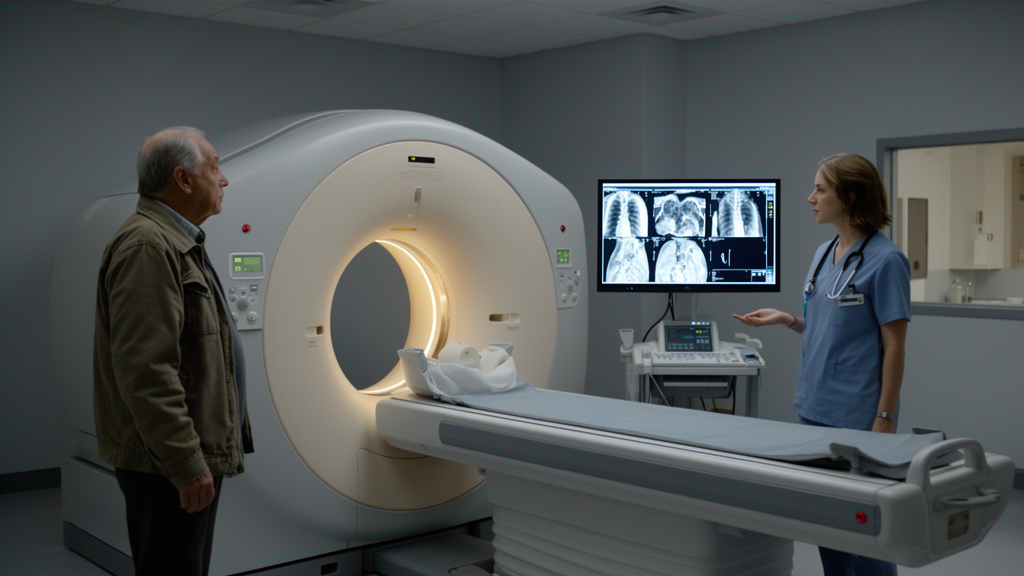
The technical backbone of the study is low-dose computed tomography, the imaging test recommended for people at high risk of lung cancer because of age and smoking history. Unlike a chest X-ray, which produces a single projection that can hide small tumors behind the heart or ribs, low-dose CT reconstructs cross-sectional images of the lungs in seconds, revealing nodules as small as a few millimeters. The National Lung Screening Trial, which enrolled more than 53,000 current and former heavy smokers in the 2000s, showed that annual low-dose CT screening reduced lung cancer mortality by about 20 percent compared with chest radiography. But the trial also exposed a central challenge: screening only saves lives if the entire pathway around the scan is engineered carefully, from identifying eligible patients to tracking suspicious nodules to guiding them swiftly to diagnosis and treatment.
That is where the VA’s experience becomes instructive. The Department of Veterans Affairs operates the largest integrated healthcare system in the country, and its patient population carries an exceptionally high burden of lung cancer risk, shaped by decades of high smoking prevalence and, in some cases, exposures during military service such as asbestos, burn pit smoke, and other airborne hazards. Veterans are diagnosed with lung cancer at rates well above the national average, and earlier attempts to launch screening programs at VA medical centers ran into familiar obstacles: incomplete smoking documentation in medical records, difficulty reaching eligible veterans, and the logistical complexity of managing the small lung nodules that screening inevitably uncovers. A previous study by coauthor Stephen Bujarski and colleagues documented those challenges at two VA medical centers, noting how much work it takes simply to initiate a screening program before a single scan is read.
The new analysis evaluated what happened once the VA moved beyond scattered, ad hoc screening efforts toward a structured program with defined eligibility criteria, standardized scan protocols, and systematic follow-up of abnormal findings. Structured screening, in this context, means more than offering CT scans. It involves a coordinated chain of steps: identifying veterans who meet age and smoking-history criteria, documenting pack-years accurately, performing low-dose CT at regular intervals, classifying any nodules found according to standardized risk categories, and routing patients with suspicious findings to pulmonary specialists, bronchoscopy, biopsy, or thoracic surgery as needed. Each link in that chain is a potential failure point, and the study’s premise was that strengthening the chain as a whole, rather than any single component, determines whether screening actually catches cancer early.
The researchers drew their data from the VA Corporate Data Warehouse, the vast repository of clinical information that records every encounter, order, imaging study, and pathology result across the VA system. Because the data contain protected health information, they are not publicly available, but the team accessed them through the VA Informatics and Computing Infrastructure under approved research protocols. Using this record, the investigators compared veterans whose lung cancers were diagnosed through the structured screening pathway with those whose cancers were identified through other routes, such as symptoms prompting an unplanned scan or an incidental finding on imaging done for another reason. They classified tumors using the eighth edition of the lung cancer stage classification, the international standard maintained by thoracic oncology experts that assigns cancers to stages based on tumor size, lymph node involvement, and distant spread.
The result was a clear stage shift. Veterans whose cancers were detected through structured screening were diagnosed significantly earlier in the disease course, when tumors were smaller and had not yet reached lymph nodes or distant organs, compared with veterans diagnosed outside the program. The clinical significance of that shift is hard to overstate. Five-year survival for lung cancer caught at a localized stage approaches 65 percent in national statistics, while survival for disease diagnosed after distant spread falls below 10 percent. Earlier diagnosis also expands treatment options: small, node-negative tumors can often be removed surgically with curative intent through minimally invasive thoracic surgery, and some patients may qualify for stereotactic ablative radiotherapy, a concentrated course of high-dose radiation that avoids major surgery. Coauthor Lorraine D. Cornwell, a thoracic surgeon at the DeBakey VA, and Farrah Kheradmand, a pulmonologist and immunology researcher at Baylor College of Medicine, brought clinical expertise from both sides of that treatment spectrum to the project.
The study also carries a technical lesson about process improvement in healthcare, a theme the authors situate in the broader science of understanding variation. Quality improvement researchers increasingly borrow tools from industrial engineering, including control charts originally developed to monitor manufacturing processes, to distinguish meaningful signals in clinical data from random noise. Applied to screening, that mindset treats the program as a production line whose output, early-stage cancer detection, must be measured, monitored, and continuously refined. The VA team’s evaluation was funded through the Center for Innovations in Quality, Effectiveness and Safety at the DeBakey VA, along with a VISN-wide learning community project aimed at optimizing the veteran experience of screening and the VA Lung Precision Oncology Program, which applies precision medicine approaches to lung cancer care across the system. That infrastructure reflects a deliberate strategy: rather than treating screening as a one-time initiative, the VA is building a learning system in which each medical center’s experience feeds back into program design.
Why does the stage shift appear when screening is structured rather than opportunistic? The answer lies in the failure modes of unorganized screening. When CT scans are ordered sporadically, eligibility criteria are applied inconsistently, and nodules are tracked informally, patients fall through the gaps at predictable points: a veteran’s smoking history is never documented, so the screening reminder never fires; a small nodule is noted but never scheduled for follow-up imaging; a patient with an enlarging lesion waits weeks for a specialist appointment while the tumor grows. Structured programs attack each failure mode with explicit protocols, dedicated staff, and information systems that flag overdue follow-ups. The VA’s integrated nature gives it an advantage here, because a single record follows the veteran across primary care, radiology, pulmonology, and surgery, allowing the program to close the loop on every abnormal finding. Drew A. Helmer, the study’s senior author and a health services researcher at Baylor, has spent years studying how veterans move through cancer care pathways, and the new results validate that systems-level perspective.
The implications extend well beyond the VA. Health systems across the United States and internationally continue to struggle with low screening uptake: national surveys suggest that only a small fraction of eligible Americans receive annual low-dose CT screening, far below uptake rates for mammography or colonoscopy. The VA’s results suggest that the gap is not primarily a problem of imaging capacity or patient willingness, but of program structure, and that investing in the connective tissue of screening, from eligibility registries to nodule-tracking dashboards to learning communities that share best practices, pays off in measurable clinical outcomes. For the roughly 19 million veterans the VA serves, many of whom face elevated risk from service-related exposures, the message is concrete: organized screening can move diagnoses into the window where treatment is most effective.
There are limits to what the study can claim. As an evaluation of a single healthcare system’s program, its findings reflect the VA’s population and infrastructure, and generalizing to other settings requires caution. The underlying data are restricted for privacy reasons, and the authors note that their opinions do not necessarily reflect those of the Department of Veterans Affairs or the US government. Still, the core result stands as a vindication of a principle that screening advocates have long argued: the CT scanner is only the beginning. What transforms a scan into an earlier diagnosis, and an earlier diagnosis into a life saved, is the disciplined architecture around it, and the VA’s structured program now offers one of the clearest demonstrations that this architecture works.
Subject of Research: A Veterans Health Administration study finds structured lung cancer screening shifts diagnoses to earlier, more treatable stages.
Article Title: Structured Lung Cancer Screening Leads to Earlier Stage Lung Cancer Diagnosis Among Veterans Using Veterans Health Administration
Article References: Roy, S. G., Sloane, J., Christie, I. C., Bujarski, S., Cornwell, L. D., Kheradmand, F., & Helmer, D. A. (2026). Structured Lung Cancer Screening Leads to Earlier Stage Lung Cancer Diagnosis Among Veterans Using Veterans Health Administration. Journal of General Internal Medicine. https://doi.org/10.1007/s11606-026-10747-2
Image Credits: AI Generated
DOI: 10.1007/s11606-026-10747-2
Keywords: Structured, Lung, Cancer, Screening, Leads, Earlier, Stage, Diagnosis, Veterans, Health, Administration, scientific research
Cite Scienmag News
Nathaniel Bowman. (October 18, 2026). Structured Lung Cancer Screening Catches Lung Cancer Earlier in Veterans. Scienmag. https://scienmag.com/structured-lung-cancer-screening-catches-lung-cancer-earlier-in-veterans/
Nathaniel Bowman. "Structured Lung Cancer Screening Catches Lung Cancer Earlier in Veterans." Scienmag, 18 October 2026, https://scienmag.com/structured-lung-cancer-screening-catches-lung-cancer-earlier-in-veterans/. Accessed 18 October 2026.
Nathaniel Bowman. "Structured Lung Cancer Screening Catches Lung Cancer Earlier in Veterans." Scienmag. October 18, 2026. https://scienmag.com/structured-lung-cancer-screening-catches-lung-cancer-earlier-in-veterans/


