


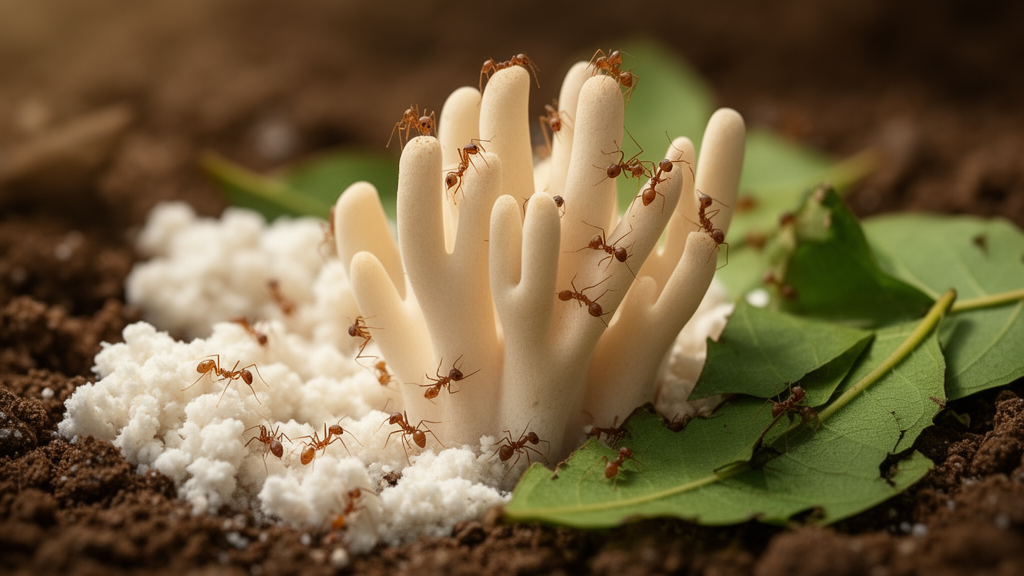
Deep inside the fungus gardens tended by Apterostigma ants—small, non-leaf-cutting farmers scattered across tropical forests from Panama to Brazil—researchers have uncovered a fungus so unusual in form that it required an entirely new genus to accommodate it. The new genus, named Manidigitorum, has now been formally described in the journal IMA Fungus, together with five new species isolated exclusively from the nests of these fungus-farming ants. The name itself is a nod to the organism’s most striking feature: under the microscope, its spore-producing structures carry an irregularly shaped basal cell that looks remarkably like a human hand supporting fingers, from the Latin manus for hand and digitus for finger.
The discovery matters because the family to which this fungus belongs, the Hypocreaceae, was already known to harbor a rich cast of characters in the attine ant symbiosis. Genera such as Escovopsis, Escovopsioides, Sympodiorosea, and Luteomyces have been found strictly associated with the nests of fungus-farming ants, while the generalist Trichoderma also turns up regularly in these subterranean gardens. Yet recent systematic surveys had hinted that even more diversity lurked unrecognized. Earlier phylogenetic work by the same research group had identified novel, undescribed Hypocreaceae clades—labeled clades C and D—found only in nests of Apterostigma. The new study formally describes representatives of clade D, transforming an anonymous genetic signature into a named, morphologically characterized lineage.
Apterostigma ants occupy a singular position among the attines, which makes their fungal associates especially intriguing. Of the four types of fungiculture known from fungus-farming ants, Apterostigma species practice three. Members of the Apterostigma pilosum group, along with species such as A. dentigerum and A. urichii, differ from all other attine ants in cultivating fungi in the family Pterulaceae—specifically Myrmecopterula nudihortorum and M. velohortorum. Meanwhile, A. auriculatum grows a Leucocoprinae fungus like other lower attines, and A. megacephala uniquely cultivates Leucocoprinus gongylophorus, the famous fungal cultivar of the leaf-cutting giants Atta and Acromyrmex. Documenting the fungi associated with Apterostigma gardens therefore opens a window onto an ant-fungus system that spans an unusually broad evolutionary range.
To bring the new lineage into focus, the team examined 11 fungal isolates recovered from Apterostigma nests in Brazil, Ecuador, and Panama. The nests themselves are modest affairs, typically located beneath or inside decaying logs, under leaf litter, in soil banks, or under rocks. Fungus gardens associated with Myrmecopterula velohortorum are often draped in a mycelial layer called a veil, whereas gardens of M. nudihortorum lack this covering. Sampling followed established protocols: once a nest was located, researchers exposed the fungus garden using flame-sterilized spoons and forceps, then transferred fragments to the laboratory for fungal isolation. Small pieces of the garden, roughly three cubic millimeters each, were plated on Potato Dextrose Agar supplemented with the antibiotic chloramphenicol to suppress bacterial growth, and plates were incubated at 25 degrees Celsius in darkness and checked daily over ten days.
The phylogenetic backbone of the study came from sequencing five molecular loci: the internal transcribed spacer region and the large subunit of the ribosomal DNA, the translation elongation factor 1-alpha gene (tef1), and the two largest subunits of RNA polymerase II (rpb1 and rpb2). Genomic DNA was extracted from seven-day-old cultures using a modified CTAB method, with aerial mycelia crushed in lysis buffer using glass beads, proteinase K digestion, and purification through chloroform-isoamyl alcohol separation and isopropanol precipitation. The final concatenated dataset contained 68 sequences totaling 3,817 base pairs. Trees were reconstructed using both Bayesian Inference in MrBayes and Maximum Likelihood in RAxML, with branch support assessed through posterior probabilities and 1,000 bootstrap replicates. The result was unambiguous: the 11 isolates formed a well-supported clade distinct from every other genus in the Hypocreaceae, positioned as a sister lineage of Sympodiorosea and Escovopsis.
Notably, the choice of genetic marker shaped how clearly the new lineage could be resolved. The ITS region, a workhorse of fungal barcoding, showed a poor phylogenetic signal for Manidigitorum, producing a tree topology quite different from the multi-locus analysis; only the position of M. minutus was preserved in the ITS tree. In contrast, tef1 and rpb2 delivered topologies closely matching the combined analysis, marking them as the better markers for resolving relationships among these species. Within the multi-locus tree, five strongly supported subclades emerged, each corresponding to one of the five new species: M. attinorum, M. cervicornutus, M. minutus, M. ramosus, and M. sessilis.
Morphological and physiological analyses then gave the genetic clades a physical identity. Cultures were grown on three media—Potato Dextrose Agar, Malt Extract Agar, and Cornmeal Dextrose Agar—at temperatures ranging from 10 to 30 degrees Celsius. No growth occurred at 10 degrees, and colonies generally began expanding after three days of incubation. Under optimal conditions on PDA at 25 degrees for seven days, Manidigitorum forms white, cottony colonies without pigmentation, reaching diameters up to 3.5 centimeters, with slight deviations in M. attinorum, which shows greyish-yellow tones, and M. ramosus, which displays pale-yellow pigmentation at the colony center. This white sporulation immediately separates the new genus from its relatives: Sympodiorosea sporulates pink and Escovopsis brown. In fact, members of this lineage had previously been informally dubbed white Escovopsis in earlier field surveys, before a genus-wide reassessment split Escovopsis into multiple genera and designated this white-sporulating group as clade D.
Under the differential interference contrast microscope, the diagnostic signature became clear. Manidigitorum produces phialidic conidiogenesis—spore-forming cells of the enteroblastic type—arising from an irregularly shaped basal cell that resembles a hand supporting fingers, a feature no other known Hypocreaceae genus exhibits. The five species differ in conidiophore length and branching pattern, the frequency of sessile phialides, and the shape of the basal cell. M. ramosus, true to its name, always forms branched conidiophores that can stretch to 858 micrometers, with tips that usually bifurcate. M. minutus, by contrast, produces the smallest conidiophores, not exceeding 250 micrometers, with basal cells that can be vesicle-like. M. sessilis is distinguished by frequent sessile phialides along the conidiophore stipe and by the presence of an additional oblong supporting cell between the basal cell and the phialide, a feature it shares with M. minutus. M. cervicornutus frequently forms basal cells with a deer-horn appearance, from the Latin cervus and cornu, and can carry up to nine hand-like cells at the conidiophore tip. M. attinorum typically arranges three basal cells in a cruciform configuration—one central cell flanked by two opposite lateral cells—and its basal cell can support up to 25 phialides.
The host range of Manidigitorum offers some of the study’s most provocative ecological implications. Whereas Escovopsis, Escovopsioides, Luteomyces, and Sympodiorosea all occur in nests of multiple attine genera, Manidigitorum has so far been isolated only from fungus gardens of the A. pilosum group, A. dentigerum, and A. urichii—all of which cultivate Myrmecopterula fungi from the Pterulaceae. It has never been found in association with A. megacephala or A. auriculatum, the two Apterostigma species that grow Agaricaceae cultivars. If this pattern holds, it would represent a novel single-genus association within the attine symbiosis, potentially reflecting an evolutionary relationship between Manidigitorum and Myrmecopterula. The researchers are careful, however, to note that they did not survey the fungus across other fungiculture systems, so exclusivity cannot yet be concluded; extensive future sampling across the full range of attine fungicultures will be needed to test the hypothesis.
What Manidigitorum actually does inside the nest remains an open question. Symbioses can span neutral, beneficial, and negative interactions, and the lifestyles of its closest relatives vary widely. Some Escovopsis species, such as E. weberi, are virulent parasites capable of rapidly overgrowing attine cultivars in laboratory assays, while others appear to be opportunists. Sympodiorosea and Escovopsioides can act as antagonists of the fungi cultivated by Cyphomyrmex, Mycetophylax, and leaf-cutting ants, though much of this antagonism is minimized in healthy gardens, where ants carefully manage their fungal crops and the associated microbial community. Because closely related clades often share evolutionary histories that shape their ecological traits, Manidigitorum’s role in the Apterostigma system may resemble that of its relatives—but only experimental research can determine whether it is mutualist, antagonist, or parasite. For now, the discovery stands as a reminder that even a symbiosis studied for more than a century still conceals lineages no one has ever named, waiting in the veiled gardens beneath decaying logs.
Subject of Research: A novel fungus genus with hand-shaped spore-producing structures has been discovered in the nests of Apterostigma fungus-farming ants, expanding the known diversity of the Hypocreaceae family.
Article Title: More diverse than previously thought: a novel Hypocreaceae symbiont from Apterostigma fungus-farming ants
Article References: da Cruz, M. O., Montoya, Q. V., Gerardo, N. M., & Rodrigues, A. (2026). More diverse than previously thought: a novel Hypocreaceae symbiont from Apterostigma fungus-farming ants. IMA Fungus, 17, Article e182573. https://doi.org/10.3897/imafungus.17.182573
Image Credits: AI Generated
DOI: 10.3897/imafungus.17.182573
Keywords: mycology, fungi, ants, symbiosis, taxonomy, phylogenetics, Hypocreaceae, Apterostigma, Manidigitorum, attine ants, diverse, than
Cite Scienmag News
Roger Howard. (October 18, 2026). Hand-shaped fungus hidden in ant gardens reveals new branch of fungal diversity. Scienmag. https://scienmag.com/hand-shaped-fungus-hidden-in-ant-gardens-reveals-new-branch-of-fungal-diversity/
Roger Howard. "Hand-shaped fungus hidden in ant gardens reveals new branch of fungal diversity." Scienmag, 18 October 2026, https://scienmag.com/hand-shaped-fungus-hidden-in-ant-gardens-reveals-new-branch-of-fungal-diversity/. Accessed 18 October 2026.
Roger Howard. "Hand-shaped fungus hidden in ant gardens reveals new branch of fungal diversity." Scienmag. October 18, 2026. https://scienmag.com/hand-shaped-fungus-hidden-in-ant-gardens-reveals-new-branch-of-fungal-diversity/


