


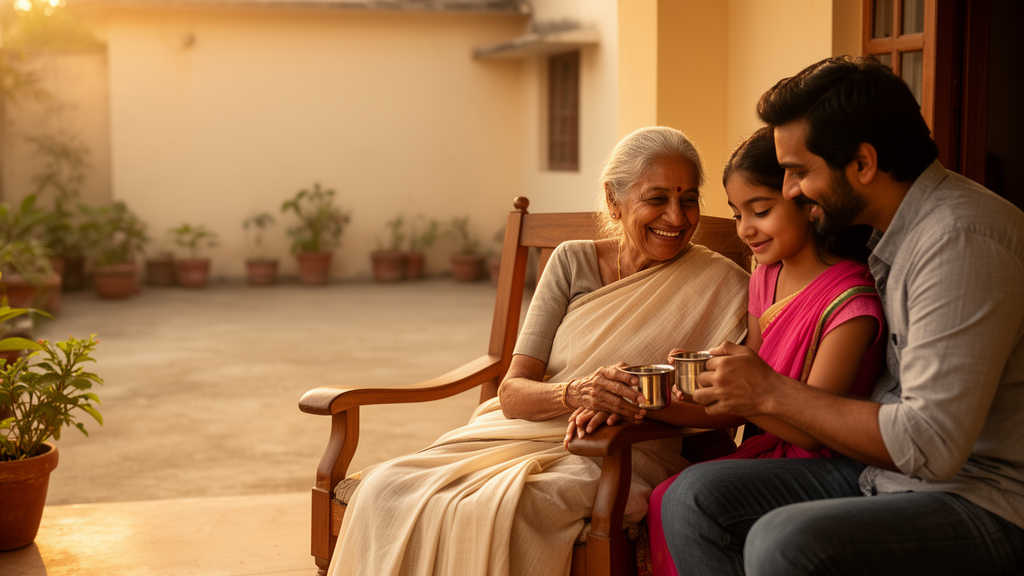
Deep in the Himalayan foothills of Himachal Pradesh, a quiet revolution in aging research is unfolding. A new study published in BMC Public Health has found that the strength of family bonds may be one of the most powerful predictors of mental health and quality of life among older adults, with the findings carrying profound implications for how societies care for their aging populations. The research, led by Sushmita Negi and Arushi Mishra of Maharishi Markandeshwar University in Solan, examined 420 adults aged 60 and above and revealed that perceived family support is intricately woven into psychological well-being, depression levels, and overall health-related quality of life.
The study was conducted between May and October 2025 at Maharishi Markandeshwar Medical College and Hospital in Solan, a region where traditional joint family structures are increasingly giving way to nuclear households and economic migration. Participants were recruited using convenience sampling and interviewed with structured questionnaires, including the Family APGAR scale, a widely used instrument that measures five dimensions of family functioning: adaptation, partnership, growth, affection, and resolve. Each dimension captures a distinct aspect of how family members support one another through life’s challenges, from problem-solving cooperation to emotional intimacy.
Depression was assessed using the Geriatric Depression Scale, or GDS, a screening tool specifically designed for older populations that minimizes the influence of somatic symptoms that could otherwise be confused with physical illness. Quality of life was measured with the Older People’s Quality of Life questionnaire, known as OPQOL, which evaluates multiple life domains including social relationships, health, independence, and psychological well-being. The researchers then applied Pearson correlation, bivariate analysis, and multivariate logistic regression to untangle the complex relationships between these variables, setting the statistical significance threshold at a p value below 0.05.
The results were striking. Among the 420 older adults studied, two factors emerged as significantly associated with good family support: living with a spouse and children, which carried a p value of 0.018, and financial self-sufficiency, which showed an even stronger association with a p value below 0.001. This suggests that the architecture of daily life, from household composition to economic independence, shapes how older adults experience the support systems around them. Those who lived alongside spouses and children reported stronger perceived family functioning, while those who maintained control over their own finances appeared to experience better family dynamics as well.
Conversely, the study found that depression and poor quality of life were strongly linked to inadequate family support, both with p values below 0.001. In other words, older adults who reported weak family functioning were far more likely to screen positive for depressive symptoms and to rate their quality of life as poor. The relationship appears to run in both directions: depression may erode the emotional bonds that sustain family support, while the absence of family support may deepen the isolation and hopelessness that fuel depression. This bidirectional dynamic is what makes the findings so compelling from a public health perspective.
The multivariate analysis, which controls for confounding variables to isolate independent effects, confirmed the strength of these associations. Financial self-sufficiency remained independently associated with good family support, with an adjusted odds ratio of 2.10 and a 95 percent confidence interval of 1.16 to 3.81, carrying a p value of 0.014. Moderate to severe depression showed an adjusted odds ratio of 0.43 with a confidence interval of 0.22 to 0.84 and a p value of 0.013, meaning that older adults with moderate or severe depression had less than half the odds of reporting good family support compared to those without such symptoms. Most dramatically, good quality of life carried an adjusted odds ratio of 15.52 with a confidence interval of 8.81 to 27.34 and a p value below 0.001, indicating that older adults with good quality of life had more than fifteen times the odds of reporting strong family support.
These numbers tell a story that resonates far beyond the Himalayan foothills. The adjusted odds ratio of 15.52 for quality of life is extraordinarily high for observational research of this kind, suggesting that the relationship between family functioning and life satisfaction in older adults is not merely statistical noise but a robust phenomenon that persists even after controlling for other variables. The researchers note that perceived family support is strongly associated with psychological health and quality of life in aging populations, and that strengthening familial bonds and integrating family-centered approaches into geriatric care may help support psychological well-being and overall quality of life within aging societies.
The study was registered with the Clinical Trials Registry-India on 11 April 2025 under registration number CTRI/2025/04/084618, and it received ethical clearance from the Institutional Ethical Committee of Maharishi Markandeshwar Medical College and Hospital in Solan. The research was performed in accordance with the Declaration of Helsinki as amended in 2024 and the National Ethical Guidelines for Biomedical and Health Research Involving Human Participants from 2019. Written informed consent was obtained from all participants before their inclusion in the study, and the authors declare no competing interests, with the work self-funded by all authors.
As India’s population ages at an unprecedented pace, the findings arrive at a critical moment. The country is home to one of the world’s largest populations of older adults, and the traditional family structures that once guaranteed care for the elderly are under strain from urbanization, migration, and changing social norms. The research suggests that public health interventions aimed at older adults should look beyond clinical treatment and consider the family as a unit of care, integrating family-centered approaches that strengthen the bonds between generations. Whether through community programs that bring families together, counseling services that address family dynamics, or policies that support financial independence for the elderly, the study points toward a future where the health of aging populations depends not just on medicine but on the strength of the relationships that surround them.
Subject of Research: Public Health
Article Title: Association of family support, depression, and health-related quality of life among older adults in Himachal Pradesh, India
Article References: Negi, S., Mishra, A., Singal, U., Kaur, N., Rawat, M., Joshi, B. P., Mahiuddin, M., Mahiujjaman, K., Akter, S., & Ahmed, S. (2026). Association of family support, depression, and health-related quality of life among older adults in Himachal Pradesh, India. BMC Public Health. https://doi.org/10.1186/s12889-026-29956-9
Image Credits: AI Generated
DOI: 10.1186/s12889-026-29956-9
Keywords: aging, depression, family support, quality of life, geriatric health, India, mental health, Association, family, support, health-related, quality
Cite Scienmag News
Glenn Wilkins. (October 18, 2026). Family Support Emerges as Powerful Shield Against Depression in Aging Indians. Scienmag. https://scienmag.com/family-support-emerges-as-powerful-shield-against-depression-in-aging-indians/
Glenn Wilkins. "Family Support Emerges as Powerful Shield Against Depression in Aging Indians." Scienmag, 18 October 2026, https://scienmag.com/family-support-emerges-as-powerful-shield-against-depression-in-aging-indians/. Accessed 18 October 2026.
Glenn Wilkins. "Family Support Emerges as Powerful Shield Against Depression in Aging Indians." Scienmag. October 18, 2026. https://scienmag.com/family-support-emerges-as-powerful-shield-against-depression-in-aging-indians/


