


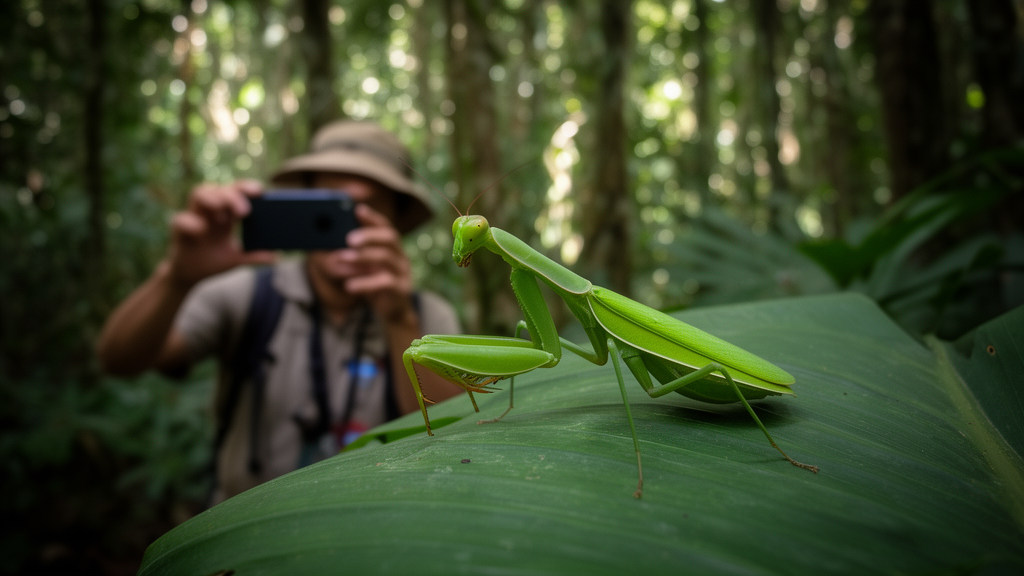
A praying mantis known only from a single male specimen collected in southern China has now been documented more than a thousand kilometers from its birthplace, thanks to a study that blends classical entomology with photographs taken by ordinary people. The research, published in the Journal of Orthoptera Research, confirms that Rhombodera latipronotum, a striking Asian shield mantis described in 1990, is not confined to the forests of Yunnan province but also lives in the Guangxi autonomous region of China and in the Indo-Chinese states of Laos and Vietnam. The finding rewrites the known range of a species so poorly understood that, until now, scientists had never formally described its females.
Rhombodera latipronotum belongs to the genus Rhombodera, a group of praying mantises in the family Mantidae, subfamily Hierodulinae, and tribe Hierodulini. Members of this genus are commonly called Asian shield mantids because of a feature shared by all species: pronounced lateral expansions of the pronotum, the dorsal plate of the first thoracic segment, which make the insect look as though it is wearing a shield. In most species the upper surface of this shield is green, allowing the mantis to blend seamlessly into foliage and even conceal its folded forelimbs from view. The underside, by contrast, is brightly colored and is flashed during deimatic displays, the dramatic threat poses a mantis performs when camouflage has already failed and a predator has spotted it.
The genus currently includes around 30 species spread widely across mainland and insular Asia, from India and Nepal to Japan, Indonesia, Papua New Guinea, and the Solomon Islands. Yet the taxonomy and phylogeny of the tribe Hierodulini remain unsettled, and synonyms between the large genera Hierodula, Rhombodera, Titanodula, and Sphodromantis are frequently rediscussed and updated. For this reason, the number of recognized Rhombodera species is likely to change again, and some current members of the genus may eventually be transferred into new genera, as has happened in the past. This instability makes it difficult to identify specimens with confidence, particularly when the scientific literature on a given species is incomplete.
Rhombodera latipronotum was described by Zhang in 1990 as endemic to the forested areas of Yunnan province in southern China, one of the richest regions in the country for mantids and insects in general, and considered an intersection of three biodiversity hotspots: the Indo-Burma region, the mountains of Southwest China, and the eastern Himalayas. The specific epithet derives from the Latin adjective latus, meaning broad or wide, and the noun pronotum, referring to the dorsal plate of the first thoracic segment. Indeed, the defining characteristic of this mantis is the exceptional width of its pronotum, which exceeds that of many other Rhombodera species and sometimes surpasses 20 millimeters in adult females. Zhang based the original description on a single male specimen designated as the holotype, and subsequent attempts by mantis enthusiasts to collect more individuals at the type locality using light traps revealed a curious pattern: only males were attracted to the traps, while females proved far more elusive.
The new study overcame these limitations by combining direct examination of specimens held in entomological collections with observations contributed by citizen scientists across Southeast Asia. The researcher gathered photographs uploaded to platforms such as iNaturalist and the Global Biodiversity Information Facility, and also collected reports through insect identification groups on Facebook and through a network called Mondo delle Mantidi, Italian for World of Mantids, on Instagram. For each photograph, users were asked to provide the exact location where the specimen was found and relevant environmental information, such as whether the site was urban or suburban. These reports were compared against specimens in the author’s collection, and photographs taken with a Nikon Coolpix B500 and processed with Adobe Photoshop were used to produce an accurate description of adults of both sexes. Distribution maps were generated using QGIS 3.34 Prizen software.
The results confirm the presence of R. latipronotum in eleven new localities across three countries. In China, specimens were documented in the Guangxi autonomous region, specifically in the Fangchenggang area, including adult females, a female nymph, a male nymph, and an ootheca, the foam-like egg case mantises produce. In Laos, records came from Louangphrabang province, Huaphanne province, and Oudomxay province, spanning elevations from around 305 meters to between 1200 and 1900 meters on Phu Phane Mountain. In Vietnam, the species was documented in the Hà Nội municipality and in Cao Bang province in the country’s northeast. All of these new territories fall within the Indo-Malay ecozone, characterized by recurrent tropical biomes such as rainforests, seasonal forests, and grasslands, with a climate largely shaped by the alternation between trade winds and monsoon seasons.
The morphological redescription reveals a large mantis with a marked dilatation of the pronotum, which measures between 16 and over 20 millimeters wide. Adult males reach total lengths of 72.5 to 82.3 millimeters, with pronota 20.5 to 21.0 millimeters long and 17.5 to 17.7 millimeters wide, while the single described female is larger still at 89.3 millimeters total length, with a pronotum 23.1 millimeters long and 22.2 millimeters wide. The hind wings are hyaline and lack the reddish tinge typical of many other species in the genus, a feature that helps distinguish R. latipronotum from its relatives. Males are uniformly green with a triangular head, a nearly flat vertex, and three large ocelli arranged in a triangle on a well-developed ocellar tubercle. The forewings have a green costal area with a whitish, milky stigma partly surrounded by a dark brown halo, and the veins are jagged and irregular. Females are very large and robust, with aquamarine highlights and reddish spots on the lower abdomen, mesothorax, and metathorax, and pronotal expansions so large they entirely occlude the dorsal view of the forelegs.
Both sexes share a distinctive arrangement of spines on the forefemora, with 13 to 15 anteroventral spines unequal in length and coloration, following a pattern in which longer spines are completely black with a brown blotch at the base while smaller spines match the inner side of the femur except for black tips. The foretibiae carry 14 to 15 internal spines and 11 external spines, all black only at the tip. The basitarsus is as long as all remaining tarsomeres combined, and well-developed euplantulae with adherent ends help the insect cling to plants. Dark spots between the third and fifth sternites are used in deimatic displays. The male genitalia, examined following standard preparation techniques, show an apical process of the left phallomere that is long with a hook-like apex, a contorted anterior lobe of the phalloid apophysis, and a rod-like lateral secondary distal process that gradually narrows to a sharp point.
Behavioral observations gathered through the citizen science reports add an ecological dimension to the redescription. The species inhabits both lowland areas and higher elevations, but always in places with a high density of tree, shrub, and grass vegetation. Females remain flattened on leaves, waiting motionless for prey, and lay their oothecae on branches several meters above the ground. Males, by contrast, are easily attracted to artificial lights and, because of their greater flying ability, can move considerable distances. As in the type locality of southern Yunnan, the species is not abundant where it occurs, remaining fairly confined and thus common only locally. This pattern of localized scarcity, combined with the difficulty of collecting females, helps explain why the species remained so poorly documented for more than three decades after its description.
The expansion of the known range carries significant implications for biogeography and conservation. The presence of R. latipronotum in different regions may suggest ancient connections between now-disjointed habitats or processes of natural dispersion, and future studies should investigate the mechanisms behind this spread, including the biotic and abiotic factors that promote its stabilization in new territories. The possibility that the species’ expansion is partly due to accidental or deliberate introductions by humans cannot be ruled out, given the increasing movement of goods and people between these regions. As an efficient predator, the mantis could alter prey populations and compete with other predators in local insect communities, making it essential to study its ecological interactions. If the new populations in Laos, Vietnam, and Guangxi are found in threatened or fragmented habitats, they may require specific protection measures, and knowledge of the species’ extensive distribution can inform more targeted conservation strategies. The study also highlights the immense biodiversity within the surveyed regions and underscores the need for continued exploration to fully catalogue the mantids of Southeast Asia, a task in which citizen scientists are proving to be indispensable partners.
Subject of Research: New data on the distribution of Rhombodera latipronotum (Mantodea, Mantidae) in Southeast Asia, with species redescription and biogeographic considerations
Article Title: New data on the distribution of Rhombodera latipronotum ( Mantodea , Mantidae ) in Southeast Asia, with species redescription and biogeographic considerations
Article References: Fasano, A. (2025). New data on the distribution of Rhombodera latipronotum (Mantodea, Mantidae) in Southeast Asia, with species redescription and biogeographic considerations. Journal of Orthoptera Research, 34(1), 39-44. https://doi.org/10.3897/jor.34.130822
Image Credits: AI Generated
Keywords: data, distribution, Rhombodera, latipronotum, Mantodea, Mantidae, Southeast, Asia, species, redescription, biogeographic, considerations
Cite Scienmag News
Margaret Porter. (October 18, 2026). Shield mantis found across Southeast Asia as citizen scientists reveal wider range. Scienmag. https://scienmag.com/shield-mantis-found-across-southeast-asia-as-citizen-scientists-reveal-wider-range/
Margaret Porter. "Shield mantis found across Southeast Asia as citizen scientists reveal wider range." Scienmag, 18 October 2026, https://scienmag.com/shield-mantis-found-across-southeast-asia-as-citizen-scientists-reveal-wider-range/. Accessed 18 October 2026.
Margaret Porter. "Shield mantis found across Southeast Asia as citizen scientists reveal wider range." Scienmag. October 18, 2026. https://scienmag.com/shield-mantis-found-across-southeast-asia-as-citizen-scientists-reveal-wider-range/


