


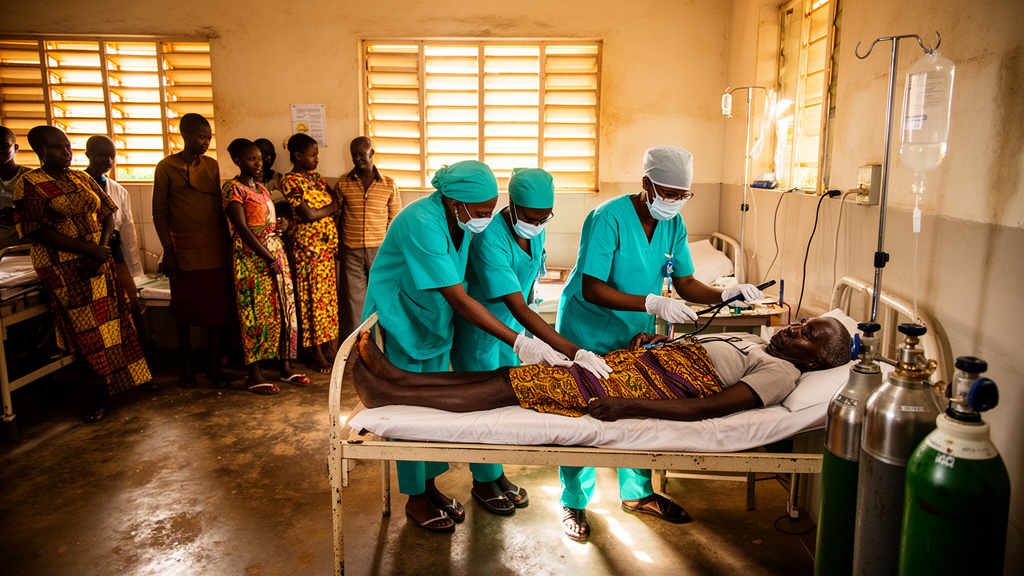
Uganda is confronting a quiet but relentless epidemic. A new national analysis of health facility data reveals that stroke cases and deaths have climbed steadily every month since 2016, and the trajectory shows no sign of bending. By December 2028, the country could be recording roughly 927 new stroke cases each month, along with about 126 stroke deaths, according to forecasts published in PLOS One by a team of Ugandan researchers led by Suzan Nakasendwa and colleagues.
The study, a retrospective time-series analysis spanning nearly a decade, drew on the District Health Information System, the digital backbone of Uganda’s public health surveillance. From January 2016 through 2025, the researchers compiled monthly counts of stroke cases and stroke deaths reported across the country. Because raw case counts can rise simply because more people live in Uganda each year, the team estimated monthly population figures using exponential growth interpolation and folded them into their statistical models as an offset term. That step allowed them to separate genuine increases in disease risk from the arithmetic of a growing population.
The modeling framework was Bayesian negative binomial regression, a choice suited to monthly count data that are typically overdispersed, meaning the variance exceeds the mean. The models yielded incidence rate ratios with 95 percent confidence intervals, quantifying how much the risk of stroke incidence or death changed month over month. For incidence, the ratio was 1.005 (95 percent CI: 1.004 to 1.006); for mortality, it was 1.006 (95 percent CI: 1.005 to 1.007). Both figures carry p-values below 0.001. The numbers look small, but their effect compounds relentlessly: a monthly increase of half a percent, sustained for years, translates into a substantially larger burden over a decade.
To understand what was driving the rise, the researchers turned to decomposition analysis using the Kitagawa method, a classical demographic technique that partitions change in a rate into contributions from population composition and from the rates themselves. Applied to the model estimates, the decomposition delivered an unambiguous verdict: the epidemiological effect was roughly twice as large as the population effect. In other words, most of the growth in stroke cases and deaths stems from rising incidence rates, not merely from more Ugandans being alive to fall ill. That distinction matters enormously for policy, because it implies that prevention, not demographic inevitability, holds the key to reversing the trend.
Before trusting the trends, the team subjected the data to rigorous diagnostic checks. Stationarity was assessed with unit root tests, and autocorrelation in the residuals was evaluated with the Ljung-Box test, standard procedures for confirming that a time series behaves in a statistically coherent way. Only after these checks did the researchers proceed to forecasting, using the exponential smoothing state-space model, known as ETS, which generates predictions with 80 percent prediction intervals that capture the plausible range of future values rather than a single point estimate.
The projections are sobering. By December 2028, monthly stroke cases are forecast to reach approximately 927, with an 80 percent prediction interval spanning 709 to 1,156. Monthly deaths are projected at roughly 126, with an interval of 94 to 160. The width of those intervals reflects genuine uncertainty in extrapolating health-system data, but even the lower bounds represent a marked escalation from current levels. If the trend holds, Uganda’s hospitals and stroke units will face a caseload in 2028 that dwarfs what they managed even a few years ago.
Stroke is already a leading cause of death and disability worldwide, and the global burden has shifted decisively toward low- and middle-income countries, where prevention infrastructure, acute care capacity, and rehabilitation services are often thinnest. Uganda exemplifies the pattern. Hypertension, diabetes, and other cardiovascular risk factors are rising across sub-Saharan Africa as diets, activity levels, and urbanization change, yet many patients never receive a diagnosis until a catastrophic vascular event occurs. The new findings give that familiar narrative a hard quantitative edge: the epidemic is not approaching, it is already underway and accelerating.
The authors are explicit about the implications. In the absence of effective prevention measures, the stroke burden will continue to climb through 2028 and likely beyond. They call for strengthened primary prevention, meaning population-level control of blood pressure, better detection and management of diabetes and atrial fibrillation, tobacco control, and dietary interventions. They also urge expanded acute stroke care capacity, including timely imaging, thrombolysis, and stroke units, which remain scarce across much of the region. And they emphasize improved surveillance, since the DHIS2 facility data that made this analysis possible still capture only part of the true disease picture, particularly among patients who never reach a health facility.
What makes the study notable beyond Uganda is its methodological clarity. By combining Bayesian count models, demographic decomposition, and formal forecasting within a single analytical pipeline, the researchers produced evidence that is both statistically defensible and directly actionable. The finding that epidemiological change outpaces population growth by a factor of two is the kind of result that can redirect national health planning: it says the crisis is behavioral and clinical, not demographic, and therefore preventable.
For a country whose health system already strains under infectious disease burdens alongside a growing tide of noncommunicable conditions, the forecast is a warning with a deadline. Every month of inaction adds roughly half a percent to stroke risk, compounding silently across a population of tens of millions. The mathematics of the trend is unforgiving, but so is the opportunity: interventions that bend the incidence curve even slightly would avert thousands of cases and deaths over the coming years. Uganda’s stroke epidemic, the data make clear, will be shaped by what happens now, not by fate.
Subject of Research: Rising stroke burden and forecasts in Uganda
Article Title: Rising stroke burden in Uganda: A national time-series analysis and forecasts, 2016–2028
Article References: Nakasendwa, S., Mutyoba, J. N., Ario, A. R., Omondi, E., Bashemera, B. B., Kakooza, F., Najjemba, L., Nabende, J. N., Guwatudde, D., & Kiragga, A. (2026). Rising stroke burden in Uganda: A national time-series analysis and forecasts, 2016–2028. PLOS One, 21(10), e0360963. https://doi.org/10.1371/journal.pone.0360963
Image Credits: AI Generated
DOI: 10.1371/journal.pone.0360963
Keywords: stroke, Uganda, time-series analysis, forecasting, noncommunicable diseases, public health surveillance, DHIS2, Bayesian regression, epidemiology, stroke prevention, health systems, sub-Saharan Africa
Cite Scienmag News
Cassandra Pierce. (October 18, 2026). Uganda Faces a Surge in Stroke Cases and Deaths Through 2028. Scienmag. https://scienmag.com/uganda-faces-a-surge-in-stroke-cases-and-deaths-through-2028/
Cassandra Pierce. "Uganda Faces a Surge in Stroke Cases and Deaths Through 2028." Scienmag, 18 October 2026, https://scienmag.com/uganda-faces-a-surge-in-stroke-cases-and-deaths-through-2028/. Accessed 18 October 2026.
Cassandra Pierce. "Uganda Faces a Surge in Stroke Cases and Deaths Through 2028." Scienmag. October 18, 2026. https://scienmag.com/uganda-faces-a-surge-in-stroke-cases-and-deaths-through-2028/


