


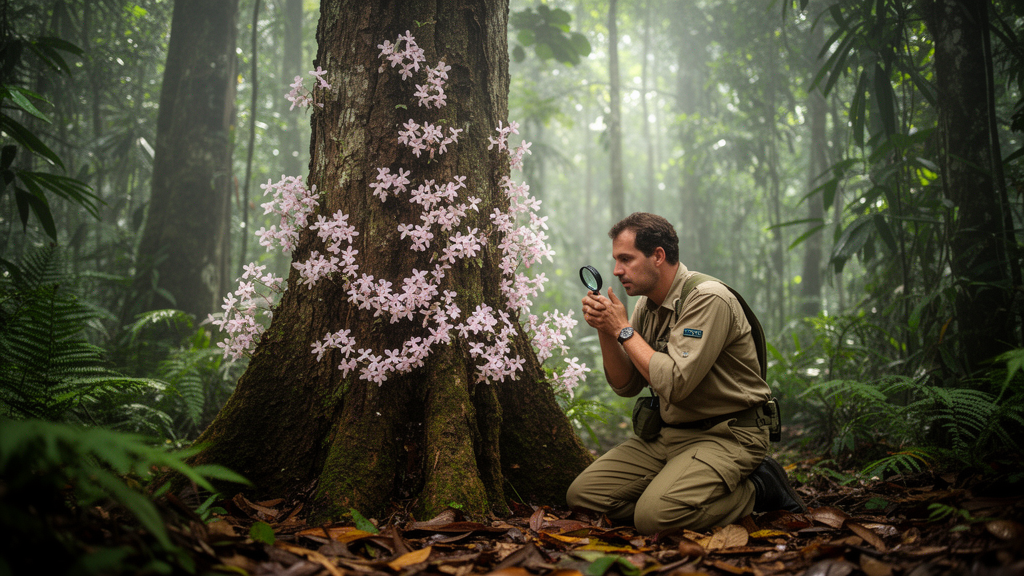
Deep in the Amazon Basin, botanists have identified a tree that had been hiding in plain sight. Specimens collected from Amazonian Bolivia and Brazil and long misidentified as a related Atlantic Forest species have now been formally described as Xylopia rubrolineata, a new species of the pantropical genus Xylopia in the custard apple family Annonaceae. The name, published in the journal PhytoKeys, refers to the striking red stripe that runs along the abaxial ridge of the plant’s pale green fruits, a feature so conspicuous that it has repeatedly caught the attention of photographers on iNaturalist.
The new species belongs to a genus of roughly 220 species of woody flowering plants distributed across the tropics. In the Neotropics, about 57 species are recognized, and more than half of them occur in the Amazon River Basin, where species new to science continue to be described. A recent molecular phylogeny established the monophyly of the Neotropical species, dating their arrival in South America at approximately 11.6 million years ago, and recovered three major clades named XY-peruviana, XY-muricata, and XY-aromatica. On the basis of its morphology, Xylopia rubrolineata is inferred to belong to the small XY-peruviana clade, and its closest relative is Xylopia ochrantha, a species endemic to the Atlantic coastal forests of eastern Brazil with which it had previously been confused.
The confusion is understandable. Both plants share two unusual traits for the genus: blunt, broadly ovate outer petals and cauliflory, the production of flowers directly on the trunk rather than in the canopy. But careful examination of herbarium specimens and field photographs reveals consistent differences. Xylopia rubrolineata has chartaceous rather than subcoriaceous leaves, smaller outer petals with more acute apices, and torulose, stipitate, glabrate monocarps, the individual fruit units of the aggregate fruit, which are pale green with a bright red abaxial stripe in life. The monocarps of Xylopia ochrantha, in contrast, are smooth or only slightly indented between the seeds, have shorter and thicker stipes, are densely velutinous, and are greenish and only faintly tinged with red. The petals of the new species are thinner and approximately half as long as those of its Atlantic Forest relative.
The description of Xylopia rubrolineata is only part of the story. The study also reviews cauliflory across the entire genus, and the findings are remarkable. Of the roughly 220 Xylopia species worldwide, flowers borne on the trunk, a subtype botanists call trunciflory, occur in only nine South American species. Four belong to the XY-peruviana clade and five to a subclade of XY-aromatica. Six of the nine have distributions centered in the Amazon Basin, while the other three are endemic to the Atlantic Forest. All are understory species. The trait is phylogenetically patchy: cauliflorous species are intermixed with non-cauliflorous species within both clades, a pattern also seen in other plant groups such as Ficus, Adenocalymma, and Desmopsis. This intermixing suggests that cauliflory is evolutionarily labile, perhaps arising and disappearing through small but heritable changes in gene expression, with multiple gains or losses over the history of the genus.
The timing of these gains is telling. The two clades containing trunciflorous species arose over a period of roughly four million years beginning about seven to eight million years ago, during the Late Miocene, in the Amazon Basin and the Atlantic Forest. This was a period of increased cooling and drying in tropical South America, accompanied by geologic change that created the modern Amazon Basin. Pollen records indicate that overall Amazonian plant diversity declined significantly during this interval, with ongoing extinctions and a fluctuating mosaic of wet and dry environments. Habitat reconstructions at the Last Glacial Maximum likewise indicate a changing complex of wet and dry habitats across the basin, which may explain the disjunct distribution of Xylopia rubrolineata, known from three small areas: the southwestern Amazon, the lower Amazon and adjacent Jarí River drainage, and the Serra dos Carajás southeast of the Amazon.
Why would a tree move its flowers from the canopy to the trunk? The question has fascinated biologists since Alfred Russel Wallace proposed in 1878 that trunk-borne flowers are more visible to pollinators in the dim tropical forest understory. Subsequent work has largely confirmed the understory habit of most cauliflorous species. In Xylopia, pollination is by small, weak-flying beetles of the families Nitidulidae and Staphylinidae, with thrips and flies sometimes visiting as well. Pollen movement in trees with such small pollinators is limited to short distances. Notably, unrelated cauliflorous Xylopia species show no convergence in floral traits in response to cauliflory; related cauliflorous and non-cauliflorous species have very similar flowers and petal movements. Whatever advantage the trait confers, it does not come from changing the flowers themselves.
Experimental evidence from other species offers a clue. In Theobroma cacao and Brownea latifolia, researchers found twice as many floral visitors near trunk inflorescences as near canopy inflorescences of the same individual, with correspondingly greater fruit set. Inflorescence placement also affects seed dispersers. In the cauliflorous liana Marcgravia longifolia, canopy frugivores fly faster and farther, while understory frugivores are more maneuverable, with shorter gut passage times and smaller home ranges. The authors of the new study suggest that in Xylopia, a lack of fruits in the canopy shifts the disperser guild toward shorter-distance understory dispersal, in contrast to the long-distance dispersal that has contributed to the genus’s geographic expansion across the tropics and onto many islands.
Synthesizing these threads, the researchers propose that cauliflory in Xylopia evolved as a bet-hedging adaptation, a strategy to ensure reproductive success against unpredictable environmental fluctuation and thereby avoid extinction. The trait meets the classic criteria for bet-hedging: it evolved in an unpredictable environment, it is a single labile trait with intermittent occurrence at the species level, and potential costs, such as producing extra inflorescences, reduced long-distance dispersal, or inbreeding, may be outweighed by long-term reproductive success. Comparable bet-hedging adaptations include serotiny, the retention of seeds in cones or fruits until fire releases them, which has arisen intermittently over roughly 150 million years in unrelated plant families, and ovule oversupply, a response to unpredictable pollination in high-elevation Andean plants. In Xylopia, unreliable reproductive success of canopy inflorescences may be ameliorated by producing more flowers below the canopy, engaging more effective pollinator and disperser guilds, or altering the timing of floral production, which is not tied to new vegetative shoot growth and can therefore shift rapidly to track local conditions.
The new species is known from only about 14 localities within its wide extent of occurrence, which spans more than one million square kilometers from northern Bolivia eastward to Pará state in Brazil, primarily south of the Amazon River. Its area of occupancy is just 128 square kilometers, and only five collections have been made since 1992. Many collections have come from areas influenced by mining, logging, and reservoir construction, and the ombrophilous forests of the Alta Floresta region where the species occurs are vulnerable to fire. The extent of occurrence places the species at Least Concern, while the area of occupancy places it at Endangered; a preliminary assessment under criterion B suggests either Near Threatened based on the large range or Vulnerable based on inferred threats and few recent collections.
Local communities have long known the plant. Chácobo collectors in Bolivia record names including bita, isonobichi, and tëtëmëtoijoni, using a leaf decoction to cure liver problems, burning the wood as fuel, and eating the sweet fruits. An identification key to the nine known trunciflorous Xylopia species is provided in the study, along with proposed experimental comparisons between cauliflorous and non-cauliflorous sister species to test whether trunk flowering was accompanied by increased or prolonged flower production, whether inbreeding has reduced genetic diversity in cauliflorous populations, and how present-day disturbances such as fire and edge effects affect reproductive success. For now, the red-striped fruits of Xylopia rubrolineata stand as living evidence of a survival strategy forged millions of years ago, when a changing South America tested its forests and the trees that flowered on their trunks found a way to endure.
Subject of Research: Description of a new cauliflorous Xylopia species from the Amazon Basin and a review of trunciflorous cauliflory in the genus
Article Title: A new species of Xylopia ( Annonaceae ) from the Amazon Basin, with a review of trunciflorous cauliflory in the genus
Article References: Vaughn, M., Harper, D., Reiter, L., Dodds, E., Murray, N. A., Floyd, K., Stull, G. W., & Johnson, D. M. (2026). A new species of Xylopia (Annonaceae) from the Amazon Basin, with a review of trunciflorous cauliflory in the genus. PhytoKeys, 277, 41-64. https://doi.org/10.3897/phytokeys.277.188891
Image Credits: AI Generated
DOI: 10.3897/phytokeys.277.188891
Keywords: Xylopia, Annonaceae, Amazon Basin, cauliflory, new species, bet-hedging, Late Miocene, plant taxonomy, PhytoKeys, South America, botany, evolution
Cite Scienmag News
Gavin Prescott. (October 18, 2026). New Amazonian tree species reveals how flowers on trunks evolved as survival strategy. Scienmag. https://scienmag.com/new-amazonian-tree-species-reveals-how-flowers-on-trunks-evolved-as-survival-strategy/
Gavin Prescott. "New Amazonian tree species reveals how flowers on trunks evolved as survival strategy." Scienmag, 18 October 2026, https://scienmag.com/new-amazonian-tree-species-reveals-how-flowers-on-trunks-evolved-as-survival-strategy/. Accessed 18 October 2026.
Gavin Prescott. "New Amazonian tree species reveals how flowers on trunks evolved as survival strategy." Scienmag. October 18, 2026. https://scienmag.com/new-amazonian-tree-species-reveals-how-flowers-on-trunks-evolved-as-survival-strategy/


