


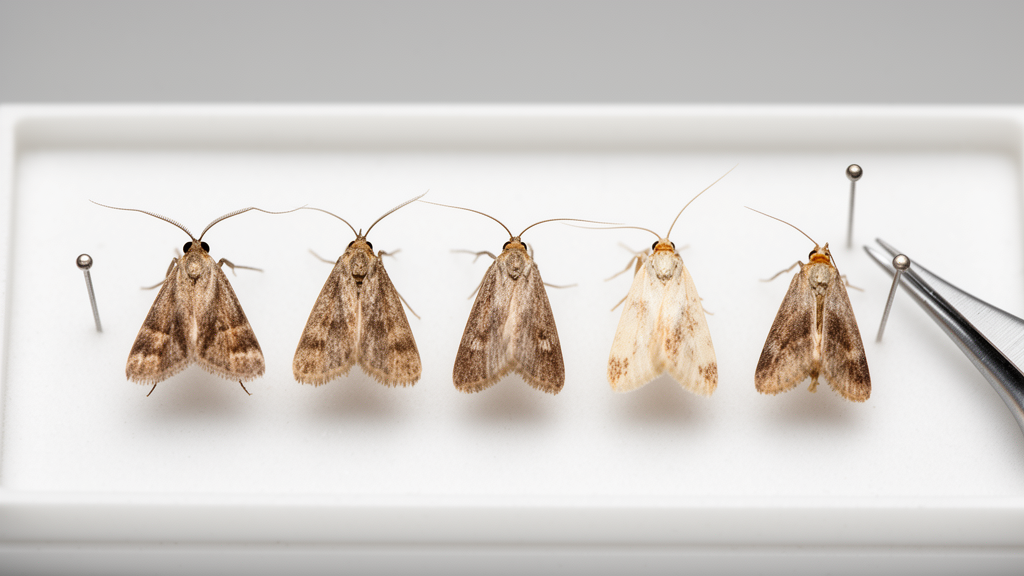
Deep in the forests of East Africa’s tallest mountains, tiny moths have been hiding in plain sight for decades. A comprehensive revision of the snout moth genus Udea in the Afrotropical realm, published in the journal Nota Lepidopterologica, has unveiled five species previously unknown to science, four of them apparently restricted to the misty slopes of Mount Kenya and Mount Meru in the East African Rift Valley system. The study, led by Richard Mally of the University of Bergen together with Torsten Karisch of the Museum für Naturkunde und Vorgeschichte Dessau, also untangled a web of misidentifications that had obscured the true diversity of these insects across Sub-Saharan Africa, bringing the number of known Afrotropical Udea species from six to eight.
Udea is a genus of snout moths in the family Crambidae and the diverse subfamily Spilomelinae, currently comprising 214 species worldwide. These moths are present on every continent except Antarctica, with their highest diversity in temperate regions and on oceanic islands. Until now, the Afrotropical region appeared remarkably poor in Udea species, with only six recorded, compared to 49 in the Neotropics and 50 in the Austral-Asian region. This apparent scarcity, the new research suggests, was largely an artefact of incomplete sampling and taxonomic confusion rather than a genuine reflection of evolutionary history.
The revision was built on a combination of classical morphology and molecular phylogenetics. The researchers examined adult specimens from numerous museum collections, dissecting and illustrating the genitalia of both sexes, the tympanic organs on the abdomen, and documenting subtle differences in wing pattern elements. They then sequenced fragments of the mitochondrial cytochrome oxidase subunit I gene, including the standard DNA Barcode region, and the nuclear wingless gene where material permitted. The combined genetic dataset comprised 1,822 nucleotides, and these sequences were analysed together with 26 binary-coded morphological characters using Bayesian inference in MrBayes 3.2.7a, extending earlier datasets published by Mally and colleagues in 2011 and 2016.
The morphological characters coded for the analysis ranged from features of the forewing pattern, such as the shape of the postmedial line and the colouration of the discoidal stigmata, to intricate details of the male and female genitalia. Two newly introduced characters proved particularly informative. The orientation of the fibula, a sclerotised structure on the male valva, turned out to point towards the sacculus centre or base in members of the Udea ferrugalis species group, whereas it points towards the distal sacculus end in all other Udea species and their sister groups. This character is now recognised as a third synapomorphy for the U. ferrugalis group, alongside the previously known cluster of small cornuti on the vesica in males and the projection at the posterior end of the ductus bursae in females.
Among the taxonomic corrections, the study found that Phlyctaenia epicoena, described by Edward Meyrick in 1937 from Lubumbashi in the Democratic Republic of the Congo, is identical with the widespread and polyphagous Udea ferrugalis, and was therefore synonymised with it. Examination of the paralectotype specimens held in the Natural History Museum London confirmed that this Central African species agrees with U. ferrugalis in the characteristic calyx-shaped antrum, the sclerotised tubular colliculum, and the shape and position of the signum in the female genitalia. Two further species, Udea infuscalis from South Africa and Udea melanostictalis from Somalia, were found to be misplaced in Udea altogether and transferred to the subfamily Pyraustinae as Lirabotys infuscalis and Achyra melanostictalis, respectively. The latter species bears a signum of unprecedented structure among Pyraustinae, which the authors hope will help future researchers recognise its affinities.
The five new species were described on the basis of single or few specimens, underscoring how much remains to be discovered. Udea kirinyaga, named after the Kikuyu name for Mount Kenya, was collected at Castle Forest Lodge on the mountain’s southern slope at 2,070 metres elevation. Its DNA yielded 1,459 base pairs of the mitochondrial COI gene and 363 base pairs of the nuclear wingless gene, and phylogenetic analysis placed it firmly within the U. ferrugalis species group. Three further species, Udea meruensis, Udea momella and Udea nicholsae, all originate from Mount Meru in northern Tanzania, with the first collected at 2,500 metres in the Mount Meru Forest Reserve and the latter two from the Momella area of Arusha National Park at 1,600 to 1,800 metres. The fifth new species, Udea namaquana, described jointly by Karisch and Mally, comes from Hondeklipbaai in South Africa’s arid Namaqualand region.
The differences between these species are often subtle but consistent. Udea kirinyaga is distinguished from its relatives by the postmedial line of the forewing, which runs from the costa inwards towards the distal discoidal stigma rather than softly bending towards the termen as in U. ferrugalis, U. delineatalis and U. meruensis. In the male genitalia, it differs from U. meruensis in the rounder U-shaped saccus, the more elongate juxta with straight sides, and the claw-shaped pointed main cornutus of the phallus, whereas U. ferrugalis exhibits a blunt thumb-shaped cornutus and strongly sclerotised horns on each side of the juxta apically. Udea momella, known from a single male, resembles U. ferrugalis closely in colouration but can be recognised by the long wide arch of the forewing postmedian line and the minute outer spur on the hindlegs’ proximal spur pair. Udea nicholsae, known only from females, bears concolorous fore- and hindwings that set it apart from the darker forewinged U. meruensis.
In a nod that will resonate beyond entomological circles, Udea nicholsae was named in honour of the late American actress Nichelle Nichols, best known for her portrayal of communications officer Nyota Uhura aboard the starship USS Enterprise in the science-fiction television series Star Trek and in six subsequent feature films. The naming follows a tradition of honouring cultural figures in taxonomy, and the authors noted that the species, presumably endemic to the mountain island of Mount Meru, joins its congeners U. momella and U. meruensis in what appears to be a radiation of Udea confined to Tanzania’s volcanic peaks.
The phylogenetic results also reshuffled the placement of an island endemic. Udea hageni from the mid-Atlantic island of Tristan da Cunha, previously thought to belong to the U. ferrugalis group based on illustrations of its male genitalia, was found to be a member of the U. numeralis group, as sister to U. numeralis. This species is the only island-endemic Udea with marked wing reduction, its narrow apically pointed fore- and hindwings more reminiscent of certain tortrix moths than of spilomeline snout moths. By contrast, Udea delineatalis from the nearby island of Saint Helena shows no wing reduction and remains within the U. ferrugalis group, sharing its DNA Barcode Index Number with U. ferrugalis and the Asian U. testacea, although all three species are clearly distinguishable morphologically.
The study raises intriguing questions about how the U. ferrugalis group came to dominate oceanic island faunas. Many species associated with this group are endemics on islands such as Saint Helena, Madeira, the Canary Islands, the Azores and the species-rich Hawaiian archipelago. The authors suggest that pronounced polyphagy, a hallmark of continental members like U. ferrugalis, U. rubigalis and U. profundalis, may be a decisive trait for insect populations establishing on islands, where floras and faunas harbour only a non-random subsample of those of the nearest larger landmass, a phenomenon known as island disharmony. Populations facing a limited spectrum of available foodplants increase their chances of survival if they can feed on plants of many families. Whether the oceanic island endemics and the newly described mountain endemics among the African Udea species exhibit a similarly narrow larval food spectrum as the Hawaiian species remains to be discovered. The authors anticipate that additional endemic Udea species may await discovery on other East African mountains, including the Aberdare Range, the Mau Escarpment, Mount Elgon and Mount Kilimanjaro, and that careful screening of museum collections and targeted collecting in and around the type localities will reveal further material of these and other undescribed species.
Subject of Research: Revision of Afrotropical Udea Guenée in Duponchel, 1845, with description of five new species of the U. ferrugalis (Hübner, 1796) group (Lepidoptera, Crambidae, Spilomelinae)
Article Title: Revision of Afrotropical Udea Guenée in Duponchel, 1845, with description of five new species of the U. ferrugalis (Hübner, 1796) group ( Lepidoptera , Crambidae , Spilomelinae )
Article References: Mally, R., Aarvik, L., Karisch, T., Lees, D. C., & Malm, T. (2022). Revision of Afrotropical Udea Guenée in Duponchel, 1845, with description of five new species of the U. ferrugalis (Hübner, 1796) group (Lepidoptera, Crambidae, Spilomelinae). Nota Lepidopterologica, 45, 315-353. https://doi.org/10.3897/nl.45.94938
Image Credits: AI Generated
DOI: 10.3897/nl.45.94938
Keywords: Revision, Afrotropical, Udea, Guen, Duponchel, description, five, species, ferrugalis, bner, group, Lepidoptera
Cite Scienmag News
Gavin Prescott. (October 18, 2026). Five new snout moth species revealed in African mountain revision. Scienmag. https://scienmag.com/five-new-snout-moth-species-revealed-in-african-mountain-revision/
Gavin Prescott. "Five new snout moth species revealed in African mountain revision." Scienmag, 18 October 2026, https://scienmag.com/five-new-snout-moth-species-revealed-in-african-mountain-revision/. Accessed 18 October 2026.
Gavin Prescott. "Five new snout moth species revealed in African mountain revision." Scienmag. October 18, 2026. https://scienmag.com/five-new-snout-moth-species-revealed-in-african-mountain-revision/


