


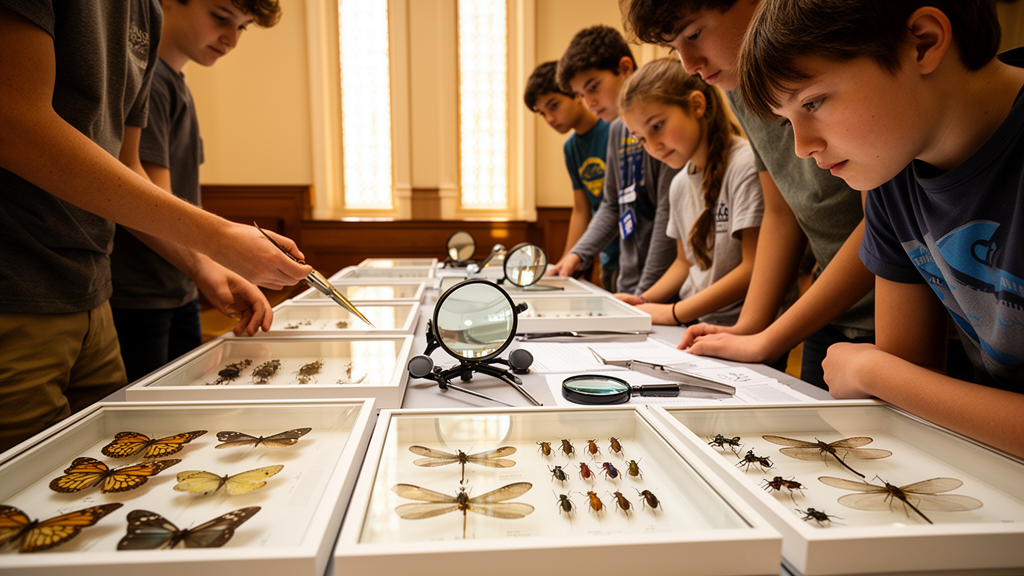
When roughly 88 high school students filed into a competition room at the University of Georgia in 2024 for a Science Olympiad entomology exam, they encountered something most practice tests could never offer: real insects. Of the 15 stations on the exam, 14 featured actual pinned specimens rather than photographs, giving competitors a tactile, three-dimensional encounter with the orders Lepidoptera, Coleoptera, Hymenoptera and beyond. The approach, described in a recent article in the journal Natural History Sciences and Collections, represents a deliberate effort by working entomologists to bridge the gap between textbook entomology and the physical reality of insect diversity.
Science Olympiad, now in its 41st year nationally, is a nonprofit organization that organizes hands-on STEM competitions for kindergarten through 12th grade students across all 50 states. Teams of 15 to 25 students compete in over 23 different events spanning testing, laboratory work and engineering challenges. The organization’s mission centers on increasing K-12 participation in science, technology, engineering and mathematics by creating exciting tournaments that give students a glimpse of higher education and scientific careers. Former participants frequently credit the competition with shaping their academic trajectories; surveys have found that roughly 88 percent of former competitors say Science Olympiad influenced their choice of college major.
Entomology occupies a peculiar position in the Science Olympiad rotation. The subject cycles back into the competition schedule roughly once every decade, giving entomologists a narrow but recurring window to engage with student competitors. When the 2024 and 2025 cycles arrived, organizers at the University of Georgia seized the opportunity. Yash Sajjan and colleagues reached out to the university’s entomology department to curate specimens and design exam stations that would test students on insect identification, behavior, ecology and economic importance using physical specimens rather than images alone.
The exam format demanded precision. Students rotated through stations in groups of 22, with roughly four minutes per station to answer between four and seven multiple-choice and short-answer questions. Questions covered insect order and family identification, distinctive morphological features, life history traits and ecological roles. Students were permitted to bring a field guide, and the specimens were drawn from the same taxonomic groups covered in the official Science Olympiad entomology list, which includes representatives from over 30 insect orders and select arachnid groups.
Beyond the competitive exam, the University of Georgia organizers launched an outreach initiative aimed at schools that would not otherwise have access to Science Olympiad materials. On 30 November 2024, the university hosted an outreach day for underserved schools in surrounding counties. Of the 12 schools invited, seven attended, bringing over 100 students and teachers to campus. The entomology station featured Schmitt boxes filled with large, charismatic specimens, including butterflies, beetles, mantises and wasps, selected specifically for their visual appeal and handling safety. Students were allowed to view and carefully handle the specimens, observing wing venation, leg morphology and body segmentation up close.
The specimens themselves came from the university’s teaching collection, supplemented by the entomology department’s research holdings. Curators deliberately selected 14 specimens representing the major insect orders covered in the competition list, choosing large, distinctive species that would hold up to repeated handling. The curation process required balancing taxonomic breadth with practical considerations: specimens needed to be robust enough to survive a full day of student interaction while still displaying the diagnostic features students needed to learn.
Feedback from the events was positive at every level. Students expressed surprise and delight at encountering real insects rather than photographs, with several reporting that the physical specimens made abstract concepts like complete metamorphosis and mimicry suddenly tangible. Teachers noted that the hands-on format aligned with how students learn best and requested materials for their own classrooms. The Georgia Science Olympiad state director endorsed the specimen-based approach, and several teachers who attended the outreach day later incorporated insect material into their own curricula.
The article’s authors argue that the specimen-based format offers a replicable model for other universities and natural history collections. Because most institutions with entomology programs already maintain teaching collections, the marginal cost of contributing specimens to a Science Olympiad event is low, while the potential payoff, in the form of students who carry an interest in insects into higher education, is substantial. The authors point to evidence that early exposure to real specimens increases student retention in STEM fields and that informal science experiences like Science Olympiad competitions can shape career decisions as powerfully as formal coursework.
Looking ahead, the organizers hope to track whether students who attended the outreach day go on to compete at higher levels of Science Olympiad, and whether exposure to real specimens influences their eventual choice of college major. They also call for entomologists nationwide to engage with the competition the next time entomology cycles into the schedule, whether by curating specimens, designing exam stations or mentoring student teams. The narrow window opens again in roughly a decade, but the collections and relationships built during the 2024 and 2025 cycles, the authors argue, will pay dividends well before then.
Subject of Research: Use of insect specimens for Science Olympiad entomology exam in Georgia, USA
Article Title: Use of insect specimens for Science Olympiad entomology exam in Georgia, USA
Article References: Carruthers, K., Sajjan, Y., & Balaji, V. (2025). Use of insect specimens for Science Olympiad entomology exam in Georgia, USA. Natural History Collections and Museomics, 2, 1-10. https://doi.org/10.3897/nhcm.2.153727
Image Credits: AI Generated
Keywords: insect, specimens, Science, Olympiad, entomology, exam, Georgia, scientific research
Cite Scienmag News
Gavin Prescott. (October 18, 2026). Real Insects, Real Impact: How University of Georgia Entomologists Brought Specimens to Science Olympiad. Scienmag. https://scienmag.com/real-insects-real-impact-how-university-of-georgia-entomologists-brought-specimens-to-science-olympiad/
Gavin Prescott. "Real Insects, Real Impact: How University of Georgia Entomologists Brought Specimens to Science Olympiad." Scienmag, 18 October 2026, https://scienmag.com/real-insects-real-impact-how-university-of-georgia-entomologists-brought-specimens-to-science-olympiad/. Accessed 18 October 2026.
Gavin Prescott. "Real Insects, Real Impact: How University of Georgia Entomologists Brought Specimens to Science Olympiad." Scienmag. October 18, 2026. https://scienmag.com/real-insects-real-impact-how-university-of-georgia-entomologists-brought-specimens-to-science-olympiad/


