


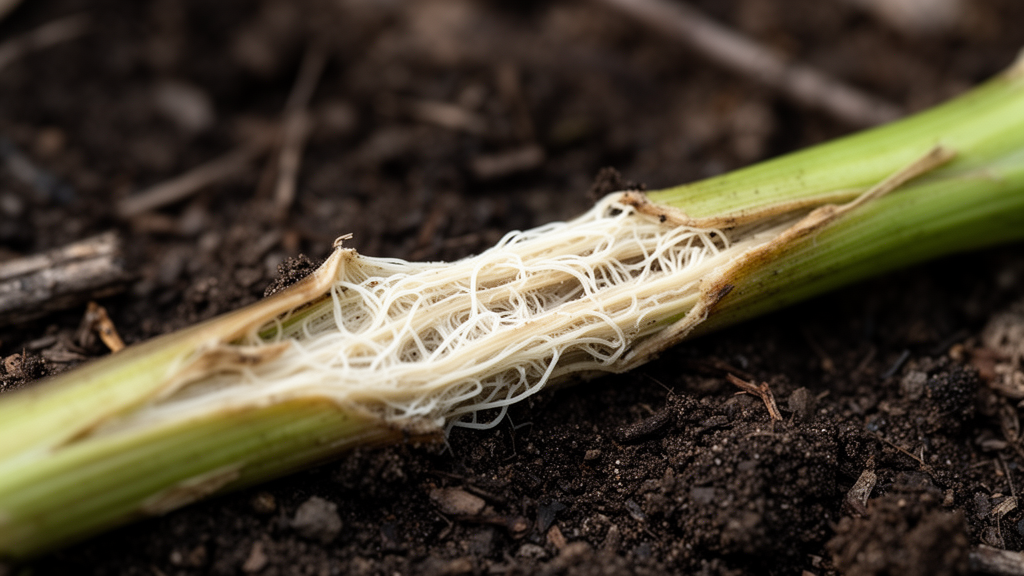
The invasive goldenrod Solidago canadensis has long been known as a botanical bulldozer, blanketing meadows across Europe and pushing out native plants. Now a new study reveals a twist in the invasion story: the very fungi already living in European soils are dismantling the plant’s tough shoots, and they do it through a shifting sequence of ecological strategies that changes as the shoots decay. The findings, published in NeoBiota, suggest that Natura 2000-protected mesic meadows may be far more vulnerable to invasion-driven change than previously assumed.
Solidago canadensis, native to North America, has spread across Eurasia, Australia and New Zealand, where it acts as an ecosystem engineer. Its presence alters soil pH, extractable nitrogen, potassium and phosphorus concentrations, and even reshapes communities of arbuscular mycorrhizal fungi. While many studies have shown that its leaf litter decomposes rapidly, far less attention has been paid to its shoots, which are heavily lignified and persist in the environment for more than a season. Understanding how fungi break down this recalcitrant material is key to grasping how the plant’s biomass enters the carbon cycle in its introduced range.
A research team based in central-eastern Europe conducted a one-year litterbag experiment across unmown mesic meadows near the Białowieża Primeval Forest, at two sites roughly ten kilometres apart. They selected forty plots in total: ten with up to 25 percent S. canadensis cover, ten with 25 to 50 percent cover, ten with more than 50 percent cover, and ten control plots with none. Lignified shoots collected in October 2023 were dried at 40 °C for 72 hours to preserve endophytic fungi, then sealed in fiberglass mesh bags with a one-millimetre mesh size, each containing five grams of material. Three bag sequences were placed on every plot, with one bag retrieved every three months over the following year.
After each collection, the bags designated for mass-loss measurements were dried at 60 °C for 48 hours and weighed. The remaining necromass was divided into three parts and placed on malt extract agar plates, into moist chambers, and into hydroponic cultures, allowing the researchers to capture fungi with different culturing requirements. Spores and fungal structures were identified under light and dissecting microscopes, with morphotypes assigned to genus or species level using established taxonomic references. The team also counted spores in suspension under a microscope across 50 fields of view at 200× magnification to estimate the relative abundance of fungi participating in decomposition.
To interpret the ecological mechanisms at play, the researchers calculated three functional diversity metrics: functional richness, functional dispersion and functional evenness, based on trophic guilds assigned through the FunGuild database. Functional richness reflects how many realised niches exist in a community, functional dispersion measures how dissimilar those niches are, and functional evenness assesses whether any single niche dominates. Different combinations of these indices can signal whether habitat filtering, niche differentiation or competitive exclusion is shaping the fungal assemblage. The team built generalised linear mixed models with a beta distribution, using plot identity nested within study site as a random factor, and tested each predictor in interaction with S. canadensis cover.
The results were striking. After one year, mean mass loss reached 60.33 percent of the initial shoot mass, with losses of 14.6 percent in February, 13.7 percent in May, 28.2 percent in August and 39.7 percent in November. The most abundant fungi shifted seasonally: Alternaria, Epicoccum and Cladosporium dominated in February; Alternaria, Septoria and Cladosporium in May; Alternaria, Chalara and Leptosphaeria in August; and Alternaria, Penicillium and Cladosporium in November. Crucially, the ecological mechanisms governing fungal community assembly changed over the course of decomposition, moving from habitat filtering and niche differentiation to interspecific competition and back to habitat filtering again.
In the first three months, habitat filtering appeared to dominate. Mass loss increased with rising fungal functional richness and dispersion alongside increasing S. canadensis cover, suggesting that environmental constraints in the highly lignified shoots favoured generalist fungi capable of tolerating secondary metabolites. By May, when the material had become easier to degrade, growing functional richness along the invasion gradient accelerated decomposition, while functional dispersion and evenness had little influence. The dominant genera Alternaria and Cladosporium, among the most cosmopolitan fungi on Earth, had negligible effects on mass loss during these early stages, hinting that their abundance reflects effective germination rather than active degradation.
By August, competition between fungi appeared to give way to niche differentiation. In dense Solidago patches, only specialised saprotrophs seemed capable of efficient decomposition, and functional dispersion and evenness negatively affected mass loss, indicating that fungal niches could not be too similar or dominated by a single function. Two genera told opposing stories: Chalara became increasingly significant with rising S. canadensis cover, likely responding to the specific microclimate within dense patches, while Leptosphaeria declined, possibly due to the high temperatures and low humidity typical of the region in late summer. By November, habitat filtering had reasserted itself, with strictly saprotrophic fungi the only group able to degrade the remaining litter efficiently under high plant cover, as most of the easily degradable parenchyma had already been consumed.
Perhaps the most consequential finding concerns the most abundant fungi, which the researchers identified as weak degraders. These taxa appeared entirely unaffected by S. canadensis cover, suggesting they possess the potential to decompose a type of plant litter recently introduced to the ecosystem. In other words, native fungi already present in European meadows readily establish novel interactions with this non-native plant, allowing large amounts of newly introduced biomass to enter the carbon cycle. This challenges the assumption that invasive plants must overcome microbial resistance in their introduced range, and instead points to rapid functional integration as an underappreciated component of invasiveness.
The implications extend beyond a single species. The authors argue that Natura 2000-protected mesic meadows may become more invasible precisely because local fungal assemblages form novel functional associations with non-native plants so readily. Other habitats within the secondary range of S. canadensis that share similar conditions may likewise be more susceptible to invasion-driven ecosystem change than expected. The study also highlights the priming effect of potentially endophytic taxa, which accelerate early decomposition before being outweighed by specialised saprotrophs. While the researchers acknowledge that molecular metabarcoding, soil physicochemical data and nutrient-leaching measurements would strengthen future work, their findings already suggest that the environmental engineering capacity of S. canadensis is stronger than previously assumed, reinforcing its continued spread through altered carbon cycling pathways.
Subject of Research: Fungal community assembly during Solidago canadensis shoot decomposition is driven by the plant’s invasion gradient
Article Title: Fungal community assembly during Solidago canadensis shoot decomposition is driven by the plant’s invasion gradient
Article References: Kisło, K., Wrzosek, M., Mazurkiewicz, M. T., Kuberski, Ł., Rawlik, K., & Czortek, P. (2026). Fungal community assembly during Solidago canadensis shoot decomposition is driven by the plant’s invasion gradient. NeoBiota, 106, 215-233. https://doi.org/10.3897/neobiota.106.165880
Image Credits: AI Generated
DOI: 10.3897/neobiota.106.165880
Keywords: Fungal, community, assembly, during, Solidago, canadensis, shoot, decomposition, driven, plant, invasion, gradient
Cite Scienmag News
Roger Howard. (October 18, 2026). Native fungi rapidly learn to dismantle invasive goldenrod’s tough shoots. Scienmag. https://scienmag.com/native-fungi-rapidly-learn-to-dismantle-invasive-goldenrods-tough-shoots/
Roger Howard. "Native fungi rapidly learn to dismantle invasive goldenrod’s tough shoots." Scienmag, 18 October 2026, https://scienmag.com/native-fungi-rapidly-learn-to-dismantle-invasive-goldenrods-tough-shoots/. Accessed 18 October 2026.
Roger Howard. "Native fungi rapidly learn to dismantle invasive goldenrod’s tough shoots." Scienmag. October 18, 2026. https://scienmag.com/native-fungi-rapidly-learn-to-dismantle-invasive-goldenrods-tough-shoots/


