


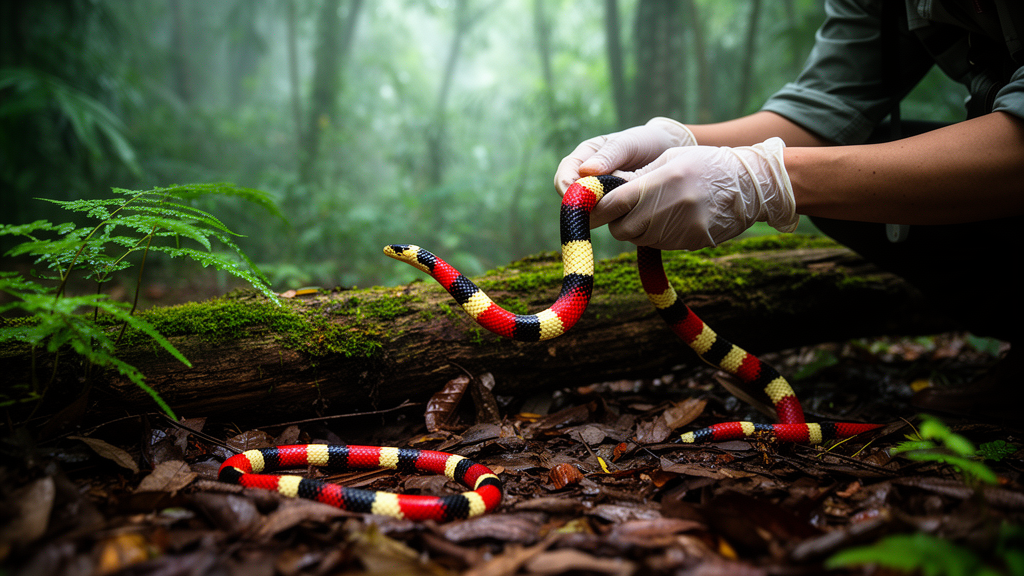
Deep in the forests of Guangxi, China, two dead snakes on a roadside have just rewritten nearly a hundred years of herpetological history. The snakes, collected in June 2024 from Napo County in Baise City, belonged to a species that science had effectively buried in 1931. A new study published in the journal Zoosystematics and Evolution has now formally revalidated Calliophis wongii, a small venomous coral snake described by Fan in 1931 from Luoxiang Township in Guangxi, as an independent species. The species is reassigned to the modern genus Sinomicrurus under the new combination Sinomicrurus wongii, and it carries a suggested English name: the Yaoshan coral snake. The rediscovery ends almost a century of obscurity for an animal that had been quietly folded into another species and forgotten.
The genus Sinomicrurus comprises small to medium-sized venomous snakes of the family Elapidae, formally established in 2001 on the basis of combined morphological and molecular systematic evidence. Before this study, the genus contained ten recognized species, distributed across southern and eastern Asia, from Japan and Taiwan to mainland China, Vietnam, and the Indian subcontinent. Among them, Sinomicrurus kelloggi, described by Pope in 1928 from four specimens collected in Ch’ungan County, now part of Wuyishan City in Fujian Province, was long considered one of the most widespread members of the group. Fan’s Calliophis wongii, described just three years later from two specimens in Guangxi, was morphologically similar: both species possess fifteen rows of dorsal scales at midbody, no longitudinal stripes along the trunk, and a distinctly separated head and neck. The differences were subtle, a shorter tail and narrower white head bands, and over the decades the two names were gradually treated as one.
The collapse accelerated in recent years. In 2018, researchers described Sinomicrurus houi as a new species from Hainan Island, China. Then, in 2021, a major taxonomic revision synonymized S. houi with S. kelloggi, citing overlapping morphological variation and a lack of resolved phylogenetic monophyly, and attributing inconsistencies in earlier mitochondrial analyses to possible sequence misalignment or sample misidentification. At that point, both S. houi and the long-forgotten Calliophis wongii were regarded as junior synonyms of S. kelloggi. The Yaoshan coral snake, in effect, ceased to exist as a recognized species, its name a historical footnote in the synonymy lists of a more familiar relative.
That changed in June 2024, when two road-killed coral snake specimens were collected from Napo County, at an elevation of 990 meters above sea level, in secondary evergreen broad-leaved forest interspersed with shrubs and vines. The specimens, an adult male and an adult female, were fixed and preserved in 80 percent ethanol and deposited in the museum of the School of Life Sciences at Guangxi Normal University. Morphologically, they matched the original description of Calliophis wongii with striking precision. They possess fifteen dorsal scale rows, smooth dorsal scales, no loreal scale, one preocular and two postoculars, and seven supralabials. Most tellingly, the black transverse bands crossing the dorsum of the body are only half a scale in width, a feature consistent with S. houi but clearly distinct from the one-scale-wide bands characteristic of S. kelloggi. The two white transverse bands on the head and the relatively short tail length in males closely correspond to the holotype of C. wongii.
To test whether these morphological signals reflected genuine evolutionary separation, the researchers turned to mitochondrial DNA. Genomic DNA was extracted from muscle tissue, and two mitochondrial genes were amplified and sequenced: cytochrome c oxidase subunit I (COI) and cytochrome b (Cyt b). The COI dataset contained 44 samples totaling 630 base pairs, while the Cyt b dataset included 42 samples totaling 1050 base pairs, drawing on sequences downloaded from GenBank alongside the new specimens. Phylogenetic trees were constructed using both maximum likelihood and Bayesian inference methods. For the COI analysis, the best-fit nucleotide substitution model was GTR+G, with maximum likelihood trees built in IQ-TREE using 1000 bootstrap approximations and Bayesian trees built in MrBayes running for 2,000,000 generations. The Cyt b analyses used the GTR+I+G model under the same software and parameters. Outgroups included Micrurus nigrocinctus and Micrurus lemniscatus for COI, and Hemibungarus calligaster and Micrurus fulvius for Cyt b. The resulting topologies from the two methods were generally consistent.
The molecular results were unambiguous. In the COI-based phylogeny, the two Napo specimens first cluster into a small clade with specimens from Shangsi in Guangxi and Hai Duong in Vietnam, and this clade then joins, with maximal support values of 100 percent for both Bayesian posterior probabilities and maximum likelihood bootstrap, with specimens from Hainan Island, including the paratypes of S. houi. This large clade is sister to S. kelloggi, with 100 percent Bayesian support and 96 percent maximum likelihood support. The genetic distances tell the same story. The uncorrected p-distance between the Napo specimens and S. kelloggi reaches 7.7 percent for COI, while the distance between the Napo specimens and known S. wongii material is at most 1.3 percent. For Cyt b, the corresponding figures are 5.5 to 6.1 percent against S. kelloggi and 0.2 to 1.4 percent against northern Vietnamese specimens. These divergences exceed the commonly accepted interspecific threshold within the genus: the known COI distance between S. annularis and S. swinhoei, two clearly distinct species, ranges only 3.3 to 4.0 percent, and their Cyt b distance ranges 4.5 to 5.1 percent.
As a control, the researchers also collected one Sinomicrurus individual from Rongshui Miao Autonomous County in Liuzhou, Guangxi. This specimen clusters firmly within the clade of S. kelloggi, with genetic distances of only 0.2 to 0.9 percent for COI and 0.0 to 1.2 percent for Cyt b relative to confirmed S. kelloggi. It was identified as S. kelloggi by both morphology and molecules, providing a useful contrast that strengthens the case for the Napo specimens. The researchers also found that a specimen reported in 2015 from Laojunshan in Yunnan, previously referred to S. kelloggi, possesses fifteen dorsal scale rows, seven infralabials, and half-scale black bands, and should instead be referred to S. wongii. Similarly, a specimen from Hainan previously identified as S. kelloggi shows genetic divergence of 8.8 to 9.2 percent from S. kelloggi but only 0.0 to 1.3 percent from S. wongii, confirming that it too belongs to the revalidated species.
Integrating all of this evidence, the study formally revalidates Calliophis wongii as an independent species, synonymizes Sinomicrurus houi with it, and reallocates the species to the genus Sinomicrurus as Sinomicrurus wongii comb. nov. The designation follows the priority principle of zoological nomenclature, since C. wongii was published in 1931, well before S. houi in 2018. The species is diagnosed by a combination of characters: fifteen smooth dorsal scale rows throughout, no loreal, one preocular and two postoculars, seven supralabials and seven infralabials, black dorsal bands finely edged with pale pinkish buff and each only half a scale wide, white head markings shaped like the Chinese character “八” or a narrow V, and a venter bearing 29 to 39 black blotches. The single most reliable external distinction from S. kelloggi is the count of infralabial scales, seven in S. wongii versus six in S. kelloggi, alongside the band width difference.
The rediscovery also clarifies the species’ distribution. Sinomicrurus wongii is now known from Guangxi, Yunnan, and Hainan in China, as well as from Hai Duong and Cao Bang provinces in northern Vietnam. Vietnamese specimens from Hai Duong and Cao Bang cluster with S. wongii in the phylogenetic trees, and their genetic distance from the species falls within the intraspecific range of 0.0 to 1.4 percent. The species shows striking geographic variation in coloration: populations on Hainan Island are scarlet, whereas continental populations are rufous brown, and the white head stripe on Hainan specimens resembles the Chinese character “八” while continental specimens show a V-shaped stripe. In the Napo habitat, the species lives sympatrically with Ptyas major, Pareas formosensis, Ahaetulla prasina, Protobothrops mucrosquamatus, and Trimeresurus albolabris.
Questions remain, and the authors flag them clearly. For Calliophis wongii tonkinensis, the subspecies described by Bourret in 1935 from Vietnam, future sampling at its type locality is needed to determine whether it represents an independent lineage or a subspecies of S. wongii. The authors also observed unstable phylogenetic placement for one Guangxi sample, consistent with the sequence problems reported in the 2021 revision, and they concur that this sequence may be problematic. What is beyond dispute is the broader lesson: two road-killed snakes on a mountain roadside in Guangxi were enough to resurrect a species lost for nearly a century, collapse a young synonym, and redraw the evolutionary map of Asia’s coral snakes. In a genus as small and secretive as Sinomicrurus, where venomous elapids hide in leaf litter and are rarely seen alive, the boundary between one species and another can be as thin as half a scale.
Subject of Research: Rediscovery and revalidation of Sinomicrurus wongii Fan, 1931 (Squamata, Elapidae), from South China and northern Vietnam following nearly a century of obscurity
Article Title: Rediscovery and revalidation of Sinomicrurus wongii Fan, 1931 ( Squamata , Elapidae ), from South China and northern Vietnam following nearly a century of obscurity
Article References: Jiang, X., Cen, H., Ding, L., Wang, X., Wu, Z., & Chen, Z. (2026). Rediscovery and revalidation of Sinomicrurus wongii Fan, 1931 (Squamata, Elapidae), from South China and northern Vietnam following nearly a century of obscurity. Zoosystematics and Evolution, 102(2), 507-517. https://doi.org/10.3897/zse.102.188068
Image Credits: AI Generated
Keywords: Rediscovery, revalidation, Sinomicrurus, wongii, Squamata, Elapidae, South, China, northern, Vietnam, following, nearly
Cite Scienmag News
Margaret Porter. (October 18, 2026). Lost Coral Snake Rediscovered in China and Vietnam After Nearly a Century. Scienmag. https://scienmag.com/lost-coral-snake-rediscovered-in-china-and-vietnam-after-nearly-a-century/
Margaret Porter. "Lost Coral Snake Rediscovered in China and Vietnam After Nearly a Century." Scienmag, 18 October 2026, https://scienmag.com/lost-coral-snake-rediscovered-in-china-and-vietnam-after-nearly-a-century/. Accessed 18 October 2026.
Margaret Porter. "Lost Coral Snake Rediscovered in China and Vietnam After Nearly a Century." Scienmag. October 18, 2026. https://scienmag.com/lost-coral-snake-rediscovered-in-china-and-vietnam-after-nearly-a-century/


