


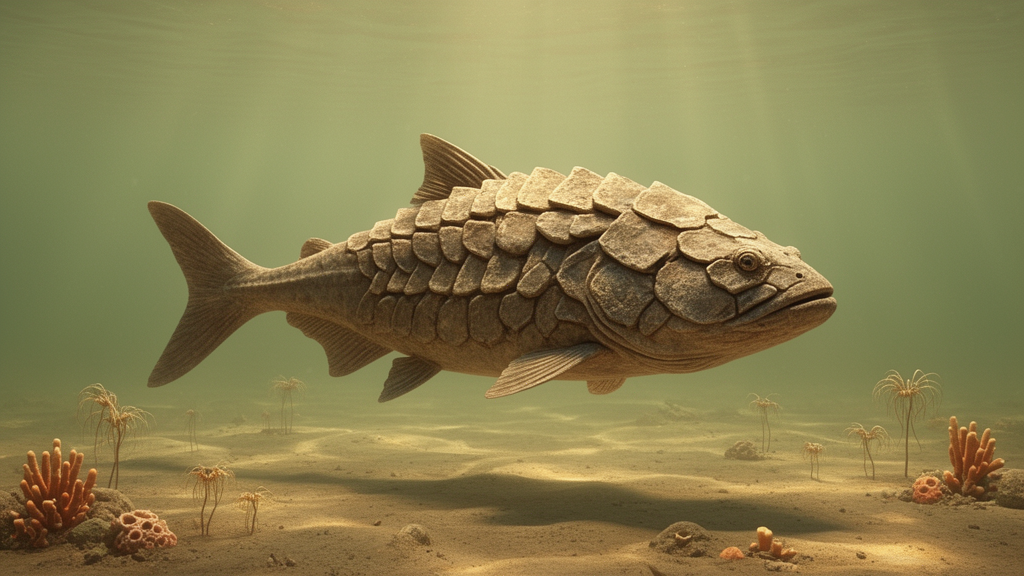
Deep in the red hills of Zhanyi, in Qujing City of Yunnan Province, southwestern China, a fish that died roughly 390 million years ago is forcing paleontologists to redraw the family tree of one of the most successful armored vertebrates of the Devonian Period. Bothriolepis yunnanensis, a placoderm first named in 1962 from two lonely fossil plates, has finally been given a full anatomical makeover. A new study published in the Swiss Journal of Palaeontology describes newly collected specimens from the type locality and the neighboring Zhujiangyuan, the Pearl River Source area, revealing for the first time the head shield, trunk armor, and pectoral appendages of this enigmatic species. The findings extend its temporal range across the entire Middle Devonian and place it within a clade that links China to ancient landmasses thousands of kilometers away.
Bothriolepis is, by any measure, a superstar of Devonian paleontology. With 97 recognized species, it is the most speciose genus among the antiarchs, a highly specialized group of placoderms, the jawed stem gnathostomes that dominated the waters of the Silurian and Devonian worlds. Antiarchs are instantly recognizable by their heavy bony armor and paired pectoral appendages that resemble jointed arms encased in plates. Sixty-five genera of antiarchs have been reported so far, and Bothriolepis stands out not only for its diversity but also for its cosmopolitan distribution, with fossils recovered from every major Devonian landmass. Yet despite this fame, many of its species remain known from frustratingly incomplete material.
B. yunnanensis is a case in point. Liu described the species in 1962 based on an anterior median dorsal plate and an incomplete posterior median dorsal plate collected from a small hillside about one kilometer north of Zhanyi Old Town, now the Taojiashan area of the Zhanyi urban district. These plates come from the Middle Devonian Shangshuanghe Formation, which is characterized by yellow to green fine-grained sandstones yielding abundant disarticulated fish plates. Although the species has been frequently cited in stratigraphic studies over the decades, no additional material had ever been described, leaving its morphology and phylogenetic position poorly understood. The new study designates the anterior median dorsal plate as the lectotype and the posterior median dorsal plate as the paralectotype, formally anchoring the species to a single anatomical reference point.
Everything changed with continuous fieldwork that began in 2020. The research team collected numerous new specimens from the type locality and from two sites in the Zhujiangyuan area, designated Zhujiangyuan Locality 1 and Zhujiangyuan Locality 4. The haul includes an articulated head shield, a head shield articulating with the trunk armor, pectoral appendages, and many disarticulated plates. All specimens are housed in the Institute of Vertebrate Paleontology and Paleoanthropology of the Chinese Academy of Sciences in Beijing. The fish-bearing layer at Zhujiangyuan Locality 1 belongs to the Shangshuanghe Formation of Eifelian age, while the layers at Zhujiangyuan Locality 4 belong to the Xichong Formation of Givetian age. This new fossil horizon extends the temporal range of B. yunnanensis from the Eifelian to the entire Middle Devonian, a significant expansion for a species previously known from a single horizon.
The Devonian strata of the Qujing area are exceptionally well exposed and subdivided into a clear succession of formations, from the Lower Devonian Xishancun, Xitun, Guijiatun, and Xujiachong formations, through the Lower to Middle Devonian Chuandong Formation, the Middle Devonian Shangshuanghe and Xichong formations, and up to the Upper Devonian Zaige Formation. In the Zhujiangyuan area, the Guijiatun, Xujiachong, and Chuandong formations are absent, and the Middle Devonian units sit directly between the underlying Lower Devonian Xitun Formation and the overlying Upper Devonian Zaige Formation. At Taojiashan, the limited fish-bearing Middle Devonian is strictly controlled by faults, but lithological characteristics and available biostratigraphic evidence assign the lectotype horizon to the Shangshuanghe Formation.
The technical heart of the study lies in the detailed description of the newly recovered material, including high-resolution computed tomography of a well-preserved head shield. The head shield of B. yunnanensis is wider than long, with a breadth to length ratio of 1.35 in the largest specimen, which measures 77 millimeters across. The orbital fenestra, the window for the eyes, is short and wide with a breadth to length ratio of 2.1, and its anterior margin is concave while the posterior margin is straight. The premedian plate is trapezoidal, the lateral plate is the largest plate of the head shield, and the postpineal plate is wider than long, shaped as a posteriorly pointing rounded triangle. The nuchal plate is roughly heptagonal, and its anterolateral margin is obviously shorter than its posterolateral margins, a subtle but diagnostic feature.
The CT scan of specimen IVPP V34361, performed on a GE v|tome|x micro-tomography scanner at 240 kV and 110 mA with a resolution of 59.963 micrometers, produced 3,979 slices that were segmented and reconstructed in three dimensions. The visceral surface of the head shield revealed a trifid preorbital recess with three well-developed extensions, a developed postorbital process, a well-developed paramarginal crista in the otico-occipital depression, and a low and broad transverse nuchal crista. Crucially, the large unpaired insertion fossa for levator muscles lies immediately behind the transverse nuchal crista, and there is no median occipital crista. This absence of the median occipital crista is one of the key characters that unites B. yunnanensis with a distinctive clade of Bothriolepis species.
The trunk armor tells an equally detailed story. The anterior median dorsal plate is hexagonal with anterior and posterior margins nearly equal in width, and its breadth to length ratios range from 0.82 to 0.91 across the studied specimens. The ratio between the breadth of the anterior margin and the maximum breadth of the plate ranges from 0.43 to 0.53, well below the 0.55 threshold that separates B. yunnanensis from its closest Chinese relatives. The levator fossa is a broad and short inverted triangle occupying one-third of the plate length, and the anterior ventral pit lies posterior to the confluence of the postlevator thickening and postlevator cristae. The posterior median dorsal plate is pentagonal with an arc-shaped posterior margin lacking a posterior corner, and the ventral median groove on its ventral side is absent. The pectoral appendage is remarkably slender, with a proximal segment reaching 87.2 millimeters in length but only 19.4 millimeters in breadth in the largest specimen, an elongation ratio of 4.49, and short, blunt, closely arranged lateral spines run along its margin.
With this comprehensive morphological dataset in hand, the team conducted a parsimony phylogenetic analysis based on the data matrices of previous studies, adding B. yunnanensis as a new taxon and one additional character. The analysis yielded 12 most parsimonious trees, each with a length of 385 steps, a consistency index of 0.213, and a retention index of 0.498. The results place B. niushoushanensis at the most basal position within the genus, while B. yunnanensis, B. zhujiangyuanensis, B. sinensis, and B. kwangtungensis from China form a clade with some Bothriolepis species from Laurussia and Kazakhstania. This clade is supported by three synapomorphies: the absence of the median occipital crista, a slender proximal segment of the pectoral appendage, and a long posterior pit line. The trifid shape of the preorbital recess appears very low in the phylogeny, consistent with recent computerized analyses but contradicting older interpretations.
The paleogeographic implications are perhaps the most thrilling part of the story. During the Devonian, the South China and Kazakhstania blocks were separate terranes, and the presence of shared Bothriolepis clades between China, Kazakhstania, and Laurussia suggests faunal connections among these regions. The new analysis further corroborates the paleogeographic proximity between the South China and Kazakhstania blocks, reinforcing a picture of Devonian seas and coastlines that were far more connected than their modern geography might suggest. Meanwhile, B. tungseni from China emerges as the sister taxon of B. dorakarasugensis from Siberia, adding another thread to this transcontinental web. For a species that sat in taxonomic limbo for more than sixty years, B. yunnanensis has now become a bridge between continents, a reminder that even the most fragmentary fossils can hold the keys to understanding how life spread across an ancient planet.
Subject of Research: Paleontology
Article Title: Morphology and phylogeny of Bothriolepis yunnanensis ( Placodermi , Antiarcha ) from the Middle Devonian of China
Article References: Yan, Y., Zhao, W., Luo, Y., Yu, H., & Zhu, M. (2026). Morphology and phylogeny of Bothriolepis yunnanensis (Placodermi, Antiarcha) from the Middle Devonian of China. Swiss Journal of Palaeontology, 145, 535-551. https://doi.org/10.3897/sjp.145.179243
Image Credits: AI Generated
Keywords: Bothriolepis, placoderm, Devonian, antiarch, paleontology, China, fossil fish, phylogeny, Morphology, yunnanensis, Placodermi, Antiarcha
Cite Scienmag News
Gavin Prescott. (October 18, 2026). Ancient Armored Fish from China Rewrites the Story of a Devonian Giant. Scienmag. https://scienmag.com/ancient-armored-fish-from-china-rewrites-the-story-of-a-devonian-giant/
Gavin Prescott. "Ancient Armored Fish from China Rewrites the Story of a Devonian Giant." Scienmag, 18 October 2026, https://scienmag.com/ancient-armored-fish-from-china-rewrites-the-story-of-a-devonian-giant/. Accessed 18 October 2026.
Gavin Prescott. "Ancient Armored Fish from China Rewrites the Story of a Devonian Giant." Scienmag. October 18, 2026. https://scienmag.com/ancient-armored-fish-from-china-rewrites-the-story-of-a-devonian-giant/


