


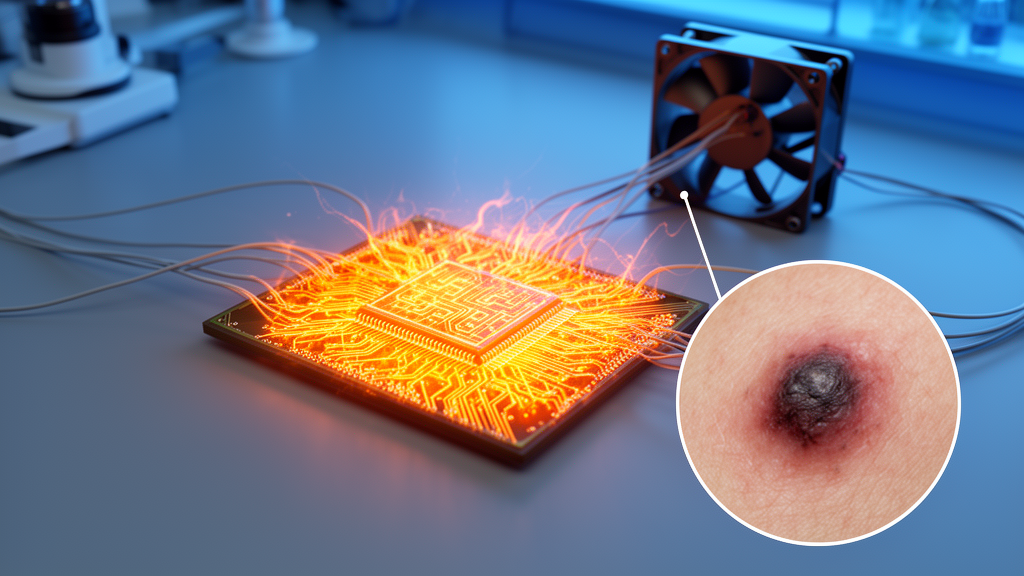
Deep learning models that read dermoscopic images of skin lesions are usually judged on a single currency: accuracy. A new study argues that this currency has a hidden exchange rate measured in kilowatt-hours and grams of carbon dioxide, and that the rate varies far more than the accuracy itself. In a comparison of three widely used architectures trained on the HAM10000 dataset, the models landed within one percentage point of each other on overall accuracy, yet differed by a factor of more than four in the energy required to get there. The finding, published in Discover Artificial Intelligence, turns a routine benchmark exercise into a pointed question for clinical AI governance: what, exactly, does the extra energy buy?
The research team, led by dermatologists and AI researchers in Turkey, fine-tuned ResNet-50, EfficientNet-B3, and Vision Transformer B/16 on 10,015 dermatologist-labelled dermoscopic images spanning seven diagnostic classes, from melanocytic nevi to melanoma and basal cell carcinoma. All three networks were initialised with ImageNet-pretrained weights, trained end-to-end in TensorFlow/Keras on a single NVIDIA Tesla P100 GPU, and evaluated three times each with identical hyperparameters, augmentation policies, and early-stopping criteria. The dataset was split at the lesion level rather than the image level, so that repeat photographs of the same lesion never straddled the training and test partitions. This detail matters more than it might seem: the authors report that the same architectures score three to six percentage points higher under the more common image-level splitting, which allows a model to recognise lesions it has already seen rather than generalise to new ones.
On the leakage-free lesion-level test set of 1456 images from 1068 lesions, accuracy was 0.807 for ResNet-50, 0.817 for EfficientNet-B3, and 0.808 for Vision Transformer B/16, with no statistically significant difference between any pair. Macro-averaged AUROC values clustered between 0.950 and 0.959. The one comparison that crossed the Bonferroni-corrected significance threshold was the transformer’s AUROC advantage over ResNet-50, a difference of 0.0097. The authors are careful about what these intervals do and do not license: the study was not designed as a non-inferiority comparison, and the confidence interval for the accuracy difference between the transformer and EfficientNet-B3 spanned minus 2.47 to plus 0.64 percentage points, a range that does not exclude differences some clinicians would consider material. The finding is that an advantage was not demonstrated, not that the models are equivalent.
Energy separated the architectures far more sharply than performance did. Measured gross training energy per run was 0.0143 kWh for ResNet-50, 0.0205 kWh for EfficientNet-B3, and 0.0630 kWh for Vision Transformer B/16, corresponding to 5.5, 7.9, and 24.4 grams of CO2-equivalent under the Turkish electricity grid scenario. The transformer consumed 3.07 times the training energy of EfficientNet-B3 and 4.41 times that of ResNet-50. Inference told a similar story: measured energy per 1000 single-image inferences was 0.115 Wh for ResNet-50, 0.071 Wh for EfficientNet-B3, and 0.307 Wh for the transformer, a 4.32-fold gap between the two extremes. Mean board power under load ranged from 111.5 W for EfficientNet-B3 to 214.5 W for the transformer, whose peak draw of 250.1 W was the only one to approach the card’s rated ceiling.
One result runs against a common intuition and is worth stating plainly: parameter count did not predict energy consumption. EfficientNet-B3 has 10.8 million trainable parameters against ResNet-50’s 23.6 million, yet consumed 43% more training energy. The reason is that EfficientNet-B3 was slower per epoch, 49 seconds against 37, and converged in more epochs, so a lower instantaneous power draw was more than offset by a longer time under load. A study that had inferred energy from model size, as much of the literature implicitly does, would have reached the opposite conclusion. Nor did training cost predict inference cost: EfficientNet-B3 was the most expensive convolutional network to train but the cheapest to run, consuming 38% less inference energy than ResNet-50 despite being 50% slower per image. The additional training energy is recovered after roughly 143,600 inferences, a threshold a screening programme would cross in its first year.
The melanoma results reveal why aggregate metrics are insufficient for clinical governance. Melanoma sensitivity was 0.446 for ResNet-50, 0.548 for EfficientNet-B3, and 0.593 for Vision Transformer B/16. Both differences from ResNet-50 crossed the corrected significance threshold, with EfficientNet-B3 gaining 0.102 and the transformer gaining 0.146. The architectures that detected more melanomas detected marginally fewer nevi, and because nevi constitute 63% of the test set, the two effects nearly cancel in the accuracy figure. An evaluation reporting only overall accuracy would have suggested little separation among the models while obscuring a 15-percentage-point difference in melanoma detection, the class with the most direct bearing on patient harm.
The same measurement framework therefore supported opposite verdicts in two adjacent comparisons, and this is the finding the authors ask readers to take from the study. The additional energy separating EfficientNet-B3 from ResNet-50 corresponded to a statistically significant and potentially clinically important absolute gain in melanoma sensitivity, roughly ten additional melanomas detected per hundred. The much larger increment separating Vision Transformer B/16 from EfficientNet-B3, 3.07 times the training energy and 4.32 times the inference energy, bought nothing detectable on accuracy, AUROC, or melanoma sensitivity. When a certain and substantial cost is set against an uncertain and undemonstrated benefit, the burden of justification falls on the party proposing the costlier option. Energy cannot decide architecture selection on its own, but it can make the exchange rate explicit, and neither verdict is available without measurement.
The measurement itself proved harder than expected, and the obstacles are cautionary in their own right. The team initially used CodeCarbon, a widely adopted software estimator, which on this hardware reported a GPU energy of exactly zero for every run, attributing the whole of the measured consumption to CPU and memory and omitting the component in which the architectures actually differ. The failure is silent, the tool reports a plausible non-zero total, and had it gone unchecked it would have inverted the conclusions. The researchers therefore sampled board-level GPU power directly through the NVIDIA management interface at 100-millisecond intervals and integrated it over time. Estimating inference energy from the accelerator’s thermal design power proved similarly unreliable: such estimates were 2.7 to 13.8 times the measured consumption, and the multiple differed by architecture, so the estimate is not a consistent upper bound and cannot be corrected by a constant factor. Rated maximum draw describes a card, not a workload.
Calibration, the property whose degradation post-market monitoring of clinical AI is most often designed to catch, produced a null result. Expected calibration error ranged from 0.052 to 0.064 across the three architectures, with run-to-run standard deviations of the same magnitude as the between-architecture differences. The reliability diagrams show the pattern typical of fine-tuned image classifiers, with confidence concentrated in the highest bin and modest overconfidence in the mid-range. The authors report this null result as a baseline against which post-deployment drift could be detected, rather than omitting a property that did not discriminate between the models.
The study’s limitations are acknowledged with unusual candour. HAM10000 is drawn from a limited number of mainly European centres, over-represents lighter skin phototypes, and contains images acquired under controlled dermoscopic conditions, so the performance figures may not transfer to larger and more heterogeneous datasets. The fixed 224 by 224 input resolution matches the canonical configuration of ResNet-50 and the transformer but not EfficientNet-B3, whose reference input is 300 by 300, so its performance here should be read as a lower bound. The energy figures are board-level measurements that exclude facility overhead such as cooling and power-supply losses, and they characterise one GPU card rather than the accelerator generations now in common use. The authors did not evaluate robustness to acquisition-device shift, a first-order concern for deployment, and note that if attention-based architectures prove more robust to changes in dermatoscope, that advantage would constitute exactly the kind of concrete clinical benefit capable of justifying the higher energy cost they document.
The wider argument is one of routine reporting and governance. The authors propose that pre-deployment evaluations and technical documentation for medical AI should report measured training energy, training carbon emissions under a specified grid, the hardware used, inference latency, measured energy per 1000 inferences, at least one calibration statistic, sensitivity on the highest-priority diagnostic class, and one or two normalised metrics such as accuracy per kWh. Their grid analysis shows that switching to lower-carbon electricity reduces absolute emissions for every architecture but does not close the gap between them, so efficient model selection and grid decarbonisation are complementary strategies rather than substitutes. Clinical AI models are not static: they are retrained when new images arrive, recalibrated when performance drifts, re-validated when they move sites, and updated when imaging hardware changes, and each of those steps consumes electricity. Reporting the energy used during initial training gives downstream stewards a baseline against which retraining cycles, model updates, and procurement decisions can be benchmarked over time. Two of the study’s findings are cautionary in this respect: parameter count did not predict energy consumption, and a widely used software estimation tool reported no GPU energy at all on the hardware used. Both would have produced a wrong answer had they been trusted without verification. Adding energy to the decision changed the conclusion here, and the authors expect it would change others.
Subject of Research: Artificial Intelligence
Article Title: Diagnostic performance and energy consumption of deep learning models for dermoscopic image classification
Article References: Ecer, N., Kankılıç, A. T., Karakoyun, Ö., Aslancan, B., & Kaldan, B. (2026). Diagnostic performance and energy consumption of deep learning models for dermoscopic image classification. Discover Artificial Intelligence, 6(1), Article 1530. https://doi.org/10.1007/s44163-026-02558-5
Image Credits: AI Generated
DOI: 10.1007/s44163-026-02558-5
Keywords: deep learning, dermoscopy, skin cancer, melanoma, energy consumption, carbon footprint, clinical AI, sustainable AI, HAM10000, algorithmovigilance, Diagnostic, performance
Cite Scienmag News
Nathaniel Bowman. (October 18, 2026). AI Skin Cancer Models Burn Four Times More Energy for No Extra Accuracy. Scienmag. https://scienmag.com/ai-skin-cancer-models-burn-four-times-more-energy-for-no-extra-accuracy/
Nathaniel Bowman. "AI Skin Cancer Models Burn Four Times More Energy for No Extra Accuracy." Scienmag, 18 October 2026, https://scienmag.com/ai-skin-cancer-models-burn-four-times-more-energy-for-no-extra-accuracy/. Accessed 18 October 2026.
Nathaniel Bowman. "AI Skin Cancer Models Burn Four Times More Energy for No Extra Accuracy." Scienmag. October 18, 2026. https://scienmag.com/ai-skin-cancer-models-burn-four-times-more-energy-for-no-extra-accuracy/


