


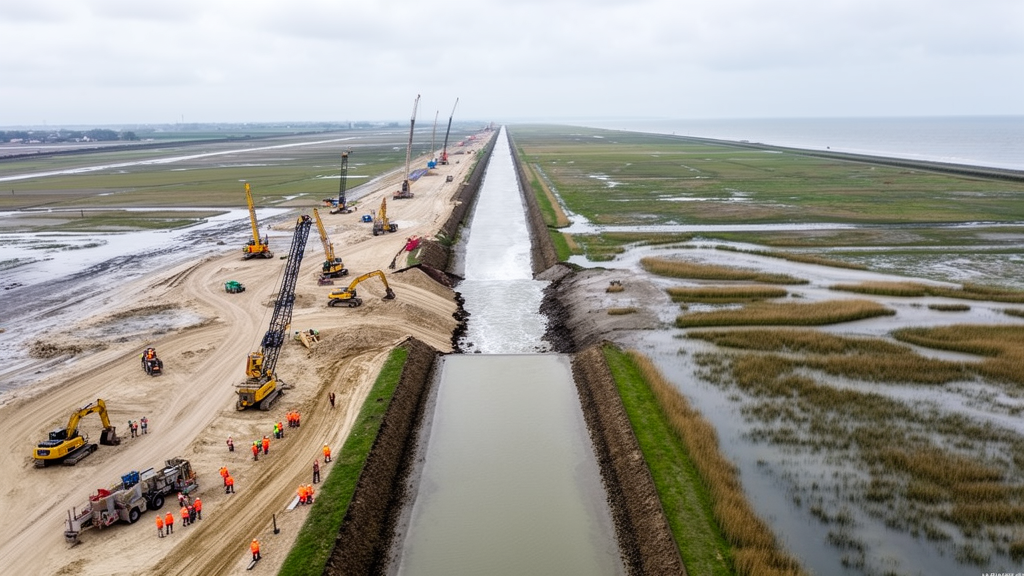
For centuries, Europe’s low-lying coasts have been locked in a battle against the sea. Dykes were raised, wetlands drained, and fertile tidal flats transformed into farmland and towns, in a process that fixed the coastline in place and, paradoxically, made it more vulnerable. Now a growing body of research argues that the most effective way to defend some of these shores is to deliberately open them up again. A new review published in Nature Conservation examines managed re-alignment, the planned removal or relocation of coastal defences to let the sea reclaim land, and finds the approach has quietly become one of the most significant tools in European ecological restoration.
The logic behind managed re-alignment departs sharply from the traditional “hold the line” doctrine. Instead of endlessly raising sea walls, engineers breach or remove existing dykes and build new defences further inland, allowing tidal water to flow back over former farmland. The reconnected land becomes salt marsh, mudflat or reed bed, habitats that absorb wave energy, store flood water and lock away carbon. The review’s authors, drawing on perspectives from both nature conservation and coastal protection, trace how the technique has evolved since the 1960s in northwest Europe and why it is increasingly seen as a cornerstone of climate adaptation rather than a radical experiment.
One of the study’s most striking findings is the sheer scale of the effort. Compiling a database of 277 wetland conservation projects across eight countries, from Denmark to Spain, the researchers counted nearly 60,000 hectares of embanked wetlands that have been restored or are being reconnected to the sea. The United Kingdom leads in the number of projects, with 102, while the Netherlands, France and Germany have restored the largest total areas. Breaching dykes and regulated tidal exchange through sluices are the two most common techniques, together accounting for well over a hundred schemes. Yet the authors caution that even this impressive total remains marginal against roughly 1.5 million hectares of intertidal environments that were historically embanked on these coastlines.
Terminology, it turns out, has been a battleground in its own right. The term “managed re-alignment” was coined in the United Kingdom specifically to avoid the phrase “managed retreat”, which the public often heard as giving land away to the sea. The words evolved from setback to retreat to re-alignment, and each country has developed its own vocabulary shaped by policy priorities. In the UK, the focus has been flood protection and coastal adaptation; in France and Germany, most projects centre on wetland restoration; in the Netherlands, the approach is tied to making flood defences more sustainable, exemplified by the national Room for the River programme. In North America, similar work is described as hydrological or tidal marsh restoration, making international comparisons genuinely difficult.
Public perception has shifted alongside the language. The Medmerry scheme in West Sussex, England, divided local opinion in its early stages, but support grew as the restored site attracted birdwatchers, cyclists and walkers. In Germany, the Langwarder Groden project, designed to compensate for habitat lost to the Jadeweser Port container terminal, was poorly received at first; acceptance rose only after the community successfully pushed for hiking trails accessible to bicycles and people with reduced mobility. These cases illustrate a consistent lesson: restoration projects succeed socially when they deliver visible amenity value, not just ecological function.
Technically, the most promising frontier is the hybrid flood defence, which deliberately combines grey and green infrastructure. A re-aligned dyke can be built with a vegetated slope and a rock armour toe that transitions smoothly into a restored salt marsh foreshore. The marsh dissipates wave energy through friction with vegetation, attenuates storm surges and stores flood waters, potentially allowing the new dyke to be lower and less massive than a conventional one. The Hedwige-Prosperpolder project on the Dutch-Belgian border, completed in October 2022, demonstrates the concept in action: tidal inflow has returned, salt marshes are recolonising the former polder, and the old dykes were left standing as research structures, turning the site into an international living laboratory for flood protection science.
But the review is candid about the biophysical limits. A restored salt marsh can only keep pace with rising seas if sedimentation balances or exceeds erosion, a condition that depends on terrain elevation, sediment availability, plant colonisation and the local rate of sea-level rise. Where those conditions fail, the restored foreshore will gradually submerge and drown. Intriguingly, the authors argue that even such “temporary” wetlands have value, opening a window for societies to think through and prepare for longer-term retreat rather than confronting it abruptly.
The social dimension emerges as the decisive challenge. Managed re-alignment breaks a long cycle in which communities expect and demand hard engineering, and projects imposed without consultation have repeatedly provoked protest and delay. The Ploubalay polder in Brittany offers a telling case: after the Conservatoire du Littoral bought the medieval dyke system in 2014, a storm breach appeared in March 2020 during the first Covid-19 lockdown. When consultations resumed, the baseline had changed, and stakeholders ended up planning a new dyke further inland while salt marshes rapidly recolonised the breached polder, a scenario now cited in France as a textbook model of adaptation.
Compensation for farmers and landowners, the review stresses, is critical where land is lost or farming must end, whether through payment or land exchange. Loss of access to footpaths and drained mires can also inflame opposition, and even successful projects that draw tourists can wear out their welcome without careful visitor management. The authors identify the credibility, approachability and resources of the leading institution, along with early and genuine participation, as the key leverage factors determining whether communities accept change.
Ultimately, the review argues that managed re-alignment is not a single technique but a flexible framework spanning everything from sluice-controlled tidal exchange to the complete removal of defences and the inland relocation of economic activity. Its real promise lies in integrated spatial planning, where zoning allows mutually exclusive conservation goals, such as protecting freshwater mires while restoring tidal salt meadows, to coexist across a single landscape, as demonstrated on the East Zingst Peninsula on the German Baltic coast. Whether the approach becomes mainstream at a time when environmental achievements face political headwinds, the authors conclude, remains an open question, but the evidence from six decades of European practice suggests the sea walls of the future may be greener, lower and further back than the ones they replace.
Subject of Research: Managed re-alignment as a strategy for ecological restoration of European coastal floodplains
Article Title: Managed re-alignment: a multifaceted approach in ecological restoration of coastal floodplains
Article References: de la Vega-Leinert, A. C., Esteves, L. S., Andreu-Boussut, V., Quinio, L., Chadenas, C., van Loon-Steensma, J. M., & van den Hoven, K. (2026). Managed re-alignment: a multifaceted approach in ecological restoration of coastal floodplains. Nature Conservation, 62, 237-260. https://doi.org/10.3897/natureconservation.62.148691
Image Credits: AI Generated
DOI: 10.3897/natureconservation.62.148691
Keywords: managed re-alignment, coastal restoration, salt marsh, flood defence, wetlands, climate adaptation, nature-based solutions, dyke breaching, hybrid infrastructure, community engagement, North Sea, sea-level rise
Cite Scienmag News
Sloane Callahan. (October 18, 2026). Europe Is Deliberately Breaching Its Sea Walls to Save Its Coasts. Scienmag. https://scienmag.com/europe-is-deliberately-breaching-its-sea-walls-to-save-its-coasts/
Sloane Callahan. "Europe Is Deliberately Breaching Its Sea Walls to Save Its Coasts." Scienmag, 18 October 2026, https://scienmag.com/europe-is-deliberately-breaching-its-sea-walls-to-save-its-coasts/. Accessed 18 October 2026.
Sloane Callahan. "Europe Is Deliberately Breaching Its Sea Walls to Save Its Coasts." Scienmag. October 18, 2026. https://scienmag.com/europe-is-deliberately-breaching-its-sea-walls-to-save-its-coasts/


