


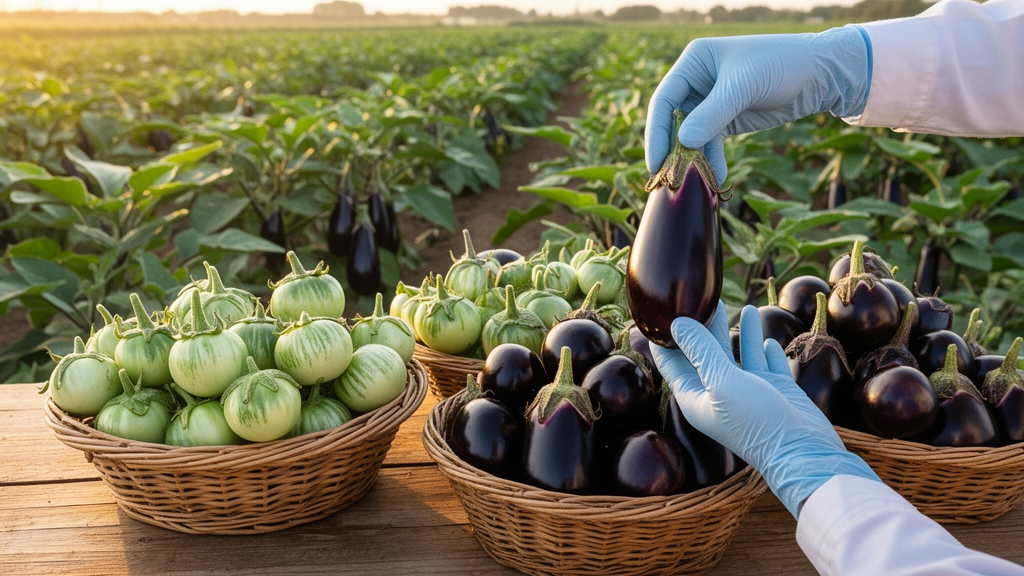
Eggplant, known scientifically as Solanum melongena L., is one of the most recognizable vegetables in the Solanaceae family, the same botanical clan that gave the world potato, tomato, and pepper. Yet despite its striking antioxidant activity and nutritional credentials, eggplant has received far less breeding attention than its famous cousins. That gap is now being addressed with a fresh dose of molecular precision. A new study published in Innovations in Agriculture has evaluated 42 eggplant genotypes collected from Malaysia, China, and Thailand, combining classic field measurements with DNA fingerprinting to map the hidden diversity of this globally important crop. The findings offer breeders a practical toolkit for selecting superior parents in a world where rising populations and shifting climates demand faster genetic gains.
The research team, led by Ibrahim Musa and Mohd Rafii Yusop of Universiti Putra Malaysia, grew the accessions in an open field at Ladan 15, Serdang, Selangor, between September 2018 and January 2019. The collection comprised 19 Malaysian varieties, 6 Chinese varieties, and 17 Thai varieties, spanning everything from miniature white-fruited types to long purple cultivars and commercial F1 hybrids. Standard agronomic practices, including fertilization, pest and disease management, and weed control, were carried out according to Malaysian Department of Agriculture recommendations, ensuring that any differences observed among the plants reflected genuine genetic variation rather than uneven crop care.
Eleven growth, yield, and yield-related traits were measured under open field conditions, including days to 50 percent flowering, first harvest date, number of branches per plant, plant height, fruit length, fruit diameter, fruit weight, average fruit weight, number of fruits per plant, and yield per plant. All measurements were taken on the same day for every accession to minimize variation in developmental stage or environmental conditions. Analysis of variance using SAS version 9.4 revealed highly significant differences, at the one percent probability level, for every trait under study, confirming that the 42 genotypes represent a genuinely diverse genetic reservoir rather than a collection of near-identical lines.
The performance data uncovered some remarkable standouts. The Thai accession TV17 produced the heaviest individual fruits at 303.83 grams, with the widest fruit diameter at 36.57 millimeters, and delivered the second highest yield per plant at 5.49 kilograms. The Malaysian accession MV18, known locally as Terung Panjang, achieved the highest average fruit weight at 269.38 grams and topped the yield rankings with 5.97 kilograms per plant. At the opposite end of the spectrum, the Thai accession TV8 produced the lightest fruits at 17.23 grams and the lowest yield at 0.98 kilograms per plant. Days to 50 percent flowering ranged from 57.33 days in MV12 and MV19 to 77.67 days in MV11, while plant heights spanned from 59.33 centimeters in TV17 to 99.55 centimeters in TV15, underscoring the extraordinary morphological spread within the collection.
To complement the field data, the researchers extracted genomic DNA from young leaves using a modified cetyl trimethylammonium bromide, or CTAB, technique and screened the 42 genotypes with 17 polymorphic simple sequence repeat, or SSR, markers. SSR markers are short, tandemly repeated DNA sequences scattered throughout the genome that mutate rapidly, making them ideal for distinguishing closely related individuals. Because they are co-dominant and unaffected by environmental conditions, they reveal genotypic differences at the DNA level that morphological traits alone cannot capture. The polymerase chain reaction was performed in 16 microliter volumes containing 40 nanograms of template DNA, 0.8 micromolar of each primer, and a 2x Power Taq PCR MasterMix, following protocols adapted from previous eggplant studies.
The molecular analysis revealed moderate but meaningful diversity. The 17 SSR markers amplified between two and four alleles each, generating a total of 43 alleles and an average of 2.53 alleles per marker. The major allele frequency averaged 0.53, ranging from 0.33 to 0.83, while the effective number of alleles averaged 2.31. Shannon’s information index reached an average of 0.84, expected heterozygosity averaged 0.54, and the polymorphism information content, or PIC, averaged 0.45, indicating a moderate level of polymorphism across the loci. These values align closely with previous eggplant diversity studies conducted in Sri Lanka and elsewhere, suggesting that the Malaysian, Chinese, and Thai accessions harbor genetic variation comparable to other regional germplasm collections.
Cluster analysis using the unweighted pair group method with arithmetic averages, or UPGMA, sorted the 42 accessions into five primary groups at a similarity coefficient of 4.24. Group I was the largest, containing 16 accessions dominated by seven Malaysian varieties and five Thai varieties, along with four Chinese accessions. Group III, the second largest with 10 accessions, was overwhelmingly Thai, containing seven of the 17 Thai genotypes. Groups II, IV, and V each contained five or six accessions, with Malaysian varieties predominating in Groups II, IV, and V. Notably, accessions from the same geographic origin did not always cluster together, implying that genetic relatedness in eggplant reflects prolonged exposure to distinct environmental conditions and possibly shared ancestry rather than simple proximity of collection sites.
The study’s authors emphasize that the combination of morphological and molecular data provides a more complete picture of eggplant diversity than either approach alone. Morphological characters remain the essential first step in assessing variation among cultivars, but they carry limitations, particularly in distinguishing homozygous from heterozygous individuals and in capturing the full spectrum of germplasm diversity because economically valuable traits result from cumulative genetic influence. Molecular markers, by contrast, are environment-independent and can reveal genotypic differences directly at the DNA level, making them powerful tools for selective breeding from diverse parental sources. Previous molecular studies have confirmed that eggplant cultivar groupings are genetically heterogeneous, and SSR markers have proven valuable for studying genetic variation across related Solanum species.
The practical implications for eggplant breeding are significant. Malaysia is currently cultivating numerous genotypes with diverse traits and wide variability, yet certain potential genotypes remain undiscovered due to their limited geographical range. By identifying high-yielding accessions such as MV18 and TV17, and by revealing the genetic structure of the collection through SSR markers, the study gives breeders informed choices about which individuals to serve as parents for the next generation. Crosses between accessions from distinct clusters, such as those in Group I and Group III, could maximize heterosis and introduce novel alleles into elite backgrounds. The researchers conclude that SSR markers can effectively estimate genetic diversity, analyze phylogenetic relationships, and assist eggplant breeders in selecting desirable quantitative traits within their breeding programs, marking an important preliminary step toward the improvement of this nutritionally valuable but under-bred crop.
Subject of Research: A study evaluated morphological traits and SSR marker diversity in 42 eggplant genotypes from Malaysia, China, and Thailand, identifying high-yielding accessions and five genetic clusters to support breeding.
Article Title: Morphological and molecular diversity of eggplant accessions ( Solanum melongena L) using simple sequence repeats (SSR) markers
Article References: Musa, I., Yusop, M. R., Magaji, U., Chukwu, S. C., Muhammad, I., Ayanda, A. F., Rini, B. Y., & Kiri, A. S. (2024). Morphological and molecular diversity of eggplant accessions (Solanum melongena L) using simple sequence repeats (SSR) markers. Innovations in Agriculture, 7, 1-9. https://doi.org/10.3897/ia.2024.124261
Image Credits: AI Generated
Keywords: Morphological, molecular, diversity, eggplant, accessions, Solanum, melongena, simple, sequence, repeats, markers, scientific research
Cite Scienmag News
Juliet Wilcox. (October 18, 2026). SSR Markers Reveal Hidden Genetic Diversity in 42 Eggplant Lines. Scienmag. https://scienmag.com/ssr-markers-reveal-hidden-genetic-diversity-in-42-eggplant-lines/
Juliet Wilcox. "SSR Markers Reveal Hidden Genetic Diversity in 42 Eggplant Lines." Scienmag, 18 October 2026, https://scienmag.com/ssr-markers-reveal-hidden-genetic-diversity-in-42-eggplant-lines/. Accessed 18 October 2026.
Juliet Wilcox. "SSR Markers Reveal Hidden Genetic Diversity in 42 Eggplant Lines." Scienmag. October 18, 2026. https://scienmag.com/ssr-markers-reveal-hidden-genetic-diversity-in-42-eggplant-lines/


