


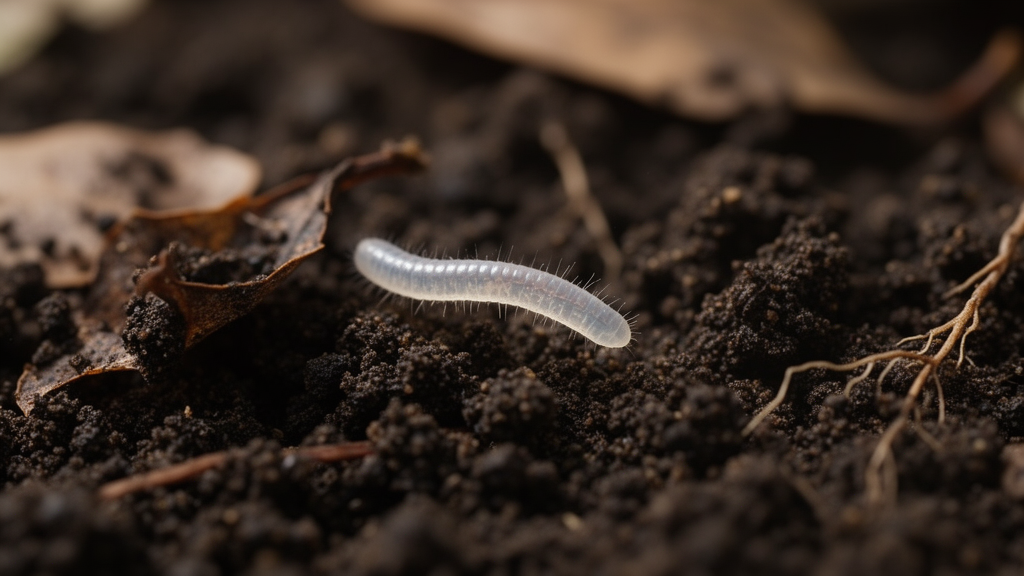
Deep in the surface soil of a Chinese farm field, a microscopic predator has been quietly going about its business, unknown to science. Researchers have now pulled it into the light, describing a brand-new species of single-celled eukaryote with a worm-shaped body, a row of granules studding its outer surface, and a genetic signature that is forcing taxonomists to rethink where its entire genus belongs in the tree of life. The creature, named Circinella granulifera, was isolated from soil collected in Ganzhou, Jiangxi Province, southeastern China, and its formal description appears in the journal ZooKeys.
The discovery matters because the group it belongs to, the hypotrich ciliates, is one of the most morphologically complex and taxonomically tangled lineages of ciliates. More than 1,200 hypotrich species have been catalogued worldwide, thriving in soil, freshwater, brackish water, and the sea, yet specialists widely agree that the real diversity is far greater than current counts suggest. Soil-dwelling stichotrichids, the subgroup to which the new species belongs, are considered especially poorly surveyed, meaning countless species likely remain undiscovered beneath our feet. Each new find, therefore, is not just a curiosity but a piece of a much larger evolutionary puzzle.
Circinella granulifera is a slender, almost impossibly narrow cell. In life it measures roughly 115 to 130 micrometers long and only 10 to 15 micrometers wide, giving it a length-to-width ratio of about 12 to 1. Its body is vermiform, meaning worm-like, with a narrowly rounded front end and a tapered rear portion that is consistently curved to the left. The cell is only slightly flattened from top to bottom in the frontal region, and it crawls slowly across the bottom of a culture dish. Under the microscope, the pellicle, the flexible outer covering, is studded with colourless cortical granules about 0.8 micrometers across, arranged in rows of varying lengths. Those granules are what give the species its name: granulifera, Latin for bearing granules.
Internally, the new ciliate is equally distinctive. Its genetic material is packaged into a chain of macronuclear nodules, on average 17 of them, globular to elongated and ellipsoidal, strung out in a row slightly left of the cell’s midline, along with two to five smaller micronuclei. A single contractile vacuole, the organelle that pumps out excess water, sits at mid-body near the left margin, pulsating at intervals of roughly 11 seconds and reaching about 6 micrometers in diameter when fully extended. The cytoplasm is colourless, dotted with lipid globules, irregular crystals, and highly refractive granules concentrated in the posterior portion of the cell.
The feeding apparatus is where the species reveals its most telling anatomical quirks. The adoral zone of membranelles, the band of fused cilia that sweeps food into the oral cavity, occupies only about one-tenth of the body length and is composed of 10 or 11 membranelles on average. Crucially, that zone is bipartite: three slightly enlarged frontal membranelles at the distal end are separated by a distinct gap from about seven ventral membranelles in the proximal portion. The cirral pattern, the arrangement of the tufts of fused cilia used for locomotion, is remarkably stable. Every specimen examined carried exactly three conspicuous frontal cirri and one buccal cirrus, a frontoventral row of about seven cirri, one left and one right marginal row with 36 to 55 and 48 to 70 cirri respectively, and a single dorsal kinety with about 17 dikinetids. Notably, the species lacks frontoterminal, midventral, transverse, and caudal cirri, features that matter greatly in hypotrich classification.
Describing a new ciliate species demands more than a quick glance. The team used light microscopy on live cells under bright field and differential interference contrast illumination, then applied protargol impregnation, a silver-protein staining technique that reveals the nuclear apparatus and the infraciliature, the precise underlying pattern of ciliary basal bodies. Measurements and counts were performed on 21 stained specimens at 1,000-times magnification, generating a detailed morphometric table covering body dimensions, nodule counts, cirri numbers, and more. The combination of a vermiform body, the bipartite adoral zone with its telltale gap, the single frontoventral row, and only one marginal row per side cleanly separates the new species from its three known congeners, Circinella arenicola, C. vettersi, and C. filiformis, each of which differs in body size, granule presence, membranelle counts, contractile vacuole numbers, or dorsal kinety counts.
To pin down the species’ evolutionary position, the researchers extracted DNA from a single washed cell, amplified the small subunit ribosomal RNA gene using the polymerase chain reaction, and sequenced it bidirectionally. The resulting sequence, 1,729 base pairs long with a guanine-cytosine content of 45.69 percent, was deposited in GenBank under accession number PZ538963. The team aligned it with 73 other hypotrich sequences and four euplotid outgroup species, producing a final matrix of 78 taxa and 1,796 nucleotide sites. Maximum likelihood analysis with IQ-TREE using 10,000 ultrafast bootstrap replicates and Bayesian inference with MrBayes produced topologies that were largely congruent, and sequence comparisons showed the new species differs from its eight closest molecular relatives by 10 to 56 nucleotide positions, corresponding to 96.3 to 99.3 percent sequence similarity.
The phylogenetic result was the study’s biggest surprise. Circinella granulifera clustered with Kahliella matisi with moderate to high support, forming a clade backed by 91 percent bootstrap support and a Bayesian posterior probability of 0.98. That sister-group relationship is significant because the genus Circinella has been a taxonomic orphan for decades. Since Foissner established it in 1994, various researchers have shuffled it among the Cladotrichidae, Orthoamphisiellidae, Amphisiellidae, and Gonostomatidae, or left it as incertae sedis, a label meaning its placement is unresolved. This study provides the first molecular data ever obtained for the genus, and the close relationship with Kahliella suggests Circinella should be assigned to, or is closely related to, the family Kahliellidae.
The morphological evidence lends weight to that assignment. Tuffrau established the Kahliellidae in 1979 based on the absence of transverse cirri, the presence of longitudinal rows of frontoventral cirri, more or less distinct marginal rows, and well-developed frontal cirri, a combination Circinella appears to fit. Yet complications remain. Berger has argued that the retention of parental cirri or dorsal bristles is a hallmark of kahliellids, and the type species Circinella arenicola retains no such structures during interphase. Moreover, SSU rRNA gene sequences of the type species of both genera are still unavailable, leaving their precise phylogenetic positions unresolved. The authors therefore provisionally place Circinella in the Kahliellidae while acknowledging it could represent an entirely new family serving as the sister group to the kahliellids.
For now, Circinella granulifera stands as a reminder that some of the least explored ecosystems on Earth are not remote jungles or abyssal trenches but the uppermost centimeters of ordinary soil. The researchers combined classical morphology, meticulous morphometrics, and modern molecular phylogenetics to give this tiny predator a name, a diagnosis, and a provisional address in the ciliate family tree. Future studies integrating morphological, morphogenetic, and molecular evidence will be needed to test whether Circinella truly belongs among the kahliellids or deserves a family of its own. Either way, the soil beneath a Chinese irrigation ditch has yielded a species that expands our picture of microbial diversity and demonstrates how much evolutionary history remains waiting to be sampled, sequenced, and understood.
Subject of Research: Discovery and phylogenetic analysis of Circinella granulifera, a new soil ciliate species from China
Article Title: Morphology and molecular phylogeny of a new soil stichotrichid ciliate, Circinella granulifera sp. nov. ( Alveolata , Ciliophora )
Article References: Liao, L., Song, H., & Hu, X. (2026). Morphology and molecular phylogeny of a new soil stichotrichid ciliate, Circinella granulifera sp. nov. (Alveolata, Ciliophora). ZooKeys, 1292, 127-139. https://doi.org/10.3897/zookeys.1292.205482
Image Credits: AI Generated
DOI: 10.3897/zookeys.1292.205482
Keywords: Morphology, molecular, phylogeny, soil, stichotrichid, ciliate, Circinella, granulifera, Alveolata, Ciliophora, scientific research
Cite Scienmag News
Gavin Prescott. (October 18, 2026). New Worm-Shaped Ciliate Species Discovered in Chinese Soil. Scienmag. https://scienmag.com/new-worm-shaped-ciliate-species-discovered-in-chinese-soil/
Gavin Prescott. "New Worm-Shaped Ciliate Species Discovered in Chinese Soil." Scienmag, 18 October 2026, https://scienmag.com/new-worm-shaped-ciliate-species-discovered-in-chinese-soil/. Accessed 18 October 2026.
Gavin Prescott. "New Worm-Shaped Ciliate Species Discovered in Chinese Soil." Scienmag. October 18, 2026. https://scienmag.com/new-worm-shaped-ciliate-species-discovered-in-chinese-soil/


