


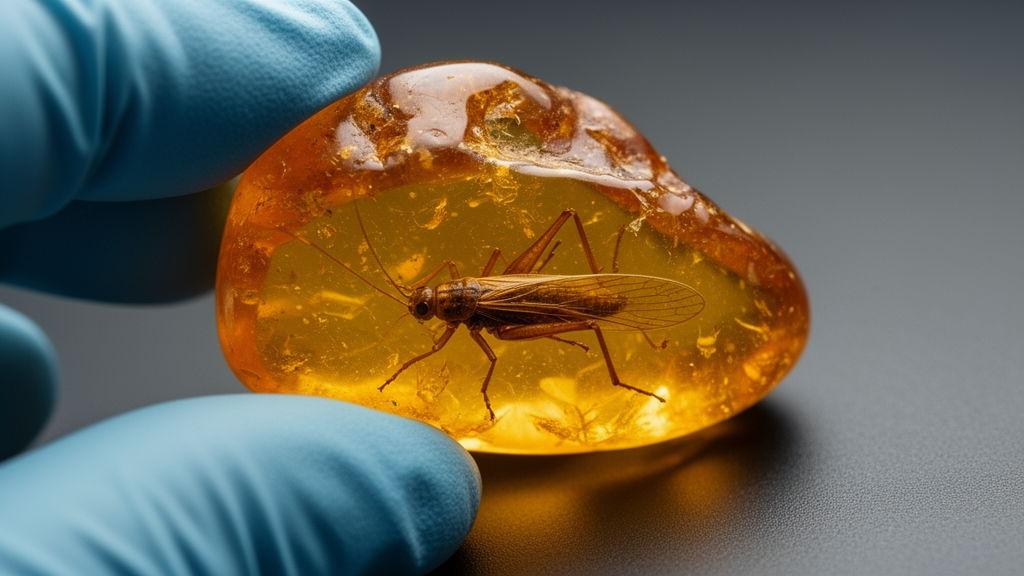
Scientists have described a bizarre new cricket preserved in mid-Cretaceous amber from northern Myanmar, and it is unlike any cricket known from the fossil record or the modern world. The tiny insect, formally named Fortigryllus xiangrui, lived roughly 99 million years ago during the late Albian to early Cenomanian stage of the Cretaceous period. What makes it extraordinary is not where it was found but how it was built: all three pairs of its legs are nearly equal in length and robustness, and the femora of each pair are exceptionally stout. That body plan contradicts the fundamental design of virtually every cricket that has ever lived.
Modern crickets, along with most of their orthopteran relatives, are built around a simple biomechanical principle: powerful hind legs. The hind femora are inflated with muscle to power explosive jumps, an escape strategy that has served the group for hundreds of millions of years. Mole crickets went the opposite direction, evolving shovel-like fossorial forelegs for digging while their hind legs became reduced. Wetas and their relatives in the family Gryllacrididae abandoned jumping altogether and crawl most of the time, with three pairs of legs nearly equal in size. Fortigryllus xiangrui appears to have converged on that crawling lifestyle, but in a lineage far removed from the modern raspy crickets, and at a time when dinosaurs still dominated terrestrial ecosystems.
The specimen itself is a small apterous insect, about 3.8 millimeters long from head to the deduced abdominal apex, embedded in a translucent yellow piece of amber collected from the Hukawng Valley in Kachin Province. The holotype, registered as NIGP208736, is housed at the Nanjing Institute of Geology and Palaeontology of the Chinese Academy of Sciences. The amber was legally collected from Tanai Township in June 2016, and the researchers spent years preparing and analyzing it, polishing the piece with progressively finer sandpaper and polishing powder to expose the fossil for study. Photographs were captured with a Zeiss Stereo Discovery V16 microscope system, combining roughly 35 to 50 individual focal planes into stacked composite images that reveal the three-dimensional structure of the specimen in remarkable detail.
Kachin amber has become one of the most important windows into Cretaceous life. Its age is constrained by biostratigraphy to the late Albian to early Cenomanian, and uranium-lead dating of zircon crystals in the associated volcanoclastic matrix puts a maximum age of 98.79 plus or minus 0.62 million years, placing it at the very beginning of the Cenomanian. The deposit has yielded an enormous diversity of arthropods, and crickets are no exception. Before the surge of amber discoveries, the Mesozoic fossil record of Gryllidea, the infraorder that includes true crickets and their closest relatives, was sparse, with most early specimens preserved as two-dimensional impression fossils that captured only limited anatomical detail. Amber inclusions changed that, preserving delicate three-dimensional structures that compression fossils simply cannot.
To date, 48 genera and 75 species of Cretaceous crickets have been recorded across eight families, including both extant lineages such as Gryllidae, Trigonidiidae, Mogoplistidae, Oecanthidae, Gryllotalpidae, and Myrmecophilidae, and extinct families like Protogryllidae and Baissogryllidae. The oldest known fossil cricket is Protogryllus grandis from the Late Triassic. But the new specimen stands apart from all of them. Its combination of features does not match any known family, leading the researchers to place it as family incertae sedis, meaning its precise familial position remains uncertain.
Several diagnostic characters do anchor Fortigryllus within Gryllidea. The presence of club-shaped setae, variable in size and irregularly distributed, on the inner basal part of the cerci is considered one of the apomorphies of the cricket clade. Similar structures occur in Stenopelmatidae, but there they are uniform in size and arranged in regular rows, a distinction that helps separate the two groups. Combined with three-segmented tarsi, these features firmly place the new fossil within the cricket infraorder. The specimen is likely an adult or at least a late-instar nymph, based on the presence of oval-shaped tympana on the forelegs, the hearing organs that crickets use to detect each other’s songs.
Ruling out candidate families required careful comparison. The fossil lacks the specialized digging forelegs of Gryllotalpidae, which bear two, three, or four claws on the fore tarsi, claws entirely absent in the new specimen. It lacks the oval body shape, extremely inflated hind femur, and pseudo-segmented erect cerci of Myrmecophilidae, the ant-loving crickets. Within Grylloidea, it cannot be assigned to Oecanthidae, which have a distinctive arrangement of apical spurs on the hind tibia and equal-sized basal tarsomeres on the fore and mid legs. Trigonidiidae are excluded because the fossil lacks subapical spurs and has only one apical spur on the metatibia. Mogoplistidae are ruled out by the absence of scales on the body and the lack of serrulations on the hind tibiae. Gryllidae typically have three apical spurs on the fore tibia, nearly hemispherical heads, and strong long hind tibial spurs, none of which match the new fossil.
The closest similarities lie with Phalangopsidae and Pteroplistidae, two families whose members often have relatively long legs and reduced apical spurs on the hind tibia. The new fossil shares two apical spurs on the fore tibia with both groups. One of the most striking characters of Phalangopsidae, as defined by Souza-Dias in 2015, is a scape as broad as the fastigium, the region between the antennal bases. In the new fossil the scape is slightly narrower than the fastigium, which is not an exact match. However, another proposed synapomorphy of Phalangopsidae, an apex of the last maxillary palpomere that is curved, is present in the fossil but absent in Pteroplistidae. Many but not all Phalangopsidae also have a broadened apical portion of that palpomere, which the fossil lacks, a condition the authors interpret as probably plesiomorphic. Taken together, the evidence suggests the new cricket could belong to the stem group of Phalangopsidae, though the authors emphasize this attribution remains tentative because the genitalia, crucial characters for convincing family-level placement in crickets, are not preserved in the specimen.
The functional morphology of the legs is where the story becomes truly intriguing. The fore femur measures 2.7 millimeters, the mid femur 2.1 millimeters, and the hind femur 3.1 millimeters on the left side, all conspicuously sturdy and covered with sparse setae. The hind femur is only slightly longer and stronger than the fore and mid femora, a proportion radically different from typical Grylloidea, where the metafemur is dramatically inflated. The authors note that this robustness is unlikely to be an artifact of preservation, because the specimen shows well-preserved articulated structures without signs of compression or deformation. Instead, the combination of relatively developed fore and midlegs with relatively undeveloped hindlegs parallels the condition seen in Gryllacrididae, leading the researchers to tentatively propose crawling as the primary mode of locomotion for this Mesozoic cricket.
This is not the first time Cretaceous insects have shown such unusual leg proportions. Spinoberotha mickaelacrai, a lacewing larva preserved in Lebanese amber, bore equally strong spines on all six legs adapted for catching prey, whereas its modern relatives use only the forelegs for that function. The Mesozoic Chresmodidae, often allied with Phasmatodea, developed extraordinary legs with up to 20 to 30 tarsomeres as an adaptation for skimming across water surfaces. These examples suggest that the Jurassic and Cretaceous periods were times of intense morphological experimentation among insects, and that only a fraction of the resulting body plans survived into the Cenozoic and persist in the modern fauna. Fortigryllus xiangrui, with its strange egalitarian legs and uncertain family ties, adds a new branch to that vanished diversity and hints at how much more remains to be discovered in the amber forests of the mid-Cretaceous.
Subject of Research: A newly described mid-Cretaceous cricket from Kachin amber with unusually robust legs on all three pairs
Article Title: A new weird cricket ( Orthoptera , Gryllidea ) from mid-Cretaceous Kachin amber in northern Myanmar
Article References: Ji, X., Nel, A., Xiao, C., Gorochov, A. V., Jarzembowski, E. A., Ma, Z., & Xu, C. (2025). A new weird cricket (Orthoptera, Gryllidea) from mid-Cretaceous Kachin amber in northern Myanmar. Fossil Record, 28(2), 219-230. https://doi.org/10.3897/fr.28.162805
Image Credits: AI Generated
DOI: 10.3897/fr.28.162805
Keywords: Kachin amber, Fortigryllus xiangrui, Gryllidea, Orthoptera, Cretaceous insects, paleontology, Myanmar amber, cricket evolution, fossil insects, locomotion, Phalangopsidae, mesofemur
Cite Scienmag News
Gavin Prescott. (October 18, 2026). Weird six-legged Cretaceous cricket preserved in amber crawled instead of jumping. Scienmag. https://scienmag.com/weird-six-legged-cretaceous-cricket-preserved-in-amber-crawled-instead-of-jumping/
Gavin Prescott. "Weird six-legged Cretaceous cricket preserved in amber crawled instead of jumping." Scienmag, 18 October 2026, https://scienmag.com/weird-six-legged-cretaceous-cricket-preserved-in-amber-crawled-instead-of-jumping/. Accessed 18 October 2026.
Gavin Prescott. "Weird six-legged Cretaceous cricket preserved in amber crawled instead of jumping." Scienmag. October 18, 2026. https://scienmag.com/weird-six-legged-cretaceous-cricket-preserved-in-amber-crawled-instead-of-jumping/


