


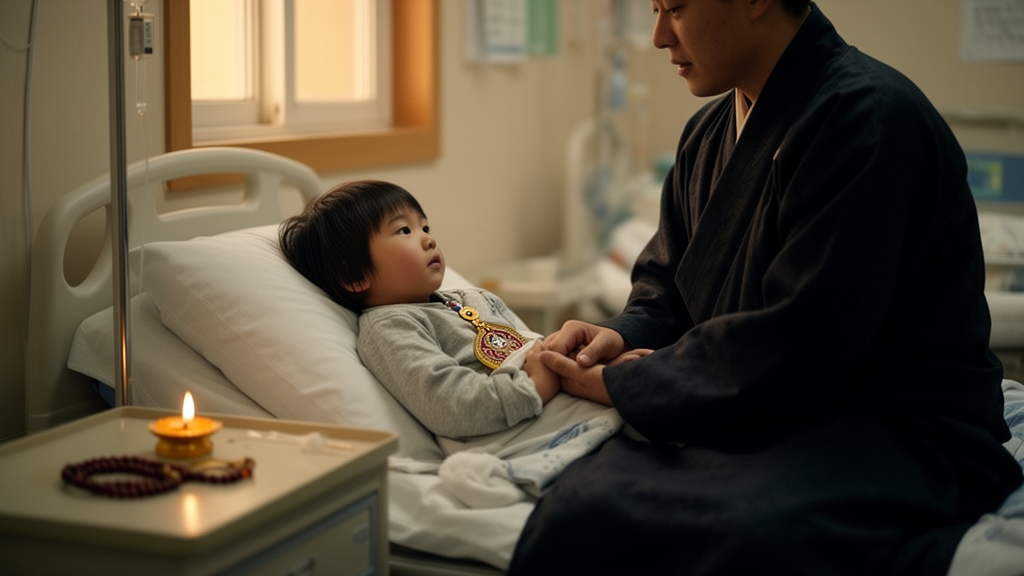
For a child undergoing treatment for leukemia or another blood cancer, pain is often the defining feature of hospitalization. But pain is never experienced in a vacuum. It is filtered through language, family, faith, and culture, and it is expressed in ways that clinicians may or may not recognize. A new study from Sichuan, China, offers one of the first detailed portraits of how Tibetan children with hematologic malignancies actually experience and communicate pain, and the picture it paints challenges some of the standard assumptions of pediatric pain assessment.
The study’s methodological choices deserve closer attention because they shape what the findings can and cannot tell us. Descriptive phenomenology, as adapted from Colaizzi’s framework, is designed to capture lived experience as participants themselves describe it, rather than to impose pre-existing categories or measure pain intensity on a numerical scale. In this case, the researchers worked with fifteen Tibetan children recruited from a single pediatric hematology-oncology ward in Sichuan between February and March 2026. Purposive sampling of this kind is standard for phenomenological work, since the goal is depth of understanding rather than statistical generalizability. What makes this study distinctive, however, is not the sample size but the deliberate adaptation of interview technique: rather than relying on conventional verbal questioning alone, the team used play-based, semi-structured face-to-face interviews. This matters enormously when working with children, whose capacity to articulate internal states is constrained by developmental stage, and doubly so when the children are navigating interviews in a language and clinical environment shaped by a culture different from their own.
The first theme, cultural and spiritual interpretations of pain, points to something that pediatric pain research has increasingly recognized but that clinical practice has been slow to absorb: pain is not merely a sensory signal to be rated on a scale. For many Tibetan children in the study, pain was understood through frames of silent endurance and religious or traditional coping. Silent endurance is particularly consequential in oncology settings. Modern pain management depends heavily on patients and families reporting pain so that analgesia can be titrated appropriately. A child who believes that enduring pain quietly is virtuous, or who interprets suffering through a spiritual lens that discourages complaint, may systematically under-report pain. This creates a real risk of undertreatment, which in pediatric hematology-oncology is not a trivial matter. Poorly controlled pain in children has been associated in the broader literature with short-term distress and with longer-term consequences, including heightened pain sensitivity and fear of medical procedures later in life. The study’s finding suggests that nurses and physicians working with Tibetan children should not assume that the absence of complaint equals the absence of pain.
The second theme, linguistic and communicative constraints, adds a practical layer to this problem. The children in the study faced limited Mandarin vocabulary for describing pain and tended to express discomfort indirectly. China’s clinical environment, particularly in major referral hospitals, operates predominantly in Mandarin, while many Tibetan children grow up speaking Tibetan at home. Pain vocabulary is notoriously difficult even within a shared language; children typically acquire pain descriptors gradually, and abstract terms like aching, throbbing, or stabbing may not map cleanly onto words in another language. When a child must translate bodily sensation from Tibetan into Mandarin, and then compress that translation into vocabulary appropriate for a young age, the resulting report may be vague, delayed, or conveyed through behavior rather than words. Indirect expression, such as describing a symptom through its effect on play or appetite rather than naming the pain itself, requires clinicians to listen for meaning rather than waiting for a direct statement. The study’s authors suggest that pain assessment in this population may benefit from child-centered communication and attention to nonverbal cues, which aligns with established best practice in pediatric pain measurement, where observational and behavioral tools supplement self-report for younger children.
The third theme, the family-centered dimension of pain, resonates with a well-documented feature of pediatric care but takes on particular cultural texture here. The children described emotional security through family presence, relational continuity through family accompaniment, and comfort drawn from familiar family-based practices. In pediatric oncology across many settings, family presence at the bedside is associated with reduced distress, better coping with procedures, and improved communication of symptoms. But the study suggests something more specific: for these Tibetan children, family members were not merely comforting presences but active participants in the pain experience itself, serving as interpreters, advocates, and providers of culturally familiar comfort practices. This has operational implications. Hospital policies that restrict visitation, or assessment protocols that interview children in isolation from family members, may inadvertently strip away a key layer of the child’s coping resources. At the same time, clinicians must balance the value of family accompaniment against the need to hear the child’s own account, since family members may filter or reframe a child’s pain reports in ways that reflect their own cultural interpretations.
The fourth theme extends the picture beyond the hospital ward. The children described disrupted schooling and loss of peer contact, along with worries about illness disclosure and social isolation. This dimension of the pain experience is sometimes labeled psychosocial, but the study’s framing treats it as integral to how pain is lived rather than as a separate category. For a child with a hematologic malignancy, hospitalization interrupts the developmental work of school attendance, friendship, and identity formation. Concerns about who will learn about the illness, and how classmates will respond, add a social dimension to suffering that can amplify the experience of physical pain or make children reluctant to report symptoms that might extend their hospital stay. Research on childhood cancer more broadly has consistently identified peer disconnection and school disruption as major sources of distress, and the present study suggests these concerns are intertwined with how pain itself is communicated and endured.
Taken together, the four themes sketch a model in which pain for these children is simultaneously a bodily sensation, a moral and spiritual matter, a linguistic challenge, a family event, and a social disruption. No single assessment tool captures all of these dimensions. Standard pediatric pain scales, whether self-report faces scales or observational measures, are designed to quantify intensity, not to surface the interpretive frameworks through which a child understands suffering. The study’s conclusion that culturally responsive assessment should attend to indirect and nonverbal expression, and to the supportive role of family, is therefore not simply a call for politeness or cultural sensitivity as an add-on. It is a claim that the standard instruments and routines of pain assessment may systematically misread children whose cultural and linguistic backgrounds differ from the assumptions embedded in those tools.
It is worth noting what a descriptive phenomenological study of fifteen children in one ward can and cannot establish. The findings are not prevalence estimates; they do not tell us how common silent endurance or indirect expression is among Tibetan children with cancer in general, nor can they be generalized to other ethnic minority populations in China or elsewhere. What they offer is a carefully documented account of lived experience that can generate hypotheses for quantitative testing and, more immediately, inform the design of assessment practices, interpreter involvement, family accommodation policies, and nursing education in pediatric hematology-oncology settings that serve Tibetan and other minority-language children. The study also joins a small but growing body of literature on culturally responsive pediatric pain care, a field in which most published instruments and protocols have been developed in Western, English-speaking contexts and validated elsewhere only unevenly.
For clinicians, the practical takeaways are concrete. Ask children about pain in ways that allow indirect answers; watch behavior rather than relying solely on verbal report; involve family members as partners while still seeking the child’s own voice; and recognize that a quiet, stoic child may be enduring significant pain rather than experiencing none. For researchers, the study opens questions about whether similar patterns of silent endurance and indirect expression appear in other cultural groups, how play-based interview methods can be standardized and scaled, and whether culturally adapted pain assessment tools improve outcomes such as analgesic adequacy and child-reported distress. For the children themselves, whose voices the study deliberately centers, the message is that pain is not only what a scale says it is, and that being understood requires those around them to attend to language, faith, family, and friendship as much as to the pain itself.
Subject of Research: Pain experiences of Tibetan children with hematologic malignancies in China
Article Title: Pain experiences of Tibetan children with hematologic malignancies in China: A descriptive phenomenological study
Article References: Chen, Y., Liu, Y., Zhou, J., Pu, H., & Zhang, J. (2026). Pain experiences of Tibetan children with hematologic malignancies in China: A descriptive phenomenological study. PLOS One, 21(10), e0360911. https://doi.org/10.1371/journal.pone.0360911
Image Credits: AI Generated
DOI: 10.1371/journal.pone.0360911
Keywords: pain, Tibetan children, hematologic malignancies, pediatric oncology, phenomenology, cultural competence, pain assessment, nursing care, China, qualitative research, experiences, Tibetan
Cite Scienmag News
Nathaniel Bowman. (October 18, 2026). Tibetan Children With Blood Cancers Describe Pain Through Silence, Faith, and Family. Scienmag. https://scienmag.com/tibetan-children-with-blood-cancers-describe-pain-through-silence-faith-and-family/
Nathaniel Bowman. "Tibetan Children With Blood Cancers Describe Pain Through Silence, Faith, and Family." Scienmag, 18 October 2026, https://scienmag.com/tibetan-children-with-blood-cancers-describe-pain-through-silence-faith-and-family/. Accessed 18 October 2026.
Nathaniel Bowman. "Tibetan Children With Blood Cancers Describe Pain Through Silence, Faith, and Family." Scienmag. October 18, 2026. https://scienmag.com/tibetan-children-with-blood-cancers-describe-pain-through-silence-faith-and-family/


