


Walking down a corridor while subtracting sevens from one hundred sounds like a party trick, but it is one of the most demanding computations the human brain performs routinely. Mental arithmetic while moving forces the prefrontal cortex, parietal quantity systems, and motor planning regions to share a limited pool of neural resources in real time. When those resources run short, performance collapses into the well-known dual-task cost, a phenomenon that grows dramatically in aging and neurodegenerative disease. Now a team at Huashan Hospital of Fudan University reports that a form of noninvasive brain stimulation capable of reaching deeper cortical networks can measurably expand that computational throughput in healthy young adults, while leaving accuracy intact.
The study, published in the open-access journal iScience, combined deep transcranial magnetic stimulation, or DTMS, with intermittent theta burst stimulation, an excitatory patterned protocol known as iTBS. Unlike conventional TMS, which uses a figure-of-eight coil to focus stimulation on a small patch of superficial cortex, DTMS employs specialized H-coils whose magnetic fields spread across broader cortical and subcortical territory. The H7 coil used in the trial engages the bilateral prefrontal cortex and the anterior cingulate cortex simultaneously, two regions that anchor executive control and conflict monitoring. Pairing this wide-field engagement with iTBS, which mimics endogenous theta-gamma coupling and efficiently induces synaptic plasticity in under four minutes, offered the researchers a way to modulate an entire distributed network rather than an isolated hotspot.
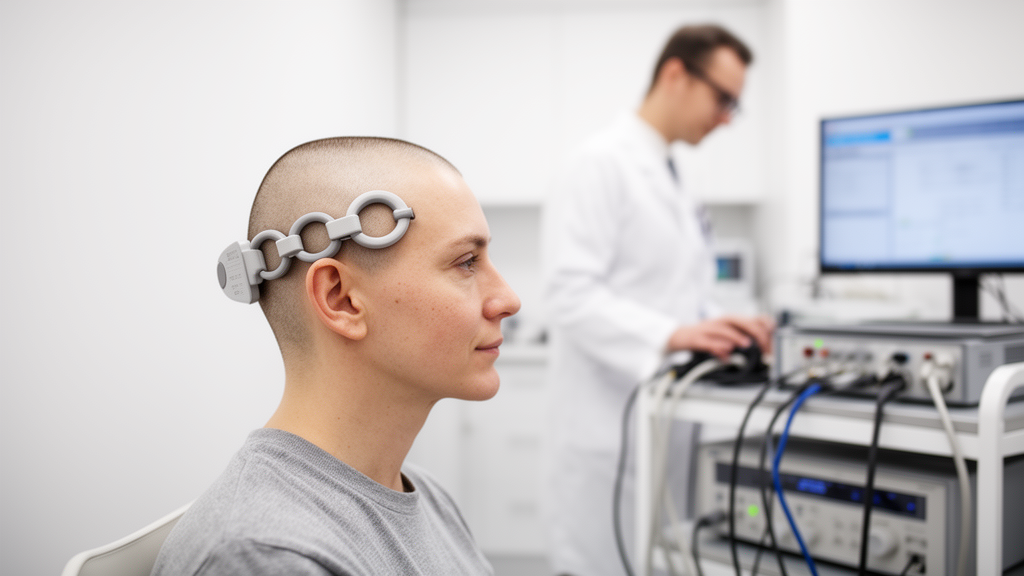
Nineteen right-handed healthy adults, seven men and twelve women with a mean age of about twenty-five, completed the randomized crossover trial. Each participant received both active stimulation and a sham condition in separate sessions separated by a two-week washout, with the order counterbalanced and assignments concealed in sealed envelopes. Before and after each intervention, the researchers recorded cortical hemodynamics with a portable functional near-infrared spectroscopy, or fNIRS, device. The sensor packed twenty-four light sources and sixteen detectors into fifty-two channels covering fourteen regions of interest, from the dorsolateral prefrontal cortex through primary and secondary motor areas to somatosensory and parietal language regions. Resting-state signals were captured over eight minutes, followed by a three-minute dual-task test in which participants walked at a comfortable pace, turned to avoid obstacles, and answered oral serial subtraction questions posed by the experimenters.
The behavioral result was striking. In a mixed-effects model controlling for baseline performance, the increase in the number of completed calculations was significantly greater after active DTMS than after sham stimulation, with a treatment effect of F(1,17) = 12.546 and p = 0.003. Participants who averaged roughly forty-eight calculations before stimulation completed about fifty-nine afterward, a jump of nearly eleven problems in three minutes. No significant period or sequence effects emerged, ruling out simple practice or ordering artifacts. Accuracy, already above ninety percent at baseline, did not differ significantly between conditions, though a trend favored active stimulation. The authors argue that a ceiling effect on correctness limited sensitivity, and that the gain in throughput therefore reflects improved processing efficiency rather than a speed-accuracy trade-off.
The neurovascular data told a complementary story. During the dual-task condition, mean oxygenated hemoglobin, or HbO, concentration rose significantly more after DTMS than after sham in the right secondary motor cortex, which encompasses the premotor and supplementary motor areas, and in the left somatosensory association cortex, with p values of 0.022 and 0.033 respectively. Deoxygenated hemoglobin fell significantly in the right secondary motor cortex, consistent with elevated neural activation. Whole-brain waveforms showed overall greater cortical activation following active stimulation, while resting-state activation did not differ between conditions. The authors interpret this task-specific pattern through the lens of state-dependent plasticity, the principle articulated by Silvanto and Pascual-Leone that neuromodulatory effects require specific brain states, such as task activation, to be expressed. The synaptic changes induced by iTBS may lie dormant until the network is recruited by actual cognitive-motor demand.
Correlation analyses added mechanistic texture. Changes in calculation quantity were positively correlated with HbO changes in the left secondary motor cortex and negatively correlated with activation in the right Wernicke area, the parietal region corresponding to the right supramarginal gyrus. Accuracy improvements rose with bilateral secondary motor cortex activation but declined with greater activation in the right primary motor cortex and right Wernicke area. Under the neural efficiency hypothesis, efficient networks activate critical regions precisely while suppressing interfering ones. The serial subtraction task is language-dependent and left-lateralized, so fluent performance plausibly demands focused allocation to the left language-motor circuit while suppressing right-hemisphere vigilance and error monitoring signals that would otherwise divert attention.
Perhaps the most intriguing finding concerns the secondary motor cortex as a relay station. After DTMS, interhemispheric activation correlations between the left and right dorsolateral prefrontal cortex, secondary motor cortex, and somatosensory association cortex were particularly strong, suggesting that excitatory stimulation may reduce interhemispheric inhibition and shift homologous regions from alternating suppression toward synchronous excitation. Left prefrontal and posterior parietal activation rose in parallel, and left secondary motor cortex hemodynamics increased alongside both. The authors propose that DTMS under the iTBS protocol strengthens the frontoparietal network, with the secondary motor cortex functioning as a transitional hub that transforms abstract cognitive commands from the prefrontal cortex and concrete sensory information from the parietal cortex into coordinated motor output. This bridging role is especially prominent in the left hemisphere, where the language and motor systems converge.
Exploratory functional connectivity analyses revealed several DTMS-induced changes, including enhanced connectivity between the left Broca area and right prefrontal, primary motor, and secondary motor regions during the dual task, but none survived false discovery rate correction, so the authors treat these as preliminary observations rather than definitive evidence of network reorganization. Baseline comparisons did show, after correction, that dual-task functional connectivity was significantly lower than resting-state connectivity, a pattern consistent with the neural efficiency hypothesis but also with alternative explanations such as task-dependent network segregation. Additional hemodynamic features indicated that cortical HbO response speed accelerated significantly in the bilateral prefrontal cortex and right Broca area after stimulation, and HbR response speed increased in several regions, with integral values mirroring mean concentration changes and confirming task-related activation levels.
The study has clear limits that the authors acknowledge candidly. There were no separate single-task walking or single-task calculation conditions and no quantitative gait measures, so the hemodynamic responses reflect combined cognitive and motor processes rather than isolated mechanisms. fNIRS captures cortical signals only, so the findings cannot directly establish whether DTMS modulates subcortical functional connectivity, even though prior work shows the H7 coil reaches the anterior cingulate. Blinding was procedural rather than formally verified, and the modest sample size of nineteen demands replication. Long-term effects of repeated deep stimulation on deep brain tissue, including glial responses and chronic inflammation, remain unexplored and warrant longitudinal multimodal imaging studies.
Even so, the trial offers a compelling proof of concept that a single session of wide-field excitatory neuromodulation can expand the computational capacity available for walking-and-thinking behavior in healthy brains, without degrading correctness. Because dual-task impairment tracks fall risk, reduced mobility, and cognitive decline in aging and neurological disorders, establishing a baseline framework in healthy adults is a prerequisite for translational work. If the state-dependent plasticity principle holds in older or clinical populations, future protocols might time stimulation to coincide with task engagement, individualize coil positioning, and combine larger cohorts with multimodal neuroimaging to determine whether the frontoparietal-secondary motor relay can be reliably strengthened. For now, the image of a brain that computes faster on its feet after a few minutes of patterned magnetic pulses is a vivid demonstration of how far noninvasive network modulation has traveled from the single-hotspot era.
Subject of Research: Neuroscience
Article Title: Deep TMS modulates neurovascular responses and enhances dual-task computation in healthy adults
Article References: Zeng, B., Wang, W., Ding, Z., Wang, C., Li, C., Yuan, R., Zhou, B., & Zhu, Y. (2026). Deep TMS modulates neurovascular responses and enhances dual-task computation in healthy adults. iScience, 29(11), Article 117586. https://doi.org/10.1016/j.isci.2026.117586
Image Credits: AI Generated
DOI: 10.1016/j.isci.2026.117586
Keywords: deep TMS, dual-task, fNIRS, neuromodulation, frontoparietal network, motor cortex, cognitive-motor integration, Deep, modulates, neurovascular, responses, enhances
Cite Scienmag News
Cassandra Pierce. (October 18, 2026). Deep brain stimulation coil boosts walking math power in healthy adults. Scienmag. https://scienmag.com/deep-brain-stimulation-coil-boosts-walking-math-power-in-healthy-adults/
Cassandra Pierce. "Deep brain stimulation coil boosts walking math power in healthy adults." Scienmag, 18 October 2026, https://scienmag.com/deep-brain-stimulation-coil-boosts-walking-math-power-in-healthy-adults/. Accessed 18 October 2026.
Cassandra Pierce. "Deep brain stimulation coil boosts walking math power in healthy adults." Scienmag. October 18, 2026. https://scienmag.com/deep-brain-stimulation-coil-boosts-walking-math-power-in-healthy-adults/


