


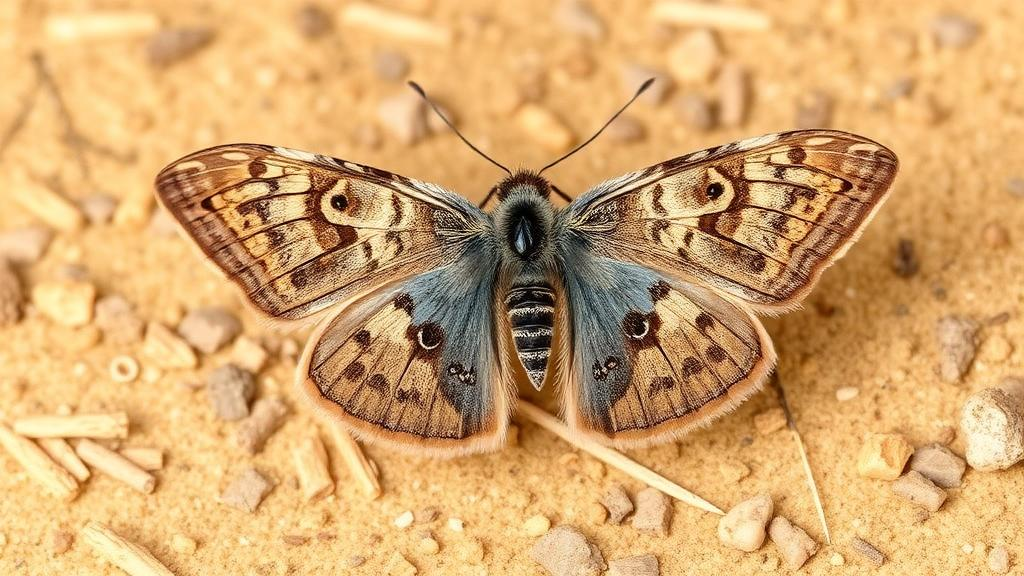
On the sun-baked shores of Cyprus, where salt lakes glitter beside juniper scrub and the autumn air still carries the warmth of the Mediterranean summer, a small brown moth has been hiding in plain sight. Scientists have now formally identified it as a species entirely new to science: Eupithecia conquesta, a delicate member of the geometer moth family Geometridae, described in the journal Nota Lepidopterologica by Finnish lepidopterists Jukka Tabell and Jari Junnilainen. The discovery is more than a footnote in taxonomy. It marks the first known endemic Eupithecia species on any eastern Mediterranean island, a distinction previously reserved for the western basins of that ancient sea.
Eupithecia is a genus of superlatives. With roughly 1,400 described species and some 2,100 named taxa worldwide, it is the most species-rich genus in the entire family Geometridae, and one of the largest genera of moths anywhere on Earth outside Antarctica. These are small insects, typically with wingspans between 12 and 30 millimetres, dressed in understated shades of brown, grey and black. Their caterpillars are equally unassuming but biologically unusual: unlike most geometrid larvae, which chew leaves, Eupithecia caterpillars tend to feed on flowers and seeds of their food plants. That quirky life history, combined with the genus’s bewildering wing patterns, has made Eupithecia a notoriously difficult group for field identification.
The story of the new species began, fittingly for its Latin name, with a purchase. Tabell acquired a small batch of specimens from Hungarian collector Attila Szabó to obtain reference material for ongoing studies. Among them was a single male from Cyprus that looked, on the surface, very much like Eupithecia phoeniceata, a species already known from the island and illustrated in a 2003 monograph of the genus. But wing patterns in this genus are famously treacherous guides to identity. When Tabell dissected the specimen and examined its male genitalia under the microscope, the structures revealed differences too pronounced to dismiss. The case was sealed when Junnilainen dissected a female from his own collection: its genitalia were unmistakably those of something else. DNA barcoding then confirmed what morphology had suggested. The Cypriot moths were genetically distinct from every other Eupithecia species on record.
The formal description rests on a series of specimens from two Cypriot localities. The holotype, a male, was collected about 1.5 kilometres north of Peyia in the Paphos district in November 2021, at roughly 400 metres above sea level. Paratypes came from the same site and from the salt lake at Akrotiri near Limassol, where Junnilainen swept dozens of individuals in late October and early November 2019. In total, the type series spans males and females from both localities, all captured in autumn. The holotype is deposited in the Finnish Museum of Natural History in Helsinki, where it has been digitized and given a unique QR identifier under the museum’s open access policy, while paratypes reside in the private research collections of the authors and Szabó.
Diagnosing a new Eupithecia species demands a two-pronged approach: morphology and molecules. Externally, E. conquesta is most similar to E. oxycedrata, another Mediterranean member of the genus. Compared with that species, the new moth’s forewing is paler and more uniform, the wedge-shaped area between the antemedial and medial lines is not or only slightly darker than the rest of the wing, and the medial line angles inwards near the inner margin rather than outwards. Against E. phoeniceata, the antemedial and medial lines of E. conquesta are less oblique and the wedge-shaped area is present rather than absent. The wingspan of the new species ranges from 16.5 to 20.0 millimetres, with pale brown elongate forewings, a small rounded discal spot, and chequered fringes on all wings.
The genitalia tell a more decisive story. In the male, E. conquesta resembles E. phoeniceata, but the uncus is slightly longer, the gnathos is narrower and parallel-sided rather than rounded, the valva is broader with a slightly concave lateral margin, and the juxta is wider. Most tellingly, the vesica, the eversible internal sac of the aedeagus, bears three long cornuti, the barbed structures used in mating, whereas E. phoeniceata has only two, and the basal diverticulum is tiny rather than large. The female genitalia, by contrast, are closer to those of E. oxycedrata, but the colliculum is narrower than the bursa copulatrix, the bursa itself is markedly longer, the robust spines are shorter, and the base of the corpus bursae is spineless. This mosaic of affinities, wing pattern and female genitalia aligning with one species, male genitalia and barcodes with another, is exactly the kind of conflicting signal that makes Eupithecia such a challenging genus and such a rewarding one for taxonomists.
The molecular evidence is unambiguous. Tabell and Junnilainen sent tissue samples from four specimens to the Canadian Centre for DNA Barcoding, which sequenced the 658-base-pair fragment of the mitochondrial COI gene, the standard DNA barcode for animals. The resulting barcodes, between 652 and 653 base pairs, showed no intraspecific variation at all among the four Cypriot samples. The nearest neighbour on the Barcode of Life Data Systems database, the vast international reference library of barcodes, is E. phoeniceata, with a minimum genetic divergence of 4.07 percent. The distance to E. oxycedrata is 5.94 percent, and divergences to other members of the E. interruptofasciata species group, which comprises 14 species in Europe, two in northern Africa, four in Asia and two in North America, range from roughly 4.9 to 6.9 percent. In the world of DNA barcoding, where sister species often differ by as little as 2 percent, these gaps are substantial and clearly separate E. conquesta as an independent evolutionary lineage. The new species has been assigned its own Barcode Index Number, BOLD:AFC0556, and its barcodes are publicly available through the BOLD dataset DS-EUPCYP.
The discovery carries biogeographic weight. Cyprus is the most eastern of the Mediterranean islands, and its Eupithecia fauna was considered well explored, with 12 species documented through decades of study by researchers including Hausmann, Mironov, and Fischer and Lewandowski. Most of those species show Mediterranean distribution ranges. Until now, no endemic Eupithecia taxa were known from any eastern Mediterranean island, in stark contrast to the western Mediterranean, where three narrowly endemic species occur: E. lentiscata on Corsica, Sardinia and in southern Greece; E. sardoa on Corsica, Sardinia and Mallorca; and E. poecilata on Corsica and Sardinia. E. conquesta breaks that pattern, suggesting that the eastern Mediterranean islands may harbour more hidden endemism than their well-trodden landscapes have revealed. With the new species included, 13 Eupithecia species are now known from Cyprus.
Little is known about the biology of the new moth. All specimens were captured between late September and mid-November, at salt lakeshores dotted with Juniperus shrubs and other low vegetation. The caterpillars of its closest relatives offer clues: E. phoeniceata larvae feed on the needles of Juniperus phoenicea, Hesperocyparis macrocarpa and Cupressus sempervirens, while E. oxycedrata larvae feed on Juniperus oxycedrus. It seems plausible that E. conquesta caterpillars likewise browse on juniper or cypress needles, but the life history of the new species remains undocumented, waiting for field ecologists to trace its caterpillars through the Cypriot scrubland.
The species name itself is a wink at its own origin story. Derived from the Latin conquestō, meaning purchase, it refers to the fact that the first specimen studied was bought rather than field-collected, a reminder that even specimens passing through the commercial trade can conceal major discoveries. Known so far from only two localities on Cyprus, E. conquesta joins a growing roster of species described through the combined power of classical morphology and molecular barcoding. For a genus with some 1,400 species and counting, the message is clear: the age of discovery is far from over, and sometimes a new species is waiting in a purchased envelope, on a Mediterranean salt lake, or in a drawer mislabelled for decades.
}
Subject of Research: New Eupithecia moth species from Cyprus
Article Title: Eupithecia conquesta Tabell & Junnilainen, a new species from Cyprus ( Lepidoptera , Geometridae , Larentiinae )
Article References: Tabell, J., Junnilainen, J., & Sihvonen, P. (2024). Eupithecia conquesta Tabell & Junnilainen, a new species from Cyprus (Lepidoptera, Geometridae, Larentiinae). Nota Lepidopterologica, 47, 11-18. https://doi.org/10.3897/nl.47.114137
Image Credits: AI Generated
DOI: 10.3897/nl.47.114137
Keywords: Eupithecia conquesta, Cyprus, Geometridae, Lepidoptera, DNA barcoding, taxonomy, endemic species, Mediterranean fauna, genitalia morphology, BOLD database, species discovery, Larentiinae
Cite Scienmag News
Gavin Prescott. (October 18, 2026). Eupithecia conquesta Tabell & Junnilainen, a new species from Cyprus (Lepidoptera, Geometridae, Larentiinae). Scienmag. https://scienmag.com/eupithecia-conquesta-tabell-junnilainen-a-new-species-from-cyprus-lepidoptera-geometridae-larentiinae/
Gavin Prescott. "Eupithecia conquesta Tabell & Junnilainen, a new species from Cyprus (Lepidoptera, Geometridae, Larentiinae)." Scienmag, 18 October 2026, https://scienmag.com/eupithecia-conquesta-tabell-junnilainen-a-new-species-from-cyprus-lepidoptera-geometridae-larentiinae/. Accessed 18 October 2026.
Gavin Prescott. "Eupithecia conquesta Tabell & Junnilainen, a new species from Cyprus (Lepidoptera, Geometridae, Larentiinae)." Scienmag. October 18, 2026. https://scienmag.com/eupithecia-conquesta-tabell-junnilainen-a-new-species-from-cyprus-lepidoptera-geometridae-larentiinae/


