


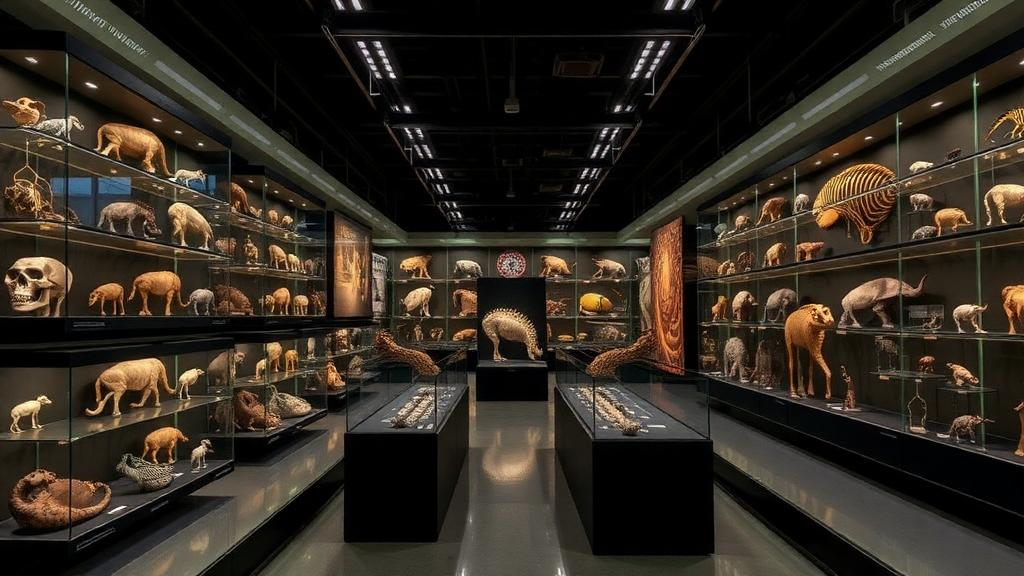
Natural history museums have always been repositories of the past, but a quiet revolution is transforming them into engines of large-scale data science. Billions of specimens, most gathered over the past two to three centuries, collectively form an unparalleled record of global biodiversity. When fossils and geological objects are included, these collections reflect hundreds of millions or even billions of years of evolutionary history. Many specimens were collected decades or centuries ago, serving as snapshots of ecosystems before the onset of significant human impact. Others are rare or irreplaceable, originating from inaccessible regions or representing species that are now threatened or extinct and cannot, or should not, be collected again. Their academic and societal value keeps growing as human-driven environmental change accelerates and biodiversity loss proceeds at an unprecedented pace.
For most of their history, collections served taxonomy, systematics, and biodiversity studies. In recent years, however, the scope of research built on museum material has expanded dramatically into evolutionary biology, ecology, epidemiology, environmental research, and molecular biodiversity assessment. The driver is methodological: researchers can now generate genome-level DNA sequence data from century-old specimens, produce high-resolution 2D and 3D imaging, and integrate these outputs with external databases. Progress in bioinformatics has made it possible to quantitatively analyze these complex datasets, bridging museum research with other disciplines. Many of these techniques fall under the umbrella of so-called -omics approaches, originally developed in molecular biology, and their migration into the museum realm has spawned a proliferation of neologisms that are often used loosely and interchangeably.
Genomics has arguably been the primary driver of modern collection-based research. DNA extraction from degraded material has been performed successfully since the 1980s, and two developments pushed the field forward. First, museums established cryogenic collections of tissues and DNA, providing high-quality genomic material for future research. Second, next-generation sequencing technologies opened vast historical collections to genomic analysis by enabling the study of low-quality and low-quantity DNA, aiming at whole genomes. Specialized protocols now allow the analysis of formalin-fixed material, previously inaccessible due to preservation-induced chemical alterations, expanding research possibilities to marine invertebrates, fish, and amphibians. Laboratory protocols tailored to short and single-stranded DNA fragments, combined with sequencing techniques, enable the recovery of usable genetic information from even minute amounts of highly fragmented historical DNA. Recent bioinformatic advances can detect and correct for degradation and contamination, both of which can otherwise confound biological interpretation.
Literature on museomics distinguishes different sources of DNA that differ in quality, quantity, and degradation. The most general term, archival DNA, refers to all DNA stored in museum collections, including tissue and cryogenic resources. Ancient DNA denotes genetic material from organically preserved organisms that died under natural circumstances and were later recovered in the field, such as subfossils and environmental deposits; it is typically found only in trace amounts, heavily degraded, and often more than 200 years old, sometimes dating back hundreds of thousands of years. Historical DNA, by contrast, comes from preserved biological specimens that were alive at the time of collection and stored without consideration of molecular analysis. Both present methodological challenges addressed by different lab standards, since environmental exposure and museum preservation methods each shape post-mortem damage in characteristic ways.
Against this backdrop, researchers at the Natural History Museum Vienna have published a comprehensive overview in the journal Natural History Collections and Museomics, examining the most commonly used key terms, their conceptual interrelations, and a literature-based survey of their usage. Their central recommendation is a three-level hierarchical framework: museomics for analytical approaches using biomolecules from museum specimens, the extended specimen concept for linking voucher specimens with diverse physical, digital, and contextual information, and collectomics for connecting extended specimen data with quantitative datasets from other research domains. A key prerequisite for this linkage is the unambiguous assignment of data to the corresponding specimen through a Persistent Identifier.
The survey, based on a formalized search of the Web of Science Core Collection, revealed how rapidly the field has grown. From 271 initial hits, 223 relevant publications across 107 journals remained after removing entries where terms were used in clearly different contexts. Museomics clearly dominated with 146 hits, three times more often than museum genomics and collection genomics combined. Usage of these terms has risen markedly only during the past five years, with museomics surging after 2018. The highest number of publications appeared in Molecular Ecology Resources and Molecular Phylogenetics and Evolution, followed by Frontiers in Ecology and Evolution, Systematic Biology, and Ecology and Evolution. Most publications dealt with evolutionary biology and environmental sciences and ecology, while a substantial share in biochemistry and molecular biology indicates ongoing development of new methods. A hand-curated qualitative assessment showed that the vast majority of museomics studies applied shotgun sequencing and target enrichment, either for whole genome analyses of organelles such as mitochondria and plastids or for sequencing ultraconserved elements for phylogenetic inference, with most studies focusing on insects, plants, or vertebrates.
Conceptually, the authors advocate using museomics as the technical term for all research investigating genetic data or other biomolecules from museum specimens of any age, encompassing proteomics, transcriptomics, metabolomics, and specialized bioinformatic tools alongside genomics. The term was first introduced in 2008 in reference to the extinct mammoth Adamy, describing the large-scale analysis of the DNA content of museum collections. Because focal specimens are often old, fragile, and irreplaceable, standard molecular protocols are frequently adapted to be less or non-destructive. The extended specimen concept, which originated in ornithology as a constellation of specimen and data types that jointly add research value to each other, positions the biological museum object at the center while digitally linking layers of data from genetics, morphology, geography, and ecology to less commonly integrated aspects such as host-parasite relationships, collection expeditions, or colonial provenance. Related terms include cybertype and cyberspecimen for digital counterparts of physical specimens, and the digital extended specimen, defined as the collective representation on the internet of all digital assets referring to a physical specimen. Neither extended specimens nor their digital replicas are intended to replace physical objects but to add value by conferring superior access to data networks.
Collectomics, first formulated collaboratively by German federal research museums with the Senckenberg Gesellschaft für Naturforschung playing a leading role, refers to the large-scale digital and molecular analysis of natural history collections emphasizing a holistic, collection-wide perspective. It integrates specimen metadata, digitized images, genomic data, and associated environmental, ecological, and historical information, seeking to utilize the collectome, the totality of all extended specimens and their associated data. The term has not yet gained widespread acceptance internationally, but the underlying vision is crucial for integrating collection-based objects with large-scale datasets like climate, land-use, historical, or ethnographic data to tackle global challenges of the Anthropocene. To harness the wealth of information stored in museum collections, data must be digitized and made publicly available following FAIR and CARE principles. As of now, only a small fraction of natural history collections has been properly digitized, and highly enriched data such as genetic or tomographic data are available for only a tiny subset, making this a huge and complex task requiring further investment in infrastructure and specialized personnel.
The authors also emphasize an often-neglected aspect: the acquisition of new material. Cryogenic collections help store genomic resources for future generations, but natural history collections also serve as repositories of newly collected specimens used in scientific research. Keeping these as vouchers ensures reproducibility, for example in the form of DNA barcode reference vouchers whose species identification can be verified by taxonomic experts, while simultaneously representing extended specimens already enriched with additional data that directly contribute to collectomics. At the Natural History Museum Vienna, this vision is being implemented through museomics approaches ranging from DNA barcoding to shotgun sequencing of historical DNA, the Austrian Barcode of Life project coordinated by the museum, and the national OSCA consortium for digitizing Austrian collections. The museum is setting up OSCA as the national node for the European Research Infrastructure DiSSCo and building an institutional collection database based on the Darwin Core data standard, which integrates digital copies of collection items with metadata catalogues and provides an OAI-PMH API for integration into national and international portals such as GBIF and Europeana. Through the Horizon-Europe funded FAIRiCUBE project, researchers are contributing to a digital hub that carries out integration of quantitative datasets from different domains, conducting case studies that link comprehensive earth observation with biodiversity data to investigate the anthropogenic impact on biodiversity and species distribution. The idea of a Global Museum serving science and society, emerging from linking digital natural history resources to answer global biological, environmental, and societal questions, has already been proposed, and the framework of museomics, the extended specimen, and collectomics provides the naming and conceptual structure to realize it.
Subject of Research: Museomics, the Extended Specimen and Collectomics – how to frame and name the diversity of information linked to specimens in natural history collections
Article Title: Museomics, the Extended Specimen and Collectomics – how to frame and name the diversity of information linked to specimens in natural history collections
Article References: Kapun, M., Schwentner, M., Haring, E., Akkari, N., Kroh, A., Kruckenhauser, L., Palandačić, A., & Vohland, K. (2025). Museomics, the Extended Specimen and Collectomics – how to frame and name the diversity of information linked to specimens in natural history collections. Natural History Collections and Museomics, 2, 1-21. https://doi.org/10.3897/nhcm.2.161331
Image Credits: AI Generated
Keywords: Museomics, Extended, Specimen, Collectomics, frame, name, diversity, information, linked, specimens, natural, history
Cite Scienmag News
Margaret Porter. (October 18, 2026). Museomics and collectomics: naming the data revolution inside natural history museums. Scienmag. https://scienmag.com/museomics-and-collectomics-naming-the-data-revolution-inside-natural-history-museums/
Margaret Porter. "Museomics and collectomics: naming the data revolution inside natural history museums." Scienmag, 18 October 2026, https://scienmag.com/museomics-and-collectomics-naming-the-data-revolution-inside-natural-history-museums/. Accessed 18 October 2026.
Margaret Porter. "Museomics and collectomics: naming the data revolution inside natural history museums." Scienmag. October 18, 2026. https://scienmag.com/museomics-and-collectomics-naming-the-data-revolution-inside-natural-history-museums/


