


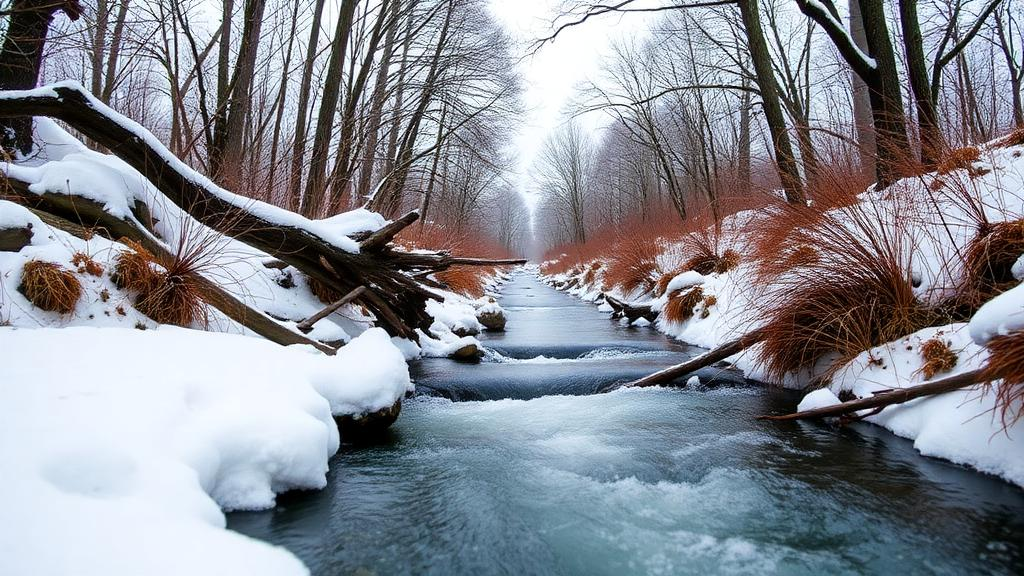
High in the mountains of Denizli, Türkiye, a small creek fed by melting snow is teaching ecologists a lesson that could reshape how freshwater ecosystems are monitored worldwide. Israfil Creek, a snowmelt-fed mountain headwater stream, was the subject of an integrated bioassessment study published in Environmental Monitoring and Assessment by Gürçay Kıvanç Akyıldız and Mehmet Akar of Pamukkale University. Their findings reveal that the physical structure of a stream, its hydromorphology, governs the longitudinal patterns of life along its course far more powerfully than conventional water quality signals. In an era when climate change is rapidly altering snow persistence and precipitation seasonality across mountain regions, the study offers a timely warning that reliance on single ecological metrics may obscure subtle but critical ecological transitions.
Mountain headwater streams are among the most sensitive freshwater ecosystems on Earth. They occupy the uppermost reaches of river networks, where cold temperatures, steep gradients, and strong elevational control on snow persistence create habitat conditions that only specialized organisms can tolerate. These streams are highly responsive to hydroclimatic variability, and as global warming reduces snow cover and shifts precipitation patterns, the biological communities they host face mounting pressure. Understanding how hydromorphological gradients structure these communities is therefore essential for integrated ecological assessment, particularly under frameworks like the European Water Framework Directive, which requires member states to monitor and protect surface waters using biological, physicochemical, and hydromorphological quality elements.
The researchers selected Israfil Creek as a model system to investigate how hydromorphological gradients and metric sensitivity structure ecological patterns along a snowmelt-fed mountain stream. Their approach was deliberately multimetric, combining benthic macroinvertebrate community analysis with saprobic indices, the Biological Monitoring Working Party scoring system, Ephemeroptera, Plecoptera, and Trichoptera percentages, substrate composition mapping, and hydroclimatic analysis. This integrated design allowed them to compare the performance of different ecological metrics against the backdrop of a strong longitudinal gradient running from the cold, lithal-dominated headwaters to warmer, finer-sediment reaches downstream.
A total of 55 macroinvertebrate taxa were identified during the study, with Chironomidae emerging as the most diverse group. This family of non-biting midges is renowned among freshwater ecologists for its extraordinary taxonomic richness and its capacity to occupy virtually every freshwater habitat from glacial meltwater to polluted lowland ponds. The community composition along Israfil Creek showed a clear longitudinal gradient that reflected the hydromorphological transition from headwaters to downstream reaches. Cold-adapted taxa such as Diamesa spp. dominated the upstream stations, where snowmelt maintains near-constant cold temperatures and the substrate is dominated by lithal, or stone, particles. As the stream descended, more tolerant taxa such as Chironomus riparius and Gyraulus albus increased in abundance, signaling a shift toward warmer, finer-sediment conditions with greater particulate organic matter.
Substrate composition shifted dramatically along the longitudinal gradient. In the headwaters, the streambed was dominated by lithal particles, large stones that provide stable attachment surfaces for cold-adapted larvae and create interstitial spaces rich in dissolved oxygen. Moving downstream, finer sediments and particulate organic matter became increasingly prevalent, altering the physical habitat template that structures macroinvertebrate assemblages. This hydromorphological transition, from coarse, stable substrate to finer, more mobile sediments, is a fundamental feature of mountain stream networks and reflects the natural sorting of particles by flow energy as streams lose gradient and gain drainage area. The researchers found that this substrate shift was closely aligned with the biological transition, confirming that hydromorphology, not water chemistry, was the primary driver of community structure.
Saprobic indices, which classify organic pollution levels based on the tolerance of indicator taxa, indicated predominantly xenosaprobic to oligosaprobic conditions upstream. These categories represent the cleanest water quality classes, associated with very low organic loading and high dissolved oxygen. Downstream, however, the saprobic classification showed increasing mesosaprobic influence, indicating a moderate rise in organic matter decomposition and a corresponding shift in the indicator community. This pattern is consistent with the natural accumulation of particulate organic matter as streams flow through vegetated reaches, but it also reflects the hydromorphological transition that creates finer sediments and slower flow velocities downstream, conditions that favor decomposer communities and more tolerant macroinvertebrates.
One of the most striking findings of the study was the divergence between different ecological metrics. Biological Monitoring Working Party scores consistently indicated high ecological quality along the entire stream, suggesting that Israfil Creek remained in excellent condition from headwaters to downstream reaches. However, Ephemeroptera, Plecoptera, and Trichoptera percentages declined longitudinally, revealing a subtle ecological transition that the BMWP metric failed to capture. This divergence in metric sensitivity is a critical insight for bioassessment practice. EPT taxa, which include mayflies, stoneflies, and caddisflies, are generally more sensitive to hydromorphological degradation and thermal stress than the broader taxonomic pool used in BMWP scoring. Their longitudinal decline signals that even in a stream with high water quality, the physical habitat structure is filtering the community in ways that single metrics cannot detect.
Hydroclimatic analysis highlighted strong elevational control on snow persistence and pronounced precipitation seasonality, two features that define the hydrological regime of snowmelt-fed mountain streams. Snow persistence varies dramatically with elevation, creating a mosaic of meltwater inputs that structure flow duration, temperature, and substrate stability across the catchment. Precipitation seasonality, with wet and dry periods concentrated in particular months, further shapes the hydrological pulse that drives biological communities. As climate change reduces snow cover and intensifies precipitation variability, these hydroclimatic controls will shift, potentially altering the hydromorphological gradients that currently govern ecological patterns along Israfil Creek and similar streams worldwide.
The overall conclusion of the study is that ecological patterns in snowmelt-fed mountain streams are governed primarily by hydromorphological gradients rather than conventional water quality signals. This finding challenges the widespread assumption that water chemistry is the dominant driver of biological community structure in streams. In climatically sensitive mountain headwaters, where organic pollution is typically low and hydromorphological variability is high, the physical habitat template exerts primary control on which taxa can persist at each station. The researchers emphasize that reliance on single metrics may obscure subtle ecological transitions, and they advocate for integrated, multimetric approaches that combine community composition, saprobic classification, BMWP scoring, EPT percentages, substrate mapping, and hydroclimatic analysis to capture the full spectrum of ecological change.
The implications extend far beyond a single creek in western Türkiye. Mountain headwater streams across the Alps, the Himalaya, the Andes, and other snowmelt-fed ranges face similar pressures from warming temperatures, shifting snowlines, and altered precipitation regimes. The study by Akyıldız and Akar provides a template for integrated bioassessment that could be applied to these systems, helping managers detect the early warning signs of ecological transition before they become irreversible. As the European Water Framework Directive and similar legislation worldwide evolve to address climate change impacts on freshwater ecosystems, the lesson from Israfil Creek is clear: to understand the ecological health of climatically sensitive mountain streams, one must read the physical structure of the stream itself, not just the chemistry of its water.
Subject of Research: Integrated bioassessment of a snowmelt-fed mountain stream: hydromorphology drives longitudinal patterns
Article Title: Integrated bioassessment of a snowmelt-fed mountain stream: hydromorphology drives longitudinal patterns
Article References: Akyıldız, G. K., & Akar, M. (2026). Integrated bioassessment of a snowmelt-fed mountain stream: hydromorphology drives longitudinal patterns. Environmental Monitoring and Assessment, 198(9), Article 987. https://doi.org/10.1007/s10661-026-15833-w
Image Credits: AI Generated
DOI: 10.1007/s10661-026-15833-w
Keywords: Integrated, bioassessment, snowmelt-fed, mountain, stream, hydromorphology, drives, longitudinal, patterns, scientific research
Cite Scienmag News
Gavin Prescott. (October 18, 2026). Snowmelt Streams Hide Ecological Transitions That Single Metrics Miss. Scienmag. https://scienmag.com/snowmelt-streams-hide-ecological-transitions-that-single-metrics-miss/
Gavin Prescott. "Snowmelt Streams Hide Ecological Transitions That Single Metrics Miss." Scienmag, 18 October 2026, https://scienmag.com/snowmelt-streams-hide-ecological-transitions-that-single-metrics-miss/. Accessed 18 October 2026.
Gavin Prescott. "Snowmelt Streams Hide Ecological Transitions That Single Metrics Miss." Scienmag. October 18, 2026. https://scienmag.com/snowmelt-streams-hide-ecological-transitions-that-single-metrics-miss/


