


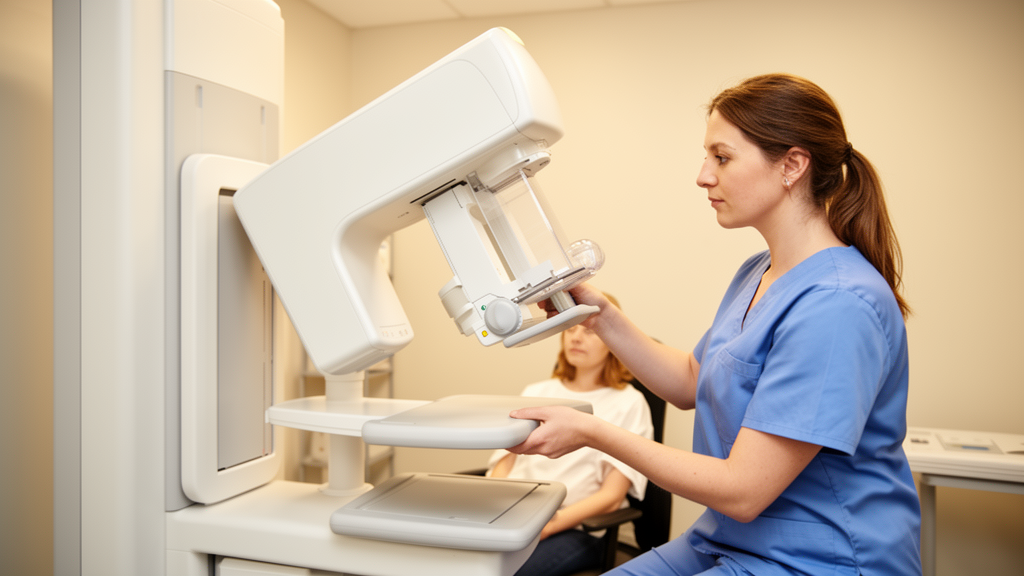
When a mammogram picks up a cluster of tiny calcium deposits deep inside the breast, the next step is often a vacuum-assisted biopsy — a minimally invasive procedure in which a hollow probe is guided to the suspicious spot and pulls out thin slivers of tissue for analysis. A new phantom study published in BMC Medical Imaging suggests that one of the most mundane decisions in that procedure, the direction from which the breast is compressed, can make the difference between a smooth, reliable tissue sample and a biopsy that runs into mechanical trouble before the needle ever reaches its target.
The research, led by Aika Hayashi of Yokkaichi Municipal Hospital and colleagues at Suzuka University of Medical Science in Japan, focused on the newer of two mammography-guided biopsy approaches. Conventional stereotactic-guided vacuum-assisted biopsy triangulates the lesion from two angled two-dimensional images, while digital breast tomosynthesis-guided biopsy reconstructs the target in three dimensions from multiple tomogram layers. Performed with the patient lying face down, the tomosynthesis-guided technique allows more accurate coordinate determination and shorter procedure times than its stereotactic predecessor. What it has lacked, the authors note, is any clear criterion for choosing the optimal compression direction based on where the calcifications sit within the breast and what the biopsy device itself can physically do.
To fill that gap, the team built a variable proprietary breast phantom embedded with simulated calcifications in all four breast quadrants — the upper-outer, upper-inner, lower-outer and lower-inner regions that radiologists use to map findings. They then compressed and imaged the phantom from eight different directions, spanning the standard craniocaudal, mediolateral, lateromedial and oblique projections used in clinical practice. For every combination of calcification location and compression direction, the researchers measured the distance from the needle tip to the support platform, the distance from the tissue sampling port to the center of the target, and the spatial relationship between the needle assembly and the compression paddle. They also recorded whether the device displayed warning messages signaling that tissue sampling would be difficult.
The statistical analysis delivered an unambiguous result: across every breast region, the choice of compression direction was significantly associated with whether an alert occurred, with p values below 0.001. In practical terms, the geometry of the approach — not chance — determines whether the biopsy proceeds cleanly. Compression direction also dictates the trajectory the biopsy needle must follow through the compressed breast, and certain trajectories are inherently riskier than others.
Two failure modes emerged from the phantom experiments, and they sit at opposite ends of the same geometric line. When the breast is compressed along the target’s diagonal from the opposite quadrant — that is, from 180 degrees across from the calcification — the needle trajectory lengthens and the risk of target deviation rises, along with the possibility of damage to the detector. Push too far in that direction and the needle may simply miss the calcifications it was aimed at, or the hardware itself may pay the price.
The mirror-image problem is just as troublesome. Compressing from the opposite direction on the same diagonal — the approach that brings the compression paddle closest to the calcification — can push the tissue sampling port above the skin level. In that configuration, the vacuum mechanism may fail to aspirate tissue, and the port itself risks bruising the patient’s skin. A biopsy designed to be gentle and precise can thus be undermined by the very maneuver intended to bring the target within reach.
These findings give device-generated warnings a new interpretation. In prone tomosynthesis-guided biopsy, the authors conclude, the alerts the machine displays serve as a proxy for technical difficulty rather than as predictors of clinical outcome. An alert does not tell the radiologist whether the biopsy will ultimately succeed in diagnostic terms; it signals that the physical setup has pushed the device toward the edge of its operating envelope. Reading the warning as a prompt to reconsider the compression direction, rather than as a verdict on the procedure, is the practical takeaway.
The study’s recommendation is correspondingly concrete: avoid the two compression directions most likely to produce errors — the 180-degree opposite approach across the target’s diagonal, and the direction immediately adjacent to the calcification area. Steering around those two angles, the authors argue, helps clinicians manage the physical constraints of the biopsy system while preserving reliable diagnostic capability. Because the phantom placed calcifications in all four quadrants and tested eight compression directions, the guidance applies across the full map of the breast rather than to a single favored region.
As with any phantom study, the results come from a laboratory model rather than living tissue, and the authors note the work involved no human or animal subjects. Real breasts vary in density, elasticity and size in ways a phantom cannot fully reproduce. Nevertheless, the systematic geometry the study documents — the diagonal trade-off between needle trajectory length and sampling-port exposure — reflects the fixed mechanics of the biopsy device itself, which behaves the same way whether the medium is gel or glandular tissue. That makes the findings directly actionable for the radiographers and radiologists who set up these procedures every day.
The broader significance lies in how small procedural choices ripple into diagnostic quality. Vacuum-assisted biopsy has become the standard alternative to surgical excision for non-palpable microcalcification lesions precisely because it is minimally invasive yet highly precise. A technique that depends on millimeter-scale targeting cannot afford avoidable geometric errors, and this study shows that the compression paddle’s angle is one of those controllable variables. By turning an intuitive choice into an evidence-based rule — never approach from directly across the diagonal, never from immediately beside the calcification — the Japanese team has given breast biopsy teams a simple decision aid grounded in measured data rather than habit.
Subject of Research: Optimal breast compression direction for tomosynthesis-guided vacuum-assisted biopsy of calcifications
Article Title: Assessment of breast compression direction based on calcification location in prone digital breast tomosynthesis-guided vacuum-assisted breast biopsy: a phantom study
Article References: Hayashi, A., Inagaki, Y., Matsuura, K., & Muto, H. (2026). Assessment of breast compression direction based on calcification location in prone digital breast tomosynthesis-guided vacuum-assisted breast biopsy: a phantom study. BMC Medical Imaging. https://doi.org/10.1186/s12880-026-02776-4
Image Credits: AI Generated
DOI: 10.1186/s12880-026-02776-4
Keywords: breast biopsy, vacuum-assisted biopsy, digital breast tomosynthesis, microcalcifications, mammography, phantom study, prone position, breast compression, breast cancer diagnostics, interventional radiology, medical imaging, BMC Medical Imaging
Cite Scienmag News
Ophelia Keating. (October 18, 2026). Which Way to Squeeze? Phantom Study Maps Safer Compression Angles for Tomosynthesis-Guided Breast Biopsy. Scienmag. https://scienmag.com/which-way-to-squeeze-phantom-study-maps-safer-compression-angles-for-tomosynthesis-guided-breast-biopsy/
Ophelia Keating. "Which Way to Squeeze? Phantom Study Maps Safer Compression Angles for Tomosynthesis-Guided Breast Biopsy." Scienmag, 18 October 2026, https://scienmag.com/which-way-to-squeeze-phantom-study-maps-safer-compression-angles-for-tomosynthesis-guided-breast-biopsy/. Accessed 18 October 2026.
Ophelia Keating. "Which Way to Squeeze? Phantom Study Maps Safer Compression Angles for Tomosynthesis-Guided Breast Biopsy." Scienmag. October 18, 2026. https://scienmag.com/which-way-to-squeeze-phantom-study-maps-safer-compression-angles-for-tomosynthesis-guided-breast-biopsy/


