


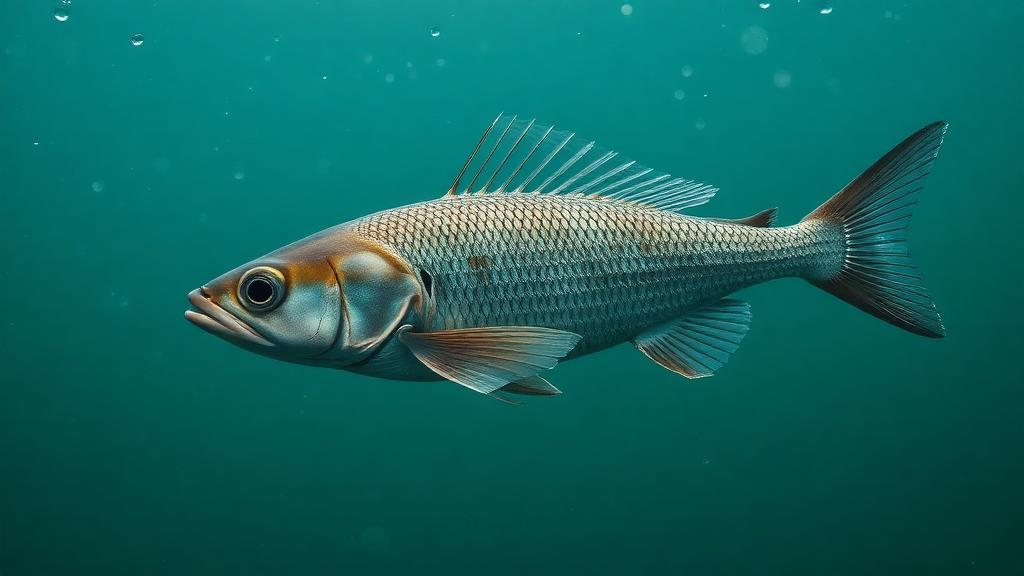
For nearly a century, scientists believed a whole way of being a herring had quietly vanished from the Baltic Sea. The fall-spawning herring, once the dominant ecotype in fisheries landings across the Baltic Proper, was widely considered functionally extirpated, a casualty of overfishing and reproductive failure. Now, a short but striking study published in Acta Ichthyologica et Piscatoria reports the discovery of fall-spawning herring larvae in coastal waters of the southern Stockholm Archipelago, in two consecutive years, suggesting that this ghost population may not be gone after all. The finding, based on opportunistic sampling during a graduate training cruise aboard the research vessel R/V Electra af Askö, is the kind of result that forces ecologists to rewrite assumptions about one of Europe’s most important fisheries.
The herring, Clupea harengus, is not merely abundant in the Baltic; it is foundational. The species links zooplankton at the base of the food web to piscivorous fish and marine mammals at the top, and since the 1960s it has been among the most heavily targeted species in Baltic commercial fisheries, with annual landings consistently exceeding 200,000 tonnes. What makes the new discovery remarkable is that the Baltic’s herring are not a single homogeneous stock. Local populations, adapted to different environmental conditions, spawn at different times of year. Spring spawners reproduce between April and June. Fall spawners reproduce between August and October. Historically, the fall-spawning ecotype dominated the Baltic from roughly 1000 AD, and remained dominant in Swedish fisheries as recently as the late 1920s, and in the southwestern and eastern Baltic fisheries into the 1960s and 1970s.
Then the fall spawners effectively disappeared. Recent assessments concluded that their contribution to Baltic herring populations had become negligible, and researchers formally described the ecotype as functionally extirpated from the Baltic Proper, likely driven by a combination of overfishing and reproductive challenges. The loss matters far beyond sentimentality. A stock composed of multiple populations enjoys what ecologists call a portfolio effect: different populations respond independently, or in synergy, to ecosystem changes, stabilizing overall production in the face of a shifting climate. Strip out one ecotype and the whole system becomes more fragile, less resilient, and more vulnerable to the warming and acidification now reshaping the Baltic.
The new evidence came almost by accident. On 26 April 2023 and again on 23 April 2024, researchers demonstrating the capabilities of R/V Electra af Askö as part of a Stockholm University graduate course deployed an Isaacs-Kidd midwater trawl near the island of Askö, trawling at a depth of five meters for ten minutes at half a meter per second. The net, with a seven-square-meter opening and a 500-micron mesh, came up with herring larvae: 61 individuals in 2023 and 23 in 2024. Surface water temperatures at sampling time were 4.4 and 3.9 degrees Celsius respectively. Under a stereo microscope, the larvae were identified as herring according to ICES standards, measured to the nearest millimeter, and weighed to the nearest thousandth of a gram.
The critical question was timing. Spring-spawning herring larvae could plausibly appear in April samples, so the team needed to prove these larvae belonged to true fall spawners. They did so by back-calculating hatch dates from observed body lengths, using a published growth model for Baltic herring larvae in which daily growth in millimeters per day is a linear function of water temperature. Starting from an approximate hatch length of 7.2 millimeters, the researchers subtracted predicted daily growth, drawn from Copernicus ocean temperature data averaged over the top ten meters of the water column, in reverse chronological order until cumulative growth reached zero. The resulting date was recorded as each fish’s estimated hatch day.
The answer was unambiguous. Larvae caught in 2023 had estimated hatch dates distributed from late October through February, peaking in late November and early December. The 2024 cohort hatched over a narrower window from September to late November, peaking in late September. Both distributions sit squarely within the fall-spawning season, months before any spring spawner would reproduce. Taken together with recent opportunistic observations of fall-spawning larvae in the Bornholm Basin, the Stockholm Archipelago findings indicate that fall-spawning herring persist in the Baltic Sea despite their presumed extirpation, and lend weight to earlier calls for systematic investigation of a possible recovering population.
The two years also told a subtler story about climate. Larvae caught in 2023 were significantly smaller and lighter than those caught in 2024, with mean lengths of 23.2 versus 29.4 millimeters and mean weights of 0.021 versus 0.056 grams, differences that were statistically significant for both measures. Crucially, the allometric relationship between length and weight showed no significant difference in its exponent between years, meaning proportional growth was similar; the 2024 fish were simply heavier at any given length, indicating better condition. The most likely explanation lies in temperature. Warmer water in the 2022 to 2023 season appears to have prolonged the spawning season, pushing hatching later into the year, consistent with recent findings that warmer temperatures extend the spawning season of Atlantic herring. The 2023 fish, hatching later, were younger and therefore smaller at capture.
Temperature may also explain the condition difference. Warm winters raise the energetic costs of basal metabolism in larval fish, and combined with scarce winter food supplies, may have left the 2023 cohort in poorer shape than their 2024 counterparts. The authors are careful to flag this as plausible rather than proven; density-dependent effects and other unmeasured mechanisms could also drive interannual variation in condition. Still, the pattern is a vivid illustration of how a warming Baltic is already rewriting the life histories of its keystone forage fish, shifting when they hatch, how fast they grow, and how well they survive their first winter.
The study is honest about its limits. The sampling was opportunistic, the sample sizes small, and the growth-model approach to hatch dating, while validated against previously reported September and October peaks, is less precise than analyzing daily growth rings in otoliths, the tiny calcium carbonate structures in fish ears that record age like tree rings. Genetic analysis, which can trace the natal origins of Atlantic herring even after larvae drift far from their spawning grounds on currents, was outside the scope of this study but would resolve whether these larvae come from one remnant population or several, and whether they represent genuine local spawners or advected strays. Recent work has also highlighted genetic differentiation among herring ecotypes and the influence of climate change on larval growth and recruitment, making genetics the obvious next tool.
What the study establishes, firmly, is that a fish ecotype written off as functionally extinct is still reproducing in the Baltic Proper, two years running, within sight of Stockholm. Whether these larvae are the first stirrings of a recovery, the last embers of a dying lineage, or simply a population that was never as gone as the textbooks claimed, nobody yet knows. Answering that question requires planned, systematic sampling across space and time, paired with genetic tools, to map the spatiotemporal abundance of fall-spawned larvae, count the distinct populations producing them, and determine what role this ecotype still plays in the food web, the ecosystem, and the fishery. For a species that underpins one of Europe’s great fisheries, and for the broader principle that biodiversity within a species is as precious as biodiversity between them, the return of the ghost herring is a discovery worth shouting about, and a reminder that the sea keeps secrets even from the people who study it most closely.
Subject of Research: Rediscovery of the fall-spawning herring ecotype in the Baltic Proper
Article Title: Recent evidence of a functionally extirpated ecotype of herring, Clupea harengus ( Actinopterygii , Clupeiformes , Clupeidae ), in the southern Stockholm Archipelago, Baltic Sea
Article References: Taylor, J. M. (2026). Recent evidence of a functionally extirpated ecotype of herring, Clupea harengus (Actinopterygii, Clupeiformes, Clupeidae), in the southern Stockholm Archipelago, Baltic Sea. Acta Ichthyologica et Piscatoria, 56, 17-22. https://doi.org/10.3897/aiep.56.173510
Image Credits: AI Generated
Keywords: herring, Clupea harengus, Baltic Sea, fall spawning, ecotype, fisheries, larvae, hatch dates, climate change, Stockholm Archipelago, portfolio effect, marine ecology
Cite Scienmag News
Gavin Prescott. (October 18, 2026). Ghost Herring: Fall-Spawning Ecotype Feared Lost Found Alive in Baltic. Scienmag. https://scienmag.com/ghost-herring-fall-spawning-ecotype-feared-lost-found-alive-in-baltic/
Gavin Prescott. "Ghost Herring: Fall-Spawning Ecotype Feared Lost Found Alive in Baltic." Scienmag, 18 October 2026, https://scienmag.com/ghost-herring-fall-spawning-ecotype-feared-lost-found-alive-in-baltic/. Accessed 18 October 2026.
Gavin Prescott. "Ghost Herring: Fall-Spawning Ecotype Feared Lost Found Alive in Baltic." Scienmag. October 18, 2026. https://scienmag.com/ghost-herring-fall-spawning-ecotype-feared-lost-found-alive-in-baltic/


