


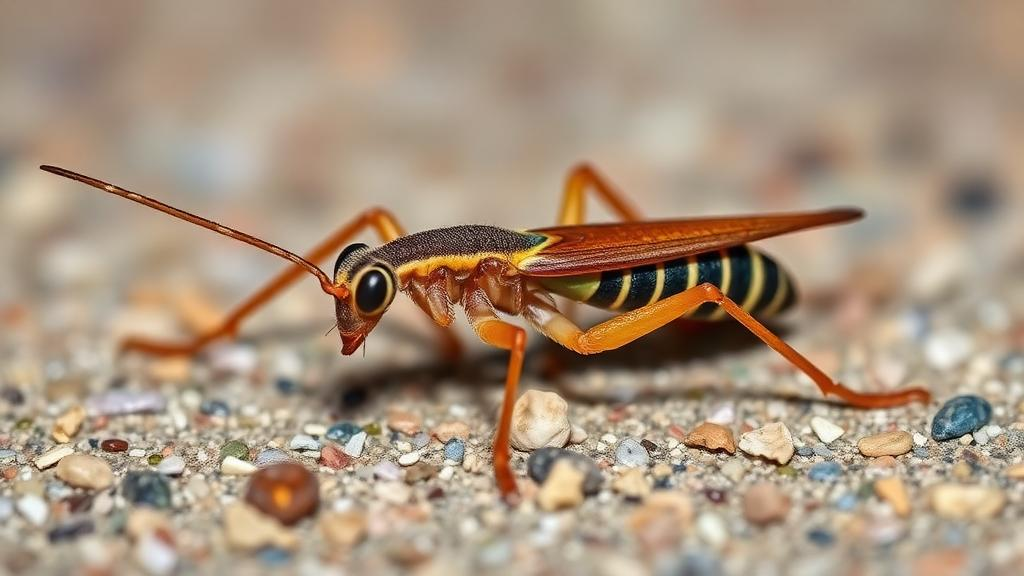
Deep in the undergrowth of Latvian floodplains, a creature barely larger than a grain of rice has just rewritten the map of European orthopterans. Researchers have reported the first-ever records of the ant cricket Myrmecophilus acervorum from Latvia, and the two discovery sites turn out to be the northernmost known observations of the species anywhere in the world. The finding, published in the Journal of Orthoptera Research, adds a new family — Myrmecophilidae — to the Latvian insect checklist and extends the documented frontier of one of Europe’s most specialized and secretive insects.
Myrmecophilus acervorum, first described by Panzer in 1799, is among the smallest members of the entire order Orthoptera and is exquisitely adapted to a life lived in the shadows of ants. The genus Myrmecophilus is divided into three subgenera and holds 64 species, but M. acervorum is the only one known from Northern Europe. It is an obligate ant kleptoparasite: the crickets feed on ant eggs, cuticle wax and prey collected by their hosts, and they even receive nutrients directly through ant trophallaxis. Roughly 20 ant species are recorded as hosts, with a reported preference for the genus Lasius — a preference that the Latvian observations appear to confirm even at the edge of the species’ range.
Life among ants demands extraordinary defenses. Ant crickets employ chemotactile and body-size mimicry along with rapid, zigzag escape movements to survive inside hostile nests. When colonizing a new colony, they accumulate ant cuticular hydrocarbons on their bodies, which reduces ant aggression because ants use these substances as nest-mate recognition cues. Female crickets lay up to four eggs per clutch under the ant brood pile, where developing young benefit from the controlled microclimatic conditions of the nest. The family as a whole has lost wings and the ability to produce or hear sound, most likely as a consequence of its heavy reliance on host species, and body size in these crickets is variable, adapting to the host species — a single specimen can even change hosts multiple times during its life.
One of the strangest aspects of M. acervorum biology is its reproductive system. For a long time the species was thought to reproduce only parthenogenetically, but recent studies have shown that some populations contain both males and females. The species exhibits geographic parthenogenesis: whether a population reproduces sexually or asexually depends on where it lives, making the species facultatively parthenogenetic. The sex ratio is female-biased, and while bacterial endosymbionts such as Wolbachia were hypothesized to drive parthenogenesis, populations with males that reproduce — and the absence of Wolbachia-infected parthenogenetic populations — contradict that idea. Because thelytokous parthenogenesis produces only female offspring, the observation of both adult and juvenile female specimens in Latvia suggests the northern subpopulation reproduces asexually, though the presence of males and the role of endosymbionts there remain open questions.
The Latvian discoveries stem from non-systematic entomological fieldwork carried out in central Latvia between 2022 and 2024, with specimens searched for manually in and around nests of ground- and wood-nesting ants. The first specimen, an adult female, was found on 19 May 2022 in Bolderāja, Rīga, on a xerothermic riverside between the River Buļļupe and Lielā Street, north of the Jaunie Bolderājas kapi cemetery. It was sitting on the upper side of a fallen birch trunk — one of several cut about a year earlier and piled roughly 50 meters from the riverside about six months before the observation — within a group of black Lasius ants. That individual was released after imaging.
The second specimen, a juvenile female with a total body length of just 1.47 millimeters, was collected on 13 June 2024 at Jugla in Rīga, on the sloping, semi-open shore of Lake Juglas. It was found on black soil in a small group of black garden ants, Lasius niger — a record that endorses the species’ reported preference for that host even at the very northern extent of its range. Based on body size and the developmental stage of the ovipositor, the juvenile is a second-instar nymph. Nymph identification is notoriously difficult because characteristic morphological features are lacking, but M. acervorum is the only myrmecophilid species occurring at this latitude, and the double pale margin on the basal part of the pronotum and first tergite matches the diagnostic features of the species. This specimen is preserved in the collection of the Latvian National Museum of Natural History in Rīga.
Both localities share a striking ecological feature: they are subject to seasonal flooding and water-level fluctuation, in the River Buļļupe and Lake Juglas respectively. The straight-line distance between the two sites is about 15.2 kilometers, and they lie on opposite sides of the River Daugava, Latvia’s major river — a significant geographic barrier and, at the same time, an ecological migration corridor for insects. Biogeographically, the Latvian records belong to the Boreal Region, whereas the bulk of available records of M. acervorum come from the Continental Region, followed by the Atlantic Region. Measured against the previously known distribution, the Latvian contribution to the species’ European extent of occurrence is 129,743 square kilometers, and to its area of occupancy, 8 square kilometers.
The previous northernmost localities of the species were a cluster of closely situated sites registered in GBIF between 2021 and 2024, along with Blomstermåla in Småland, south-eastern Sweden, recorded in 2017. In Asia, the northernmost and easternmost record comes from Barnaul in Altai Krai, south-west Siberia, Russia. Both Latvian observation sites lie slightly north of the Swedish location and considerably north of the Siberian one, making them the northernmost known distribution limit of M. acervorum. The discovery itself was anticipated: Lithuanian records, the Swedish distribution pattern, and a wave of recent range-expansion records across Europe and Asia all pointed to the species’ eventual appearance in Latvia. The most recent catalogue of Latvian orthopterans listed 43 species in six families; the ant cricket now adds a seventh.
What is driving this northward march? Climate change is a plausible candidate, since a similar pattern has been observed in other orthopteran species in the region. But the authors caution that the species may simply have been overlooked for a long time — its minute body size and cryptic lifestyle inside ant nests make it easy to miss. Anthropochoric spread is another possibility: the species may travel inadvertently with transported soil, stone and wood, and it is thought to have been unintentionally introduced to parts of its Asian range, where it is considered invasive. Whether the River Daugava played a role in the species’ dispersal within Latvia remains to be clarified.
Despite the range expansion, the species is assessed as of Least Concern by the International Union for Conservation of Nature, with an increasing population trend for the European region. In Central Europe it can be observed from early spring to late September, usually in ant nests in ruderal, urban and other disturbed habitats — and notably, the association with ants is not compulsory, as individuals are often found under rocks and pieces of wood, sometimes without any trace of ants. The Latvian records, from urban riversides and lakeshores within the capital city itself, fit that pattern of quiet persistence in disturbed ground. The authors conclude that M. acervorum is autochthonous in the Latvian fauna — a genuine native, not a recent stowaway — and its presence at the top of Europe marks a new northern benchmark for one of the insect world’s most intimate social parasites.
Subject of Research: First Latvian records and northernmost global observations of the ant cricket Myrmecophilus acervorum
Article Title: The northernmost known observation of Myrmecophilus acervorum and the first records of Myrmecophilidae ( Orthoptera , Ensifera ) from Latvia
Article References: Balodis, A., Starka, R., & Telnov, D. (2025). The northernmost known observation of Myrmecophilus acervorum and the first records of Myrmecophilidae (Orthoptera, Ensifera) from Latvia. Journal of Orthoptera Research, 34(2), 169-173. https://doi.org/10.3897/jor.34.138202
Image Credits: AI Generated
Keywords: Myrmecophilus acervorum, Myrmecophilidae, Orthoptera, Latvia, ant kleptoparasite, geographic parthenogenesis, Lasius niger, range expansion, Boreal Region, climate change, biogeography, new record
Cite Scienmag News
Gavin Prescott. (October 18, 2026). Ant crickets reach Latvia: northernmost record of Myrmecophilus acervorum. Scienmag. https://scienmag.com/ant-crickets-reach-latvia-northernmost-record-of-myrmecophilus-acervorum/
Gavin Prescott. "Ant crickets reach Latvia: northernmost record of Myrmecophilus acervorum." Scienmag, 18 October 2026, https://scienmag.com/ant-crickets-reach-latvia-northernmost-record-of-myrmecophilus-acervorum/. Accessed 18 October 2026.
Gavin Prescott. "Ant crickets reach Latvia: northernmost record of Myrmecophilus acervorum." Scienmag. October 18, 2026. https://scienmag.com/ant-crickets-reach-latvia-northernmost-record-of-myrmecophilus-acervorum/


