


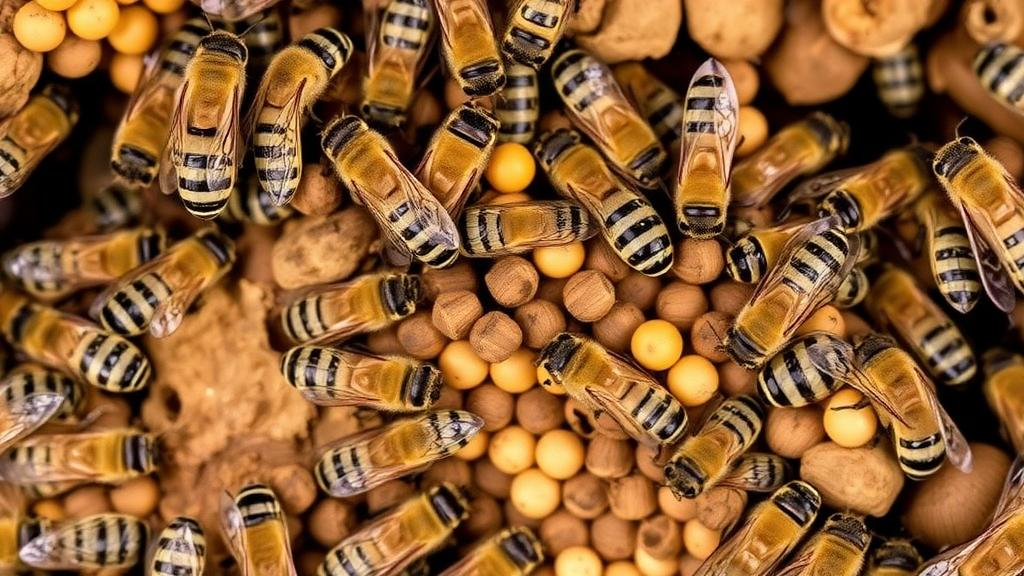
Across Canada, hundreds of small PVC-pipe bee hotels dangled from schoolyards and gardens, quietly filling with the brood of solitary bees and wasps. When researchers opened those paper tubes and ran DNA metabarcoding on every larva, pollen clump, and prey fragment inside, they uncovered a hidden world of range expansions, unexpected foraging habits, and parasite-host relationships never before documented. The study, published in Metabarcoding and Metagenomics, paired community science with molecular identification to map the distributions and trophic interactions of cavity-nesting Hymenoptera on a scale no single lab could achieve alone.
Solitary cavity-nesting bees and wasps are ideal subjects for this kind of monitoring because they nest in hollow, above-ground cavities such as pithy stems and beetle burrows. Females construct linear brood cells from the rear of the tube forward, provisioning each with food: bees supply a pollen-and-nectar mixture called bee bread, while wasps stock their cells with arthropod prey like spiders, caterpillars, or aphids. Both groups are targeted by parasitoid wasps, flies, and beetles that lay their eggs in completed nests or inject them directly into host larvae. A single paper tube can therefore contain a pollinator, its pollen, a predator, its prey, and a parasite, all stacked in one narrow column.
Trap nests, also known as bee hotels, have been used to study these insects for more than a century, since Jean-Henri Fabre first deployed them in the early 1900s. Unlike pan traps or blue vane traps, which merely detect species flying nearby, trap nests provide indisputable evidence of where a species is nesting and what it is feeding to its offspring. The pollen or prey stored in each cell can be directly linked to the species that collected it, making the method uniquely suited for building interaction networks. Although cavity-nesting bees represent only a fraction of all solitary bee species, their abundance correlates strongly with the overall abundance of nest-provisioning bees, allowing researchers to extrapolate about local communities.
The research team distributed trap nests to elementary and high schools across Canada through the Bees@Schools program during the summers of 2019 and 2020. Each trap consisted of a 30-centimetre section of 10-centimetre PVC pipe with a 60-degree angled opening for weather protection, housing a Styrofoam disc plugged with 30 paper tubes in three diameters: 3.4, 5.6, and 7.6 millimetres. In 2019, 88 traps were sent out and 42 returned; in 2020, 202 traps were distributed and 170 came back to Guelph. Teachers installed the nests facing south at one to 1.5 metres above the ground and reported orientation, height, latitude, and longitude with photographs to confirm correct placement.
Back in a clean-room laboratory at the University of Guelph, researchers opened each tube with sterilized instruments and separated larvae, pollen, and prey from nesting material. They mechanically pulverized samples with disposable pestles, sand, and stainless steel beads before DNA extraction using guanidinium thiocyanate lysis buffer and Proteinase K incubation. Two gene fragments were amplified: the mitochondrial cytochrome c oxidase I (COI) gene using BF3 and BR2 primers for bee, wasp, and prey identification, and the ribulose bisphosphate carboxylase large chain (rbcL) gene for plant identification. Samples were indexed with custom tags in a second PCR, normalized, pooled, and sequenced on Illumina MiSeq and Novaseq 6000 platforms. Bioinformatic processing in JAMP and Usearch demultiplexed, merged, primer-trimmed, and quality-filtered the reads, comparing amplicon sequence variants against custom reference databases built from the Barcode of Life Data System and NCBI GenBank.
The sequencing revealed 2,313 hymenopteran detections from 78 taxa, including 29 bee species and 49 wasp taxa, alongside 384 plant genera from 91 families. Species richness and abundance of both bees and wasps were significantly higher in 2020 than in 2019, with 25 bee and 41 wasp species detected in the second year compared to 7 and 16 in the first. Beyond the Hymenoptera, the team detected 328 specimens from 11 other insect orders, including 72 taxa of potential prey spanning spiders, beetles, moths, grasshoppers, and thrips, and 12 taxa of parasitic or parasitoid insects including flies, beetles, and strepsipterans.
When compared against historical distribution records from GBIF and Discover Life, ten bee species appeared to have expanded their ranges. Three of these are non-native: Chelostoma rapunculi, Hylaeus pictipes, and most strikingly Osmia taurus, which was detected in British Columbia, Alberta, Manitoba, Ontario, and Prince Edward Island despite having previously been recorded only in Ontario. Osmia taurus is thought to have been accidentally imported in place of the similar-looking Osmia cornifrons used agriculturally, and its rapid spread through the Mid-Atlantic United States since 2002 has been closely watched. Finding it as far north as Churchill, Manitoba represents a substantial range expansion over a short period. Reference specimens with 100 percent barcode matches were confirmed by a taxonomic expert at the Canadian Museum of Nature. Four wasp species, including three non-native Passaloecus and Psenulus species, were also found outside their historically reported Canadian ranges, with Trypoxylon cf. nitidum detected in British Columbia, Alberta, and Manitoba in addition to Ontario.
The interaction networks painted an equally surprising picture. The plant-pollinator network, built from 22 cavity-nesting bee species and 88 plant families, showed largely generalist pollen consumption consistent with historical records for most species. However, three species classified as oligolectic specialists, Chelostoma rapunculi, Megachile lapponica, and Megachile pugnata, were detected foraging on plant genera well outside their known host plants. Prior work has shown that observational plant-pollinator networks can differ considerably from those built with pollen metabarcoding, sometimes reclassifying specialists as generalists. The researchers suggest that nectar detections within bee bread, incidental pollen collection during flower visits, and multiple nest occupancy may all contribute to these unexpected foraging patterns. Asteraceae, Fabaceae, and Rosaceae dominated the pollen provisions, accounting for 20, 13, and 13 percent of detections respectively.
Predatory wasp networks revealed that ten of 23 analyzed species were found with prey outside their recorded choices. Trypoxylon cf. nitidum, historically known as a spider-collecting wasp, also provisioned nests with beetle and moth larvae as well as grasshoppers. Isodontia mexicana, known for collecting grasshoppers, was additionally found with beetles, moth larvae, and spiders. On the parasitism side, half of all occupied sites and a quarter of occupied tubes contained natural enemies with their hosts, rates substantially higher than the 5 to 13 percent reported in previous studies. Ten parasitic species were identified with hosts not prominent in historical records, including Coelioxys kleptoparasites found attacking three wasp species in addition to their known Megachile bee hosts, and Sapyga louisi and Sapyga similis for which the study provided the first host records altogether. The researchers attribute the elevated detection rates partly to metabarcoding’s sensitivity compared to earlier studies that relied on hatching occupants, where failed pupae and consumed prey would have gone unidentified.
A quarter of all nesting tubes contained two or more solitary bee or wasp species, a phenomenon the authors link to nest abandonment, usurpation, and the heightened sensitivity of molecular detection. Landcover analysis within 500 metres of each site, classifying surroundings as predominantly crop, forest, or urban, revealed no significant differences in bee or wasp species richness or abundance across landscape types, though community composition shifted: Megachile rotundata dominated cropping landscapes, Megachile relativa forests, and Osmia lignaria and M. rotundata urban areas. The authors note that most schoolyard sites were unlikely to represent intensely agricultural or intensely urban landcovers, which may have muted landscape effects. Over its five-year run, the Bees@Schools program reached some 5,000 students across Canada, and the researchers argue that pairing community science with metabarcoding of trap nest inhabitants offers a powerful template for future studies of these essential pollinators, predators, and the ecosystem services their interactions fuel.
Subject of Research: Welcome to Hotel Hymenoptera: monitoring cavity-nesting bee and wasp distribution and their trophic interactions using community science and metabarcoding
Article Title: Welcome to Hotel Hymenoptera : monitoring cavity-nesting bee and wasp distribution and their trophic interactions using community science and metabarcoding
Article References: Handler, S., Coveny, K., Braukmann, T. W. A., Raine, N. E., & Steinke, D. (2026). Welcome to Hotel Hymenoptera: monitoring cavity-nesting bee and wasp distribution and their trophic interactions using community science and metabarcoding. Metabarcoding and Metagenomics, 10, Article e139674. https://doi.org/10.3897/mbmg.10.139674
Image Credits: AI Generated
Keywords: Welcome, Hotel, Hymenoptera, monitoring, cavity-nesting, wasp, distribution, trophic, interactions, community, science, metabarcoding
Cite Scienmag News
Margaret Porter. (October 17, 2026). Bee hotels across Canada reveal hidden lives of cavity-nesting bees and wasps. Scienmag. https://scienmag.com/bee-hotels-across-canada-reveal-hidden-lives-of-cavity-nesting-bees-and-wasps/
Margaret Porter. "Bee hotels across Canada reveal hidden lives of cavity-nesting bees and wasps." Scienmag, 17 October 2026, https://scienmag.com/bee-hotels-across-canada-reveal-hidden-lives-of-cavity-nesting-bees-and-wasps/. Accessed 17 October 2026.
Margaret Porter. "Bee hotels across Canada reveal hidden lives of cavity-nesting bees and wasps." Scienmag. October 17, 2026. https://scienmag.com/bee-hotels-across-canada-reveal-hidden-lives-of-cavity-nesting-bees-and-wasps/


