


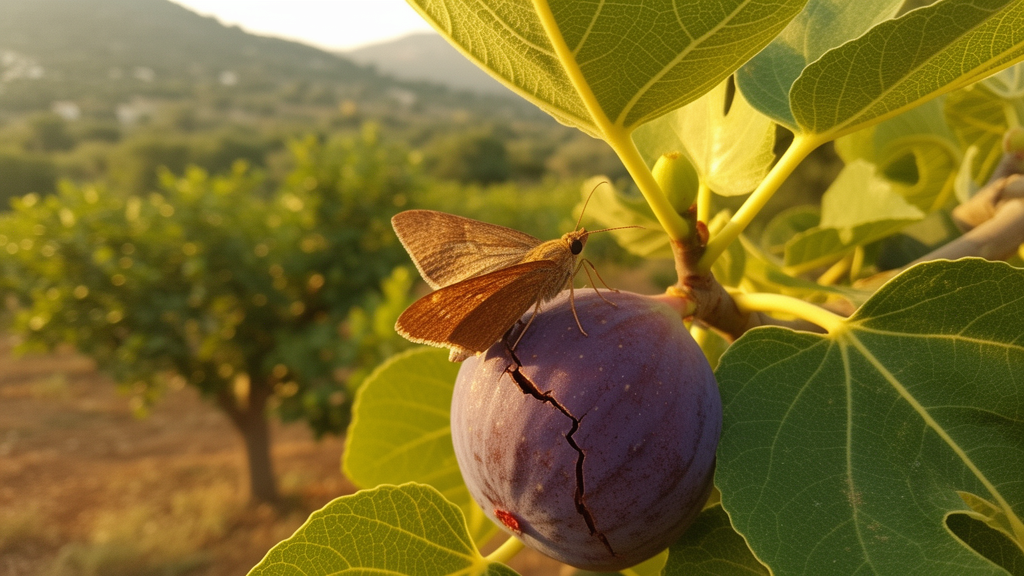
A small moth with a taste for ornamental fig trees has quietly added Cyprus to its growing list of conquests. Researchers report the first record of the Banyan Leaf Skeletonizer, Choreutis sexfasciella, from the island, where its larvae were found damaging the foliage of Chinese banyan, Ficus microcarpa, and weeping fig, Ficus benjamina, in urban areas of Larnaca, Limassol, and Paphos. The finding, published in Nota Lepidopterologica, is more than a routine faunistic note. It combines field surveys, DNA barcode sequencing, and a multi-gene phylogenetic analysis with the unexpected rearing of a parasitoid wasp, offering one of the most complete portraits yet of a cosmopolitan invader on the move.
The species was originally described more than a century ago from the Philippines and is considered native to parts of the Eastern Palaearctic and Indomalayan realms. In the last five years, however, it has extended its range at remarkable speed. It had already been reported from Israel, Egypt, Türkiye, and Réunion, and it has even crossed oceans to reach California and Florida in North America. Its arrival in Cyprus was probably only a matter of time. The island has extensively planted non-native fig species as ornamentals in parks, gardens, and roadsides, and more than thirty non-native insect species associated with these trees have already been documented there, ranging from sap-feeding bugs and thrips to the chalcid wasps known as fig wasps.
The discovery began with visual signs rather than adult moths. During sampling in July and August 2021, researchers noticed damaged and withered leaves of F. microcarpa and F. benjamina covered in small, dark excrement and silk webs. The larvae rest beneath these webs on the upper leaf surface, and thick silken cocoons on the leaf midrib betray the presence of developing pupae. Adults were sparsely observed on the foliage during the evening hours before nightfall. Infested and healthy leaves were collected in plastic containers and reared until adult moths emerged, allowing preliminary identification from photographic diagnoses that was later confirmed molecularly. In total, specimens were examined from multiple localities across the three districts, including house gardens, a school environment, and sites near the Tombs of the Kings in Paphos.
Eleven of the Cyprus specimens were sequenced for the mitochondrial cytochrome oxidase I gene, the standard DNA barcode, and the nuclear wingless gene. The researchers combined these sequences with publicly available data from Australia, Papua New Guinea, and the United States, and for the broader phylogenetic analysis they assembled a dataset of eight gene fragments, one mitochondrial and seven nuclear, spanning 6,401 base pairs. The analysis included outgroups from the choreutid genus Brenthia, representatives of several other choreutine genera such as Anthophila, Caloreas, Niveas, Prochoreutis, and Tebenna, and two additional species of Choreutis. Maximum likelihood trees were built with IQ-TREE 2, using ultrafast bootstrap and SH-like approximate likelihood ratio tests with 1,000 replicates to gauge branch support.
The barcode results carry a striking message about invasion history. All of the haplotypes from Cyprus group together, suggesting a single introduction event, and they show no population structure across the different regions of the island. More intriguingly, the Cyprus specimens are closely related to those from the United States, hinting that the populations in Europe and North America share a recent common source. Whether the Mediterranean arrival was one event that then spread rapidly because its host trees are widely grown as ornamentals across the region, or whether there were several separate introductions through the trade in ornamental plants, remains an open question. Answering it will require far greater sequencing effort covering the full range of the species, and notably no specimens have yet been sequenced from the Philippines, the type locality.
The molecular work also settles a taxonomic tangle. When the species first appeared in California in 2021, it was recorded under the name Choreutis emplecta, an Australian species, because its DNA barcode matched specimens of that moth. A later transfer of C. emplecta into the genus Anthophila without explanation added to the confusion about the invader’s correct generic placement. In 2023, Heppner synonymized C. emplecta with C. sexfasciella. The new analysis supports that decision: the Australian specimens show less than 2% divergence in COI sequences from the rest of the world’s specimens, with no clear separation between regions. The phylogeny also places C. sexfasciella deeply nested within the genus Choreutis with full branch support from both statistical measures, confirming what its morphology already suggested.
Perhaps the most unexpected result came from the rearing containers. Two female specimens of a parasitoid wasp of the genus Elasmus, in the family Eulophidae, emerged from pupae in Limassol district and were identified as Elasmus cf. cyprianus. This constitutes the first known parasitoid for C. sexfasciella anywhere in its range. Known cases of chalcid wasps parasitizing Choreutidae are exceedingly rare, previously limited to Elasmus nudus on Tebenna bjerkandrella and Conura side on Tebenna silphiella. Elasmus cyprianus was first described from Cyprus itself in 1947, breeding in young green carob pods, and its true hosts remain unknown, presumably being some lepidopteran developing in carob pods. Male individuals of the species have never been described. The reared specimens match E. cyprianus in key features, such as a pedicel longer than the first flagellomere, although comparison with type material is still required before the identification can be considered definitive.
The socioeconomic implications of the moth are discussed with some nuance. The larval damage undermines the aesthetics of ornamental plantings, a real concern in urban landscapes, but the observed extent of defoliation did not seem to significantly affect plant survival. The stakes could still rise. Ficus microcarpa, though commonly grown as an ornamental, has escaped urban areas and reached natural habitats in the Mediterranean basin, where in other invaded regions it has been associated with infrastructure damage and the replacement of native flora. In Cyprus, the tree itself already poses documented socioeconomic and human-health risks, from slippery sidewalks and road crossings caused by fallen figs to damage to cars and pavements. A moth that adds defoliation pressure to an already problematic ornamental is worth monitoring.
The researchers place the record in context: by the end of 2024, a total of 30 non-native species of Lepidoptera had been reported from Cyprus, and since then two more have been added, including C. sexfasciella and the fall armyworm, Spodoptera frugiperda, a notorious pest on the EPPO A2 list. The moth probably reached the island as a contaminant of nursery material or on infested alien fig trees, from neighbouring Egypt, Israel, or directly from its native range. The authors hypothesize that the Israeli introduction, in turn, may have come through the import of Asian Ficus species. The pattern fits a familiar script of globalization: ornamental plants travel the world, and their insect passengers travel with them.
Future research directions are clearly laid out. Mapping the full extent of the moth’s distribution on the island, determining other possible host plants, and identifying any further adverse impacts are immediate priorities. The potential use of E. cf. cyprianus for biological control could be assessed by measuring its parasitism rate and seasonal dynamics, and continued rearing may finally provide male specimens of the wasp, which are currently undescribed, while comparison with type material awaits the collection of additional individuals. For now, the study stands as a model of how molecular tools, careful fieldwork, and a bit of luck in the rearing containers can turn a first record into a rich story of invasion genetics, taxonomic resolution, and the serendipitous discovery of a native enemy that may yet help rein in a cosmopolitan invader.
Subject of Research: First record of the invasive moth Choreutis sexfasciella in Cyprus with molecular characterization and a reared parasitoid wasp
Article Title: A cosmopolitan invader – Choreutis sexfasciella ( Lepidoptera , Choreutidae ) – in Cyprus: first record, molecular characterization, and a reared parasitoid
Article References: Demetriou, J., Aristophanous, M., Koutsoukos, E., John, E., Roy, H. E., Martinou, A. F., & Rota, J. (2025). A cosmopolitan invader – Choreutis sexfasciella (Lepidoptera, Choreutidae) – in Cyprus: first record, molecular characterization, and a reared parasitoid. Nota Lepidopterologica, 48, 15-28. https://doi.org/10.3897/nl.48.137778
Image Credits: AI Generated
DOI: 10.3897/nl.48.137778
Keywords: cosmopolitan, invader, Choreutis, sexfasciella, Lepidoptera, Choreutidae, Cyprus, first, record, molecular, characterization, reared
Cite Scienmag News
Patricia Pace. (October 17, 2026). Cosmopolitan moth invades Cyprus fig trees, DNA reveals North American link. Scienmag. https://scienmag.com/cosmopolitan-moth-invades-cyprus-fig-trees-dna-reveals-north-american-link/
Patricia Pace. "Cosmopolitan moth invades Cyprus fig trees, DNA reveals North American link." Scienmag, 17 October 2026, https://scienmag.com/cosmopolitan-moth-invades-cyprus-fig-trees-dna-reveals-north-american-link/. Accessed 17 October 2026.
Patricia Pace. "Cosmopolitan moth invades Cyprus fig trees, DNA reveals North American link." Scienmag. October 17, 2026. https://scienmag.com/cosmopolitan-moth-invades-cyprus-fig-trees-dna-reveals-north-american-link/


