


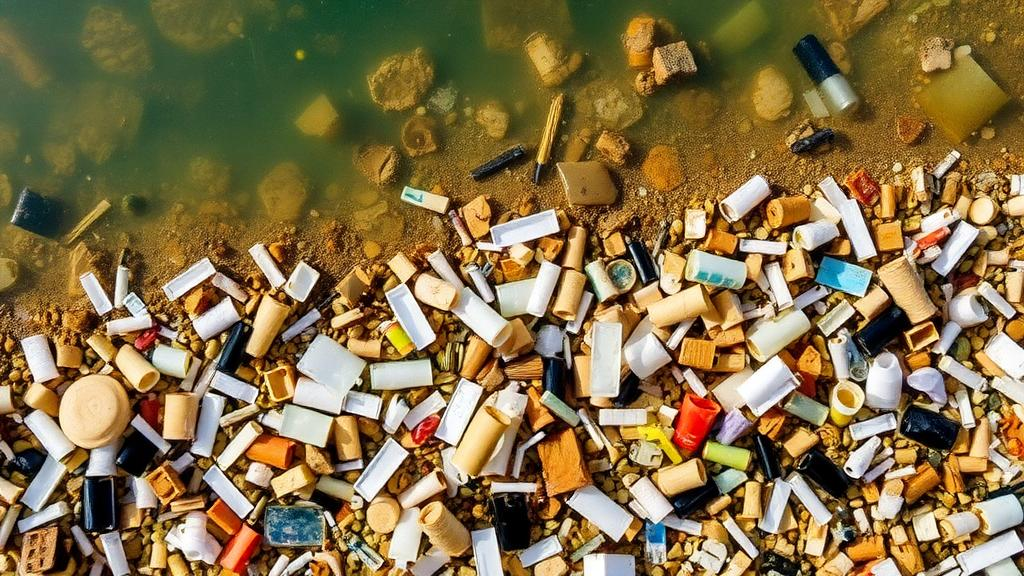
Plastic pollution has become one of the defining environmental stories of our time, but few places illustrate the problem as starkly as the Black Sea. A new study of Bulgaria’s coastal waters has revealed that microplastics—tiny plastic particles smaller than five millimetres—are present in nearly every sample of seawater collected along the country’s shoreline. The findings, published in the journal BioRisk, offer the most detailed picture yet of floating plastic contamination in the surface waters of the Bulgarian Black Sea coast, and they carry a warning about the invisible cargo these particles may be transporting into the marine food web.
The research team collected 23 samples of surface waters from March 2021 to April 2022 at stations spanning the entire Bulgarian coastline, from the northern border with Romania down to the southern resorts near Turkey. The sampling sites were deliberately chosen to cover a range of ecological settings: protected areas such as Cape Kaliakra and the Kamchia River estuary, aquaculture zones including mussel farms near Kavarna, and industrial harbours in the major port cities of Varna and Burgas. Surface waters at depths of one to three metres were sampled aboard a vessel using a manta net, a standard tool for skimming floating particles from the sea surface.
Back in the laboratory, the samples underwent a rigorous preparation protocol designed to strip away everything that was not plastic. Organic matter was digested with hydrogen peroxide combined with ferrous sulphate on a hot plate at 60 degrees Celsius, a chemical treatment that took roughly 24 hours to dissolve all biological material. Plastic particles were then isolated by density separation and captured on a membrane filter with a pore size of just 0.45 micrometres. Identification was performed visually under a Zeiss stereomicroscope at magnifications of 4x and 10x, with every particle between 20 micrometres and five millimetres counted, measured and classified by size, colour and shape according to internationally recognised guidelines for marine litter monitoring.
Quality control was central to the study’s credibility. The researchers used only glass and stainless-steel equipment during laboratory work, covered all samples with aluminium foil to prevent airborne contamination, and included procedure blanks—ultrapure water treated with the same reagents and digested in the same way as the real samples—in every analytical series. All results were corrected against these parallel blanks, ensuring that the particles reported were genuinely present in the seawater rather than introduced during handling.
The results were unambiguous: microplastic particles were detected in 22 of the 23 samples, with only one site failing to register any plastic. The mean concentration across the entire monitoring period was calculated at 7.3 plus or minus 4.9 particles per litre, a figure that places the Bulgarian coast among the more heavily contaminated nearshore waters of the Black Sea region. Individual samples varied dramatically, from a low of 1.3 particles per litre at Cape Kaliakra in winter 2021 to a striking peak of 16.3 particles per litre at Pasha Dere near Varna in autumn 2021. Other hotspots included Varna Bay’s fourth breakwater beach with 14.3 particles per litre and the mussel farm area near Kavarna with 14.0 particles per litre.
Perhaps the most surprising finding was the geography of the contamination. When the researchers compared the North, Varna and South sampling areas, they found no statistically significant difference in microplastic abundance, with regional means of 7.8, 8.7 and 6.4 particles per litre respectively. Even more counterintuitively, the waters around the heavily urbanised Burgas Bay in the south registered lower concentrations—just 2.3 particles per litre—than the environs of protected areas such as Ravda, Pomorie and Nesebar. The authors attribute this pattern to the powerful influence of sea surface currents, wind regime and seasonal flows that redistribute floating particles along the coast, driven by the Black Sea’s generally counter-clockwise current system. The variation within each region likely reflects different land-based sources of plastic waste rather than any simple relationship between local urbanisation and contamination.
The characterisation of the particles tells its own story about where they come from. In every sample, only fragments, fibres and films were identified—all secondary microplastics produced by the degradation of larger plastic items. No primary plastics such as spherules, microbeads or industrial granules were found, indicating that the contamination stems from the breakdown of everyday plastic waste rather than direct industrial discharge. Fibres dominated overwhelmingly, making up 73.3 percent of all particles, followed by fragments at 23.4 percent and other forms at 3.2 percent. Fibres are known to originate mainly from wastewater, clothing, ropes and shipping activities, which explains their prevalence around ports and populated areas along the Bulgarian coast.
Colour analysis added further detail to the picture. Transparent pieces were the most abundant at 38 percent of the total, followed by blue at 29 percent and black at 26 percent, with red, yellow and other colours together accounting for just 7 percent. Size distribution revealed that the most abundant size class of fragments fell between 101 and 500 micrometres in Ferret diameter—a range small enough to be accidentally ingested by marine organisms during feeding. Particles below 100 micrometres represented only a minor portion of the total, a pattern similar to that observed in recent Mediterranean studies off Tuscany.
The ecological implications are considerable. Microplastics have the potential to adsorb persistent organic pollutants from seawater, including polychlorinated biphenyls, polycyclic aromatic hydrocarbons and organochlorine pesticides such as DDT and DDE. Several studies have already confirmed that residues of these contaminants are present in the marine environment and biota of the Black Sea. Because these chemicals are lipophilic, they accumulate on the surface of plastic particles, and when marine organisms ingest the particles, the pollutants may be released and bioaccumulated through the food chain. Ingestion of microplastics by marine life can also cause physiological disorders and even death, making the combination of physical harm and chemical transport a double threat to Black Sea ecosystems.
The study’s mean concentration of 7.3 particles per litre is comparable with data from other Black Sea investigations and with previous Mediterranean studies, but it is significantly higher than the microparticle contamination reported from the western Black Sea off Romania, which averaged around 7 particles per cubic metre, and from UK coastal waters at 1.97 to 3.38 particles per cubic metre. The authors note that higher concentrations in the northern Bulgarian region could be expected due to freshwater inflows from the Danube River, one of Europe’s largest plastic carriers into the western Black Sea. Indeed, previous research has reported the highest plastic abundances close to the Danube’s mouth, suggesting that riverine transport plays a major role in the region’s plastic budget.
The researchers emphasise that their findings represent first insights rather than a complete assessment, given the limited number of samples and the natural variation in results. They call for confirmation of pollution sources through advanced polymer analysis using pyrolysis gas chromatography-mass spectrometry or FTIR spectrometry, techniques that can identify the specific plastic polymers present and thereby trace them back to their origins. They also urge the development of a more complex monitoring programme and continued observation of the studied regions, alongside an urgent need to coordinate monitoring methodologies at national, regional and European Union levels, as highlighted by the European Commission’s 2020 report on the Marine Strategy Framework Directive.
For the Black Sea—a semi-enclosed basin whose coasts are subjected to high levels of marine litter from river discharges, harbours, industrial cities, fisheries, tourism and agriculture—the study fills a critical data gap. The European Commission’s own implementation report acknowledged sizeable gaps in data on seabed litter, surface layer litter and micro-litter and their effects on marine species. By providing quantitative estimates of floating microplastics along the Bulgarian coast, the research contributes to the evidence base needed to evaluate the distribution of plastic particles throughout the Black Sea and their potential ecological risk. As plastic pollution continues to accumulate in every ocean region from the Arctic to Antarctica, studies like this one remind us that the problem is not confined to distant gyres or famous beaches—it is floating in the waters off every shore, including those of the Bulgarian Black Sea coast.
Subject of Research: Microplastic pollution in Bulgarian Black Sea coastal waters
Article Title: Evaluation of abundance of microplastics in the Bulgarian coastal waters
Article References: Georgieva, S. K., Peteva, Z. V., & Stancheva, M. D. (2023). Evaluation of abundance of microplastics in the Bulgarian coastal waters. BioRisk, 20, 59-69. https://doi.org/10.3897/biorisk.20.97555
Image Credits: AI Generated
Keywords: microplastics, Black Sea, Bulgaria, marine pollution, plastic pollution, ocean science, environmental monitoring, coastal waters, Evaluation, abundance, Bulgarian, coastal
Cite Scienmag News
Reese Ellison. (October 17, 2026). Microplastics Found in Every Sample of Bulgarian Black Sea Coastal Waters. Scienmag. https://scienmag.com/microplastics-found-in-every-sample-of-bulgarian-black-sea-coastal-waters/
Reese Ellison. "Microplastics Found in Every Sample of Bulgarian Black Sea Coastal Waters." Scienmag, 17 October 2026, https://scienmag.com/microplastics-found-in-every-sample-of-bulgarian-black-sea-coastal-waters/. Accessed 17 October 2026.
Reese Ellison. "Microplastics Found in Every Sample of Bulgarian Black Sea Coastal Waters." Scienmag. October 17, 2026. https://scienmag.com/microplastics-found-in-every-sample-of-bulgarian-black-sea-coastal-waters/


