


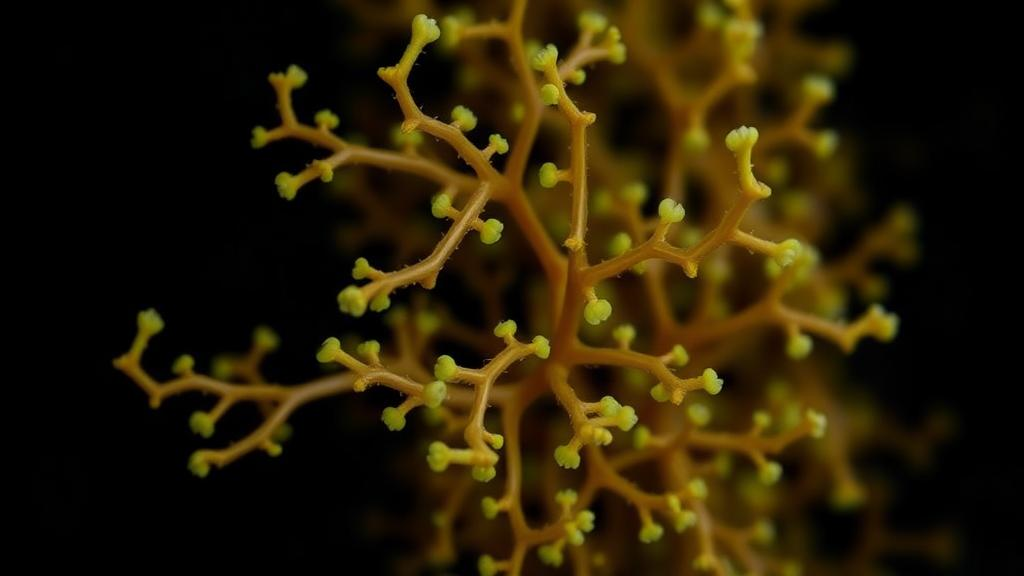
A team of phycologists has finally pinned down the identity of a marine red alga first collected in the 1840s, and in doing so has released a set of modular DNA primers that could reshape how scientists catalogue seaweed biodiversity worldwide. The study, published in Metabarcoding and Metagenomics, resolves the long-standing taxonomic puzzle of Corallina armata, a geniculate coralline alga described by William Harvey in 1849 from specimens sent to London by the New Zealand collector William Colenso. Because the original type material proved too degraded for DNA extraction, the researchers turned to freshly collected specimens from the type locality, sequencing two genetic markers and formally designating an epitype to anchor the name to a physical, sequenced reference specimen.
The genus Corallina has long frustrated taxonomists. Its species are built from articulated, calcified fronds that look remarkably alike, and recent work has shown that there are no diagnostic morpho-anatomical characters capable of separating them. The type species, C. officinalis, was once assumed to be globally distributed, but DNA sequence data have since restricted it to the North Atlantic and north-eastern Pacific, leaving a trail of misapplied names across the Southern Hemisphere. In New Zealand, the name C. officinalis was applied almost exclusively for more than a century, while early names based on local type material, including C. armata and C. hombronii, languished in obscurity. Clarifying these historical names has become essential as molecular surveys keep uncovering previously unrecognised diversity within the genus.
The identity of C. armata has been uncertain since its description. Colenso sent two collections to W.J. Hooker in London, numbered 224 and 654, gathered from tidal rocks near Mataikona and between Cape Turnagain and Castlepoint in the 1840s. Specimens bearing these numbers survive in the herbaria of Trinity College Dublin and the Natural History Museum in London, constituting isosyntypes. Unfortunately, the morphological features of this material and the illustrations accompanying the original description are insufficient for unambiguous identification. Attempts to sequence the historical specimens using both Sanger sequencing and short-read high-throughput methods returned no usable organellar sequences, indicating the DNA had degraded beyond recovery over nearly two centuries.
To overcome this obstacle, the team collected fresh specimens in 2024 from Mataikona tidal pools on the Wairarapa coast of New Zealand’s southern North Island, targeting the locations described by Colenso and the morphology of the isosyntype material. Four specimens conforming to C. armata and one to C. berteroi were gathered, air dried, preserved in silica and deposited in the herbarium of the Museum of New Zealand Te Papa Tongarewa. DNA was extracted and amplified for two gene regions: the chloroplast rbcL gene, one of the core plant barcodes proposed by the Consortium for the Barcode of Life, and the mitochondrial COI gene, amplified with the widely used Leray primers.
A key innovation of the study lies in the sequencing strategy. Rather than relying solely on traditional Sanger sequencing, the researchers used short-read metabarcoding on an Illumina MiSeq platform, processing the data through Cutadapt and DADA2 to produce high-quality amplicon sequence variants. The three Rhodophyta rbcL primer sets amplified the Corallina specimens more readily than the Ochrophyta sets, and post-filtering quality retention averaged 95 percent for the red algal primers and 96 percent for COI. The resulting sequences were aligned against reference entries from recent Corallina phylogenetic studies, many derived from expertly identified voucher material and rooted by type specimen sequences, providing a robust comparative framework.
The phylogenetic analyses delivered a clear verdict. Specimens collected as C. armata formed a distinctive clade, and the material collected as C. berteroi fell squarely within the C. berteroi clade, confirming the field identifications. Notably, one of the fresh C. armata specimens matched a single GenBank entry, collected from Otago roughly 800 kilometres from the type locality, with 100 percent confidence. That entry had been misidentified as C. caespitosa, a name whose type material has since been shown to be synonymous with the earlier-described C. berteroi. The match suggests C. armata may have a wider distribution in New Zealand than previously appreciated, and it highlights how taxonomic mislabelling in public databases can obscure true species identities.
Beyond standard tree-building, the researchers borrowed analytical tools from population genetics to sharpen species boundaries. They extracted single nucleotide polymorphisms from the COI and rbcL alignments, computed scaled allele frequencies and ran principal component analyses, including interactive three-dimensional visualisations, to assess how cleanly species separated in genetic space. Hierarchical clustering grouped sequences into species-specific clusters de novo, and pairwise permutational analysis of variance confirmed significant genetic differentiation amongst species with adequate replication, with the sole exception of C. armata versus the mislabelled “C. caespitosa” sequence. COI proved the more powerful marker, revealing 85 SNPs and roughly 5.8 percent divergence between C. armata and C. berteroi, compared with far fewer SNPs across the short rbcL fragments.
On the strength of this evidence, the team formally stabilised the nomenclature. They designated Colenso specimen 654, housed in Dublin and annotated as type by H.W. Johansen in 1967, as the lectotype, and selected a 2024 specimen from Mataikona, WELT A036058, as the epitype, following the requirements of the International Code of Nomenclature. An epitype serves as an interpretative type when the original material is demonstrably ambiguous and cannot be critically identified, which is precisely the situation created by the degraded historical specimens. The epitype now provides an unambiguous, sequenced reference point for future studies of Corallina phylogeny and biogeography.
The second major contribution is the primer suite itself. Surveying GenBank for nine candidate gene regions across 808 New Zealand seaweed species, the team found rbcL was by far the best represented, with entries for 438 species overall and the highest coverage in each of the three major macroalgal phyla: Chlorophyta, Ochrophyta and Rhodophyta. They designed 11 primers for Chlorophyta, 12 for Ochrophyta and nine for Rhodophyta, spanning more than 1,000 bases of the gene and arranged in modular pairs that can be mixed and matched to generate amplicons short enough for Illumina sequencing. In silico testing against roughly 53,000 GenBank entries showed the Rhodophyta primers each captured about 60 percent of red algal entries on average, with the Chlorophyta and Ochrophyta sets capturing around 40 and 30 percent respectively, and only about one percent of entries missed by every primer in their respective phyla.
The modular design is what sets these primers apart from existing universal rbcL primers, which the authors found were either too long for metabarcoding, not developed for macroalgae, or prone to non-specific amplification. Because environmental DNA is typically fragmented, short, overlapping amplicons are far more likely to succeed than full-gene barcodes, and the ability to tile primer pairs across the gene lets researchers target the best-represented regions of reference databases. The Ochrophyta and Rhodophyta short-read sets tested here enabled species-level identification, and the comprehensive primer-to-species match lists published with the study should help researchers worldwide select appropriate combinations. The Chlorophyta primers remain untested in the laboratory but are provided for future validation.
The study also carries a cautionary message about DNA reference databases. Taxonomic mislabelling of submitted sequences emerged as one of the most serious obstacles, since end users are typically unaware of the original misidentifications, and sequences from a single species can accumulate under a diversity of names. The authors argue that sequencing type material and incorporating it as a reference standard remains essential, and that multi-locus approaches are needed for robust species delimitation, as each gene revealed distinct interspecific relationships. With algal genomes still scarce, only 280 reference genomes for the three phyla combined compared with more than 2,400 for flowering plants, targeted PCR-based barcoding remains a cost-effective and immediate route to building reliable reference libraries.
For a genus once described as an ongoing project in systematics and nomenclature, the resolution of Corallina armata marks a tangible step forward. The combination of fresh field collections from historical type localities, next-generation sequencing of short amplicons, population-genetic analyses of SNP data and formal epitypification offers a template that other taxonomic groups with degraded type material and cryptic species could readily adopt. As metabarcoding becomes a mainstay of biodiversity assessment, tools like these modular rbcL primers promise to bridge the persistent gap between classical barcoding studies and large-scale environmental DNA surveys, bringing a stable classification of Corallina and its relatives within reach.
Subject of Research: DNA barcoding and metabarcoding of coralline algae using modular universal rbcL primers to resolve the taxonomy of Corallina armata
Article Title: Modular universal rbc L primers for (meta)barcoding: a systematic case study clarifying the identity of the marine macroalga Corallina armata ( Rhodophyta , Corallinales )
Article References: van der Reis, A. L., Sewell, M. A., Wade, R. M., & Nelson, W. A. (2026). Modular universal rbcL primers for (meta)barcoding: a systematic case study clarifying the identity of the marine macroalga Corallina armata (Rhodophyta, Corallinales). Metabarcoding and Metagenomics, 10, Article e173634. https://doi.org/10.3897/mbmg.10.173634
Image Credits: AI Generated
Keywords: Corallina armata, rbcL, DNA barcoding, metabarcoding, Rhodophyta, coralline algae, epitype, New Zealand, taxonomy, primers, COI, GenBank
Cite Scienmag News
Margaret Porter. (October 17, 2026). New DNA Primers Crack a 175-Year-Old Mystery of a New Zealand Seaweed. Scienmag. https://scienmag.com/new-dna-primers-crack-a-175-year-old-mystery-of-a-new-zealand-seaweed/
Margaret Porter. "New DNA Primers Crack a 175-Year-Old Mystery of a New Zealand Seaweed." Scienmag, 17 October 2026, https://scienmag.com/new-dna-primers-crack-a-175-year-old-mystery-of-a-new-zealand-seaweed/. Accessed 17 October 2026.
Margaret Porter. "New DNA Primers Crack a 175-Year-Old Mystery of a New Zealand Seaweed." Scienmag. October 17, 2026. https://scienmag.com/new-dna-primers-crack-a-175-year-old-mystery-of-a-new-zealand-seaweed/


