


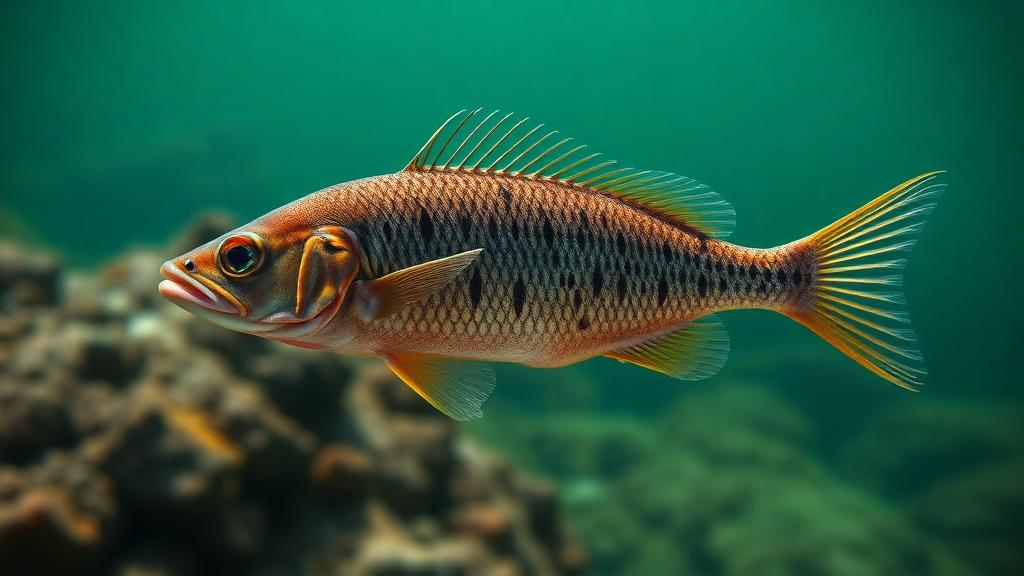
In the hill country of northern Tunisia, a quiet extinction is unfolding behind dam walls. The Algerian barb, Luciobarbus callensis, a cyprinid fish endemic to North Africa and once common in the country’s rivers and reservoirs, has now vanished from nearly half of the water bodies where it was historically recorded. A decade-long standardized survey of 21 Tunisian reservoirs, published in Acta Ichthyologica et Piscatoria, reveals that the species survives in only 11 of them, and that even where it persists, its numbers are alarmingly low. The study is the first comprehensive assessment of a native freshwater fish in Tunisian reservoirs, and its findings read like a case study in how outdated regulations, unsustainable fishing, and habitat degradation can combine to push an endemic species toward local extinction.
The Algerian barb belongs to the family Cyprinidae, one of the most diverse fish families in freshwater ecosystems, with more than 800 species distributed across Africa, Europe, and Asia. The genus Luciobarbus, to which the species belongs, is the most abundant and widespread fish genus in many freshwater systems of the Maghreb. Luciobarbus callensis is distributed across Morocco, Algeria, and Tunisia, primarily north and south of the Atlas Mountains. Its name originates from Lake La Calle in Algeria, where the first specimen was found. On the IUCN Red List, it is categorized as Least Concern globally because of its widespread presence in the region. But the new data from Tunisia suggest that this global status masks a much more precarious national reality, and that the species meets the criteria for threatened status within the country.
The research emerged from a development project initiated in 2013, a collaboration between the Technical Centre of Aquaculture in Tunis and the Higher Institute of Marine Sciences in Bizerte. The project aimed to update the freshwater fish database for Tunisian reservoirs and to develop a management plan for both native and introduced fish. Sampling followed the European standard for lake fish monitoring, using multi-mesh gillnets adapted to Tunisian conditions. Each net was 20 meters long and 1.5 meters deep, with eight different mesh sizes ranging from 18 to 80 mm. Nets were deployed in stratified depth zones, from the surface down to beyond 20 meters, and set in the late afternoon for approximately 12 hours, following the timing when fish swim intensively. Surveys were conducted during the spring season, from April 2013 to May 2023, a period of high fish mobility.
The results paint a stark picture. Among the eight freshwater fish species documented in Tunisian reservoirs, only two are strictly freshwater indigenous species, both cyprinids: the Algerian barb and the phoxinel, Tropidophoxinellus callensis. The Algerian barb was captured in only 11 of the 21 reservoirs surveyed. Catch per unit effort, calculated as the number of fish caught per 1000 square meters of net, was alarmingly low across most sites, typically below 50 fish per 1000 square meters. The sole exception was Bir Mcherga reservoir, where the catch rate was significantly higher than at all other sites. Statistical analysis revealed highly significant differences in catch rates among reservoirs, and follow-up surveys showed significant temporal declines. Catches fell to zero in Sidi Barrak between 2013 and 2022, and in Siliana between 2015 and 2021. In Kasseb reservoir, catch rates collapsed from 20.02 to 0.83 fish per 1000 square meters between 2015 and 2021.
To assess the health of the remaining stocks, the researchers applied two data-limited stock assessment models: the Length-based Bayesian Biomass model, known as LBB, and the Catch Maximum Sustainable Yield model, known as CMSY++. Both methods are validated for fisheries where conventional data are scarce, which is precisely the situation for the Algerian barb in Tunisian reservoirs, where no commercial fishery exists and the species is caught only as bycatch. The LBB model uses length-frequency data to estimate biomass ratios and fishing intensity, while CMSY++ relies on a time series of catches and assumptions about the intrinsic population growth rate to estimate reference points such as the biomass at maximum sustainable yield and the fishing mortality relative to that level.
The LBB analysis, applied to six reservoirs with sufficient data, revealed stark contrasts in stock status. Relative fishing intensity exceeded 1 in Siliana, Kasseb, Ghezala, and Bir Mcherga, indicating high exploitation rates. This was consistent with unfished biomass ratios falling below 0.5 in these reservoirs, suggesting severely depleted biomass. By contrast, Sidi Saad and Sidi Barrak in 2013 had healthier stock levels. However, ratios of mean length in the exploited population to the optimal length below unity in several reservoirs indicated a truncated population structure and the capture of undersized individuals. The CMSY++ results corroborated the diagnosis of widespread overexploitation. Across all reservoirs, biomass was notably lower than the biomass at maximum sustainable yield, indicating stock depletion. Fishing mortality surpassed the sustainable level in Joumine, Barbara, Bouheurtma, and Sidi Barrak. Kobe plots derived from the model showed a high probability that stocks were overfished in Sidi Saad, Kasseb, Sidi Barrak, Ghezala, Bouheurtma, Barbara, and Joumine, with probabilities ranging from 61.9 to 94.9 percent.
The length-frequency analysis exposed a critical regulatory failure at the heart of the species’ decline. Tunisian legislation sets the minimum legal catch size for the Algerian barb at 15 centimeters. But the species reaches sexual maturity at 26.5 centimeters in Tunisia and 27.7 centimeters in Algeria. This means that most of the specimens caught, particularly in reservoirs such as Bir Mcherga, Mellegue, and Joumine, where mean lengths were 22.5, 19.5, and 13.8 centimeters respectively, are biologically immature, yet remain legally exploitable under the outdated minimum size limit. From a biological perspective, these fish are undersized, even though they exceed the legal catch size. The harvest of juveniles before they can reproduce truncates the population structure and undermines the species’ capacity for recruitment, a fundamental prerequisite for sustainable exploitation.
The vulnerability of the Algerian barb is deeply rooted in its life-history strategy. It is a slow-growing species characterized by late sexual maturity and relatively low fecundity, a classic K-selected strategy. While this strategy is evolutionarily successful in stable environments, it becomes a severe liability in the face of rapid environmental change and heightened mortality, because the population lacks the intrinsic rate of increase required to recover quickly from perturbations. This liability is compounded by behavioral vulnerabilities. The species exhibits a nocturnal feeding rhythm that coincides with the operational timing of gillnets, significantly increasing its susceptibility to capture. It also shows a strong preference for the upper three meters of the water column, a behavioral adaptation that allows it to avoid deoxygenated, warmer, and saltier conditions in the deeper, stratified layers of reservoirs.
Beyond fishing pressure, dam construction has fundamentally transformed the species’ habitat. The most significant impact is the hydrological fragmentation of river systems, which blocks essential migratory pathways that the species relies on to access optimal spawning grounds. The transformation of flowing river environments into still reservoirs creates a habitat that is intrinsically alien to this rheophilic species. Climate change is now amplifying these detrimental effects. Spawning in the Algerian barb is thermally mediated and initiated when water temperatures exceed 20 degrees Celsius, historically occurring between mid-May and early July. This timing was ecologically synchronized with the Tunisian national fishing calendar, which traditionally prohibits fishing in March and April, thereby protecting pre-spawning adults. But documented warming trends suggest that the spawning window is shifting earlier, potentially beginning at the end of April. This phenological shift creates a critical misalignment: spawning adults, previously protected by the spring fishing ban, are now becoming vulnerable to fishing pressure in May, before they have had the opportunity to reproduce. Climate change is also exacerbating regional droughts, resulting in reduced freshwater input, increased salinity, and the fragmentation of water bodies into isolated, stagnant pools, conditions detrimental to a species that requires clear, well-oxygenated waters for successful egg and larval development.
The decline may be further exacerbated by the introduction of non-native piscivorous fish such as pike-perch and wels catfish, which have been documented to impact native fish communities. This creates a compounded mortality risk across life stages: fishing pressure contributes significantly to adult mortality, while introduced predators cause severe mortality among juveniles, suppressing recruitment while fishing simultaneously depletes the spawning stock. The researchers call for an integrated, multifaceted conservation strategy. The most urgent action is the immediate revision of fishing regulations, raising the legal size limit to at least 26.5 centimeters to ensure that every individual can spawn at least once. Proactive management of invasive predators, habitat restoration to improve hydrological connectivity, and a robust long-term monitoring program are also essential. Targeted breeding programs and restocking efforts should be considered to recover critically depleted populations. The loss of the Algerian barb is not inevitable, the study concludes, but avoiding it requires moving beyond merely documenting its decline and implementing bold, science-based conservation actions before this important native species becomes completely and irreversibly extinct.
Subject of Research: Under threat in North African reservoirs: The decline of the Algerian barb, Luciobarbus callensis (Actinopterygii, Cypriniformes, Cyprinidae), in Tunisia as a case study
Article Title: Under threat in North African reservoirs: The decline of the Algerian barb, Luciobarbus callensis ( Actinopterygii , Cypriniformes , Cyprinidae ), in Tunisia as a case study
Article References: Mili, S., Ennouri, R., Agrebi, S., Fatnassi, M., Chargui, T., Hedfi, A., Ben Ali, M., Boufahja, F., & Laouar, H. (2026). Under threat in North African reservoirs: The decline of the Algerian barb, Luciobarbus callensis (Actinopterygii, Cypriniformes, Cyprinidae), in Tunisia as a case study. Acta Ichthyologica et Piscatoria, 56, 41-54. https://doi.org/10.3897/aiep.56.157532
Image Credits: AI Generated
Keywords: Under, threat, North, African, reservoirs, decline, Algerian, barb, Luciobarbus, callensis, Actinopterygii, Cypriniformes
Cite Scienmag News
Violet Maxwell. (October 17, 2026). North African reservoirs are losing the Algerian barb, a native fish squeezed by outdated rules. Scienmag. https://scienmag.com/north-african-reservoirs-are-losing-the-algerian-barb-a-native-fish-squeezed-by-outdated-rules/
Violet Maxwell. "North African reservoirs are losing the Algerian barb, a native fish squeezed by outdated rules." Scienmag, 17 October 2026, https://scienmag.com/north-african-reservoirs-are-losing-the-algerian-barb-a-native-fish-squeezed-by-outdated-rules/. Accessed 17 October 2026.
Violet Maxwell. "North African reservoirs are losing the Algerian barb, a native fish squeezed by outdated rules." Scienmag. October 17, 2026. https://scienmag.com/north-african-reservoirs-are-losing-the-algerian-barb-a-native-fish-squeezed-by-outdated-rules/


