


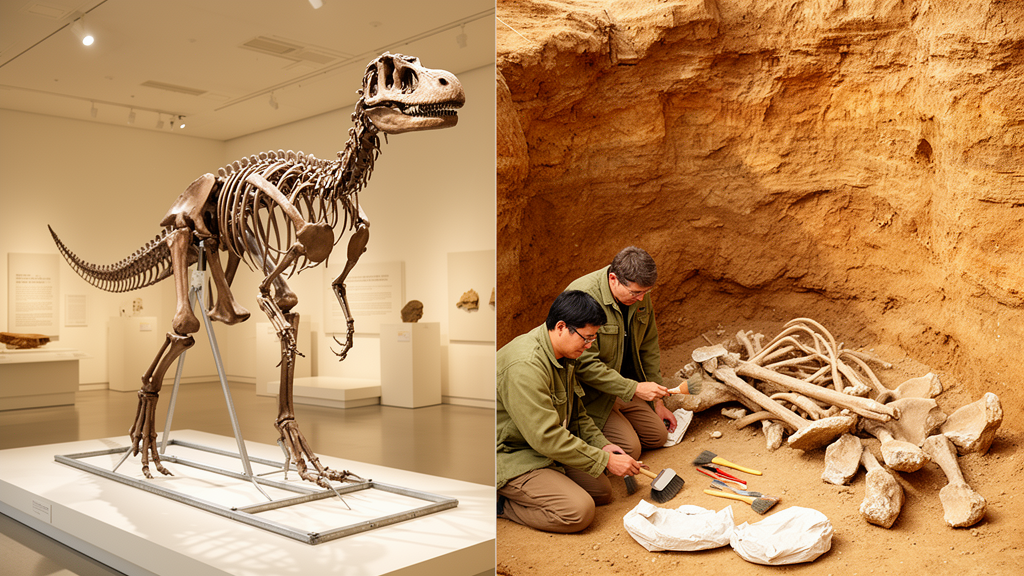
For decades, South Korea has been one of the world’s most generous suppliers of dinosaur footprints and eggs, yet one of its stingiest when it comes to actual dinosaur bones. That paradox has now been broken in spectacular fashion. A team of paleontologists has described a brand-new species of small, plant-eating dinosaur from a remarkably complete skeleton unearthed on Aphae Island, off the country’s southwestern coast. The animal, named Doolysaurus huhmini in a nod to a beloved Korean cartoon dinosaur, is the first dinosaur from the Korean Peninsula known from diagnostic skull material, and it is forcing scientists to rethink just how rich the Cretaceous dinosaur fauna of East Asia really was.
The skeleton, catalogued as KDRC-SA-V001, was recovered from the Ilseongsan Formation, a sequence of reddish-brown sandy mudstones exposed along the island’s shoreline. These fine-grained layers, interbedded with gray volcanic ash deposits, represent a quiet floodplain environment where sediment accumulated steadily and relatively rapidly, punctuated by episodes of soil formation marked by calcareous nodules. The same strata have previously yielded an exceptionally preserved nest of giant theropod eggs assigned to Macroelongatoolithus, making Aphaedo one of the most intriguing dinosaur localities in all of Korea. Dating of the formation has been contentious, but the weight of evidence, including U-Pb zircon ages of roughly 97.55 million years for an overlying tuff and biostratigraphic data from ostracods and egg types, places the Ilseongsan Formation in the mid-Cretaceous, between about 113 and 97 million years ago.
What makes the new specimen extraordinary is its state of preservation. It comprises a small, partially articulated skeleton with cranial elements, including a maxilla, dentary, quadrate, and several braincase bones, alongside hindlimb bones, vertebrae, ribs, and a cluster of swallowed stones known as gastroliths. Because the bones are embedded in hard mudstone, the researchers turned to X-ray micro-computed tomography, scanning the block at the University of Texas High-Resolution X-ray Computed Tomography Facility. Three scans, with voxel sizes ranging from about 60 to 134 micrometers, allowed the team to digitally segment and visualize the anatomy in three dimensions, revealing details that would have been impossible to extract mechanically. The result is the first studied cranial material of any dinosaur from Korea.
Microscopic examination of a thin section cut from the femur told an equally compelling story about the animal’s age. The cortical bone is thin, measuring only 1.2 to 1.6 millimeters, and consists of parallel-fibered tissue laced with longitudinal vascular canals. Crucially, there is no sign of reduced vascularization toward the outer surface, indicating the animal was still growing rapidly when it died. A single faint line near the mid-cortex may represent a line of arrested growth, but the researchers interpret the overall picture as that of a juvenile, probably between zero and two years old. Supporting this, the vertebral centra remain unfused from their neural arches, and the cranial bones are disarticulated, hallmarks of an immature individual. The estimated femoral length of roughly 12 to 13 centimeters matches that of other known juvenile neornithischians such as Fona and Haya.
Phylogenetic analysis placed Doolysaurus firmly within Thescelosauridae, a clade of small-bodied, early-diverging neornithischian dinosaurs. Using a large character matrix of more than 900 morphological characters and 174 ornithischian taxa, the team ran both parsimony searches in TNT and tip-dated Bayesian analyses in MrBayes under a fossilized birth-death model. Both approaches recovered Doolysaurus within Thescelosaurinae, as the sister taxon to a group containing the North American genera Parksosaurus, Fona, and Thescelosaurus. Sensitivity analyses using a second, independently published dataset confirmed that whenever Thescelosauridae resolves as monophyletic, the Asian taxa, including Doolysaurus, consistently occupy basal positions within the group. This pattern carries significant biogeographic implications, suggesting that the initial divergence between Thescelosaurinae and Orodrominae may have occurred in Asia before dispersing into North America.
The discovery also helps bridge a temporal gap in the Asian fossil record. Koreanosaurus boseongensis, the only other Korean neornithischian, hails from the much younger Seonso Conglomerate, dated to about 81 million years ago, and has consistently been recovered within Orodrominae. Doolysaurus, by contrast, is a thescelosaurine from rocks roughly 20 million years older. In North America, thescelosaurines were long thought to appear only near the end of the Cretaceous, but recent finds such as Fona from the Cedar Mountain Formation demonstrate that both subclades coexisted there during the Late Cretaceous. The Korean record now shows a similar temporal overlap, hinting that these two groups may have occupied distinct paleoenvironments, with thescelosaurines favoring the floodplain settings preserved at Aphaedo.
Perhaps the most unexpected find within the skeleton was a cluster of 40 to 50 small, well-sorted pebbles nestled between the vertebrae and femur. These gastroliths, ranging from 2 to 10 millimeters in diameter and composed of quartzite and volcanic rocks, form an ellipsoidal mass with an estimated minimum volume of 9.3 milliliters and a mass of at least 30.7 grams. Relative to the animal’s estimated body mass of about 8.3 kilograms, derived from femoral circumference, this represents roughly 0.37 percent of body weight. Comparative analysis across ornithischian dinosaurs with known gastroliths, including Haya, Gasparinisaura, and Zavacephale, reveals a strong linear correlation between body mass and gastrolith mass, with a coefficient of determination of 0.90. The subrounded morphology of the stones, combined with the presence of discoid pebbles alongside more spherical ones, suggests a less powerful gastric mill than that of modern granivorous birds and points toward a more generalized or omnivorous diet for this small dinosaur.
One of the most puzzling aspects of the Korean dinosaur record is the complete absence of footprints attributable to early-diverging neornithischians, despite the country’s extraordinary trackway abundance. The researchers propose two possible explanations. First, the floodplain environments where these animals lived and died, characterized by prolonged subaerial exposure under unsaturated conditions, are fundamentally poor at preserving footprints, which typically require brief exposure followed by rapid burial, as along lake margins or shorelines. Second, many early-diverging neornithischians may have exhibited fossorial or semi-fossorial behaviors, digging in dry substrates far from the waterlogged settings where tracks form. Alternatively, it is possible that some tridactyl footprints previously assigned to theropods were actually produced by these small bipedal ornithischians, whose reduced first digits would have left little trace on the ground, producing sharp, three-toed prints nearly indistinguishable from those of predatory dinosaurs.
The rarity of dinosaur skeletons in Korea more broadly reflects a confluence of geological and practical factors. Most Mesozoic body fossil-bearing strata are exposed in coastal and island regions where strong tidal activity and limited access hinder systematic excavation. Furthermore, widespread magmatism during the Late Cretaceous and early Paleogene thermally metamorphosed many sedimentary rocks into hornfels and deformed stratigraphic sequences, compromising fossil preservation and complicating mechanical preparation. Yet the sheer diversity of the Korean footprint record, documenting ankylosaurs, large ornithopods, and theropods across a wide size range, makes clear that the actual Cretaceous dinosaur fauna was far richer than the skeletal record suggests. Doolysaurus now provides tangible confirmation of that hidden diversity.
The Aphaedo site itself holds special promise for future discoveries. The co-occurrence of a giant theropod egg nest and a delicately preserved small-bodied neornithischian skeleton within the same formation suggests that other small dinosaur fossils may await discovery at Aphaedo or at localities with similar taphonomic conditions elsewhere in Korea. The site also occupies a key stratigraphic position, bridging the gap between the Early Cretaceous Yixian Formation of China and the Late Cretaceous Javkhlant Formation of Mongolia, two of Asia’s most productive dinosaur localities. As excavations continue and new material comes to light, Doolysaurus huhmini stands as both a scientific milestone and an invitation, reminding paleontologists that even in a country famous for its footprints, the bones themselves may hold the richest stories of all.
Subject of Research: A new dinosaur species from Korea and its implications for early-diverging neornithischian diversity
Article Title: A new dinosaur species from Korea and its implications for early-diverging neornithischian diversity
Article References: Jung, J., Kim, M., Jo, H., & Clarke, J. A. (2026). A new dinosaur species from Korea and its implications for early-diverging neornithischian diversity. Fossil Record, 29(1), 87-113. https://doi.org/10.3897/fr.29.178152
Image Credits: AI Generated
DOI: 10.3897/fr.29.178152
Keywords: dinosaur, species, Korea, implications, early-diverging, neornithischian, diversity, scientific research
Cite Scienmag News
Cassandra Pierce. (October 17, 2026). New Korean dinosaur Doolysaurus reveals hidden diversity of Cretaceous Asia. Scienmag. https://scienmag.com/new-korean-dinosaur-doolysaurus-reveals-hidden-diversity-of-cretaceous-asia/
Cassandra Pierce. "New Korean dinosaur Doolysaurus reveals hidden diversity of Cretaceous Asia." Scienmag, 17 October 2026, https://scienmag.com/new-korean-dinosaur-doolysaurus-reveals-hidden-diversity-of-cretaceous-asia/. Accessed 17 October 2026.
Cassandra Pierce. "New Korean dinosaur Doolysaurus reveals hidden diversity of Cretaceous Asia." Scienmag. October 17, 2026. https://scienmag.com/new-korean-dinosaur-doolysaurus-reveals-hidden-diversity-of-cretaceous-asia/


