


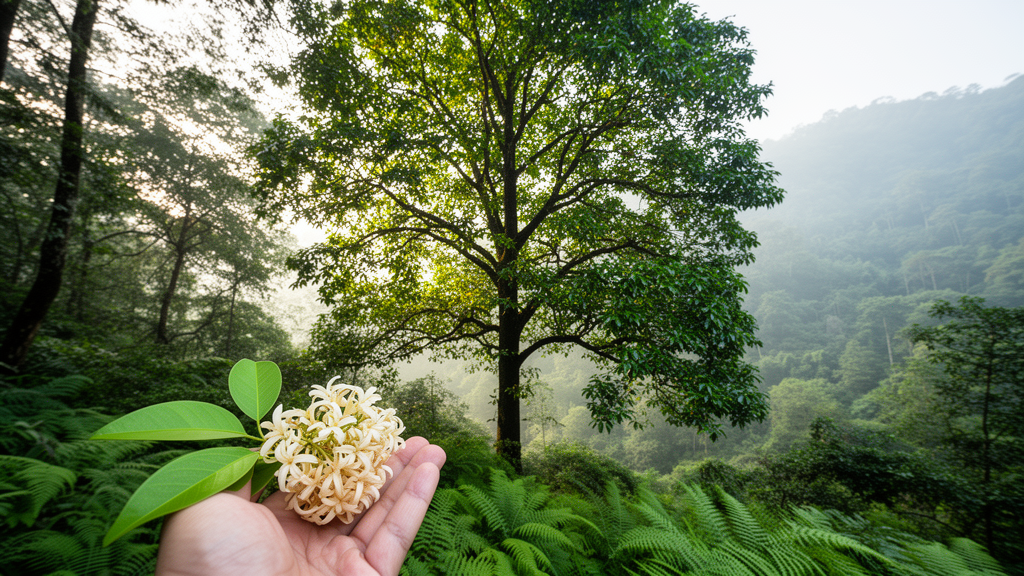
Deep in the subtropical evergreen broad-leaved forests of Jiangmen City, in south-central Guangdong Province, China, botanists have identified a tree that turns out to be entirely new to science. The species, formally named Cinnamomum fasciculatum, belongs to the laurel family (Lauraceae), one of the defining plant families of tropical and subtropical evergreen forests worldwide, and to the camphor section of the genus Cinnamomum, the group that includes the famous camphor tree. The discovery, published in the journal PhytoKeys, was confirmed through a combination of careful field observation, detailed morphological comparison with herbarium specimens, and phylogenetic analysis of complete chloroplast genomes.
The story began during field expeditions in 2024 and 2025, when researchers working in Jiangmen encountered an unfamiliar Cinnamomum tree that they could not match to any known species. Rather than relying on a single sighting, the team carried out phenological monitoring across seasons, watching when the tree flowered and fruited, and collected voucher specimens that were deposited at the Herbarium of the South China Botanical Garden of the Chinese Academy of Sciences. They then compared the living plants and pressed specimens against digitized type specimens from major herbaria in China, Europe, and North America, accessed through the Chinese Virtual Herbarium, JSTOR Global Plants, and the TAIF website, as well as against the relevant taxonomic and floristic literature.
Cinnamomum is one of the largest and most economically important genera in the laurel family, with roughly 250 species distributed from tropical and subtropical Asia to the western Pacific. The genus is traditionally split into two sections: sect. Camphora, with about 20 species including the camphor tree itself, and sect. Cinnamomum, with around 230 species that include cinnamon. The two sections differ in leaf arrangement and venation, in the presence of domatia, small chambers in the axils of lateral veins, and in the structure of their buds. Sect. Camphora species bear alternate, pinnately veined leaves, usually have domatia, and typically develop perulate buds protected by scales, whereas sect. Cinnamomum species have more or less opposite, trinerved leaves without domatia and non-perulate buds.
The new tree displays the classic hallmarks of sect. Camphora: alternate pinnately veined leaves, thyrsoid inflorescences whose cymes bear strictly opposite lateral flowers, bisexual flowers with nine fertile stamens and three sagittate staminodes, cupulate fruits whose tepals do not persist, and turbinate pedicels. Among its section-mates, it most closely resembles Cinnamomum parthenoxylon, sharing silky-haired terminal buds, glabrous branchlets, glabrous leaves, and fruits of similar shape and size. Yet the two species are readily told apart. The new species has obovate to obelliptic leaves with an obtuse apex, rather than the elliptic-ovate leaves with acute or shortly acuminate tips of C. parthenoxylon, and its fruits are subglobose, measuring 8 to 9 millimeters long and 8 to 10 millimeters across.
The most striking difference, and the feature that gives the species its name, lies in where the flowers are borne. Within sect. Camphora, inflorescences are usually axillary or lateral, and only rarely terminal. In the new species, the thyrsoid inflorescences are subterminal, arranged in the axils of cataphylls just below the terminal vegetative bud, and sometimes also on short axillary brachyblasts, producing a fasciculate, bundle-like appearance. This subterminal arrangement is reported for the first time in the section. The flowering branches resemble miniature versions of those of C. parthenoxylon, but the inflorescences are subtended by caducous bracts that fall early, rather than by leaves. The species also flowers distinctly later in the year, from June to July, whereas C. parthenoxylon flowers from March to May, a phenological gap that helps keep the two species reproductively separate where they occur in the same region.
Comparison with a second relative, Cinnamomum micranthum, further sharpens the diagnosis. That species also bears inflorescences at the branch apex, but its inflorescences are truly terminal, crowning shoots that lack a terminal bud, whereas the new species flowers below an intact terminal bud. The fruit differences are even more dramatic: C. micranthum produces large ellipsoid fruits 1.5 to 2.2 centimeters long, roughly twice the length of the subglobose fruits of the new species. The authors compiled a twelve-character comparison table covering leaf shape, leaf apex, the texture of the vein axils on both leaf surfaces, leaf dimensions, inflorescence position, length, and indumentum, fruit shape and size, cupule form, and flowering season to document these distinctions rigorously.
To test whether the tree was not merely morphologically distinct but also evolutionarily independent, the researchers sequenced complete chloroplast genomes. DNA was extracted using a modified CTAB method, sequencing libraries were prepared on a PCR-free protocol and run on a DNBSEQ-T7 platform producing 150-base-pair paired-end reads, and the plastomes were assembled, connected, and annotated with GetOrganelle, Bandage, and Geneious, using the published camphor tree plastome as a reference. The resulting sequences were deposited in GenBank. The phylogenetic dataset ultimately comprised 39 chloroplast genome accessions, including five newly generated sequences and 34 downloaded from GenBank, spanning 20 species of sect. Camphora, 10 species of sect. Cinnamomum, and seven species from closely related genera such as Sassafras, Ocotea, Nectandra, Aiouea.
The analysis followed a standard maximum likelihood workflow: one inverted repeat region was excluded from each plastome, sequences were aligned with MAFFT using iterative refinement, the alignment was trimmed with TrimAl under an automated heuristic, and the tree was inferred with IQ-TREE with automatic model selection and 1,000 bootstrap replicates. The resulting phylogeny resolved Cinnamomum into two major clades with an unexpected twist. In clade I, seven species traditionally assigned to sect. Camphora are nested within sect. Cinnamomum, six of them forming a monophyletic group. In clade II, the remaining 13 species of sect. Camphora form a monophyletic group sister to Sassafras. The three samples of the new species cluster tightly together in clade I, where they are sister to a clade comprising Cinnamomum mollifolium and Cinnamomum tenuipile, confirming its status as a distinct lineage within sect. Camphora.
The tree’s placement also touches a live controversy in laurel systematics. In 2022, researchers resurrected the older genus name Camphora to accommodate the species of sect. Camphora in the strict sense, while retaining Cinnamomum for sect. Cinnamomum and a handful of camphor-section species. However, plastome studies have repeatedly shown that sect. Camphora as traditionally circumscribed is not monophyletic, with some species sister to Sassafras and others nested inside sect. Cinnamomum, and an earlier analysis of three nuclear markers, ITS, LEAFY, and RPB2, found a similar intermixing. Because morphological and molecular delimitations of the two genera do not fully agree, the authors of the new study adopted a conservative approach and placed the species in Cinnamomum sect. Camphora, noting that further investigation is needed before the generic boundary question can be settled.
In the formal description, Cinnamomum fasciculatum is an evergreen tree 7 to 11 meters tall with a trunk diameter at breast height of up to 50 centimeters, yellow-brown longitudinally fissured bark, and a broadly ovate to globose crown. Its thinly leathery leaves are 5 to 8 centimeters long, glaucous beneath, with five to six pairs of secondary veins and foveolate depressions on both surfaces. The white-yellow flowers are about 5.5 millimeters across, with six tepals, nine fertile stamens in three whorls, the third whorl extrorse and bearing two reniform glands at the base of each filament, and three sagittate staminodes. Fruits ripen black from August to November. The species is currently known only from Xinhui District and Taishan County of Jiangmen City, growing in subtropical evergreen broad-leaved forest at 190 to 300 meters elevation, and both known populations, totaling roughly 50 individuals, lie within the Gudoushan Provincial Nature Reserve. Because so little is known about its true population size and distribution, the species is provisionally assessed as Data Deficient under the IUCN Red List criteria, and the authors emphasize that further field surveys are critically necessary to determine whether this newly recognized member of the camphor lineage is rare by nature or simply hidden in plain sight.
Subject of Research: Description of a new laurel tree species, Cinnamomum fasciculatum, from Guangdong, China, based on morphology and chloroplast genome phylogenetics
Article Title: Cinnamomum fasciculatum ( Lauraceae ), a new species from Guangdong, China
Article References: Deng, S.-W., Huang, G.-Y., Zeng, S.-Y., Xu, Y., & Wang, R.-J. (2026). Cinnamomum fasciculatum (Lauraceae), a new species from Guangdong, China. PhytoKeys, 278, 105-116. https://doi.org/10.3897/phytokeys.278.199869
Image Credits: AI Generated
DOI: 10.3897/phytokeys.278.199869
Keywords: Cinnamomum fasciculatum, Lauraceae, new species, Guangdong, chloroplast genome, phylogenetics, sect. Camphora, taxonomy, camphor tree, IUCN Data Deficient, inflorescence, PhytoKeys
Cite Scienmag News
Margaret Porter. (October 17, 2026). New Camphor Tree Species Hidden in Guangdong’s Forests Revealed by DNA and Unusual Flowers. Scienmag. https://scienmag.com/new-camphor-tree-species-hidden-in-guangdongs-forests-revealed-by-dna-and-unusual-flowers/
Margaret Porter. "New Camphor Tree Species Hidden in Guangdong’s Forests Revealed by DNA and Unusual Flowers." Scienmag, 17 October 2026, https://scienmag.com/new-camphor-tree-species-hidden-in-guangdongs-forests-revealed-by-dna-and-unusual-flowers/. Accessed 17 October 2026.
Margaret Porter. "New Camphor Tree Species Hidden in Guangdong’s Forests Revealed by DNA and Unusual Flowers." Scienmag. October 17, 2026. https://scienmag.com/new-camphor-tree-species-hidden-in-guangdongs-forests-revealed-by-dna-and-unusual-flowers/


