


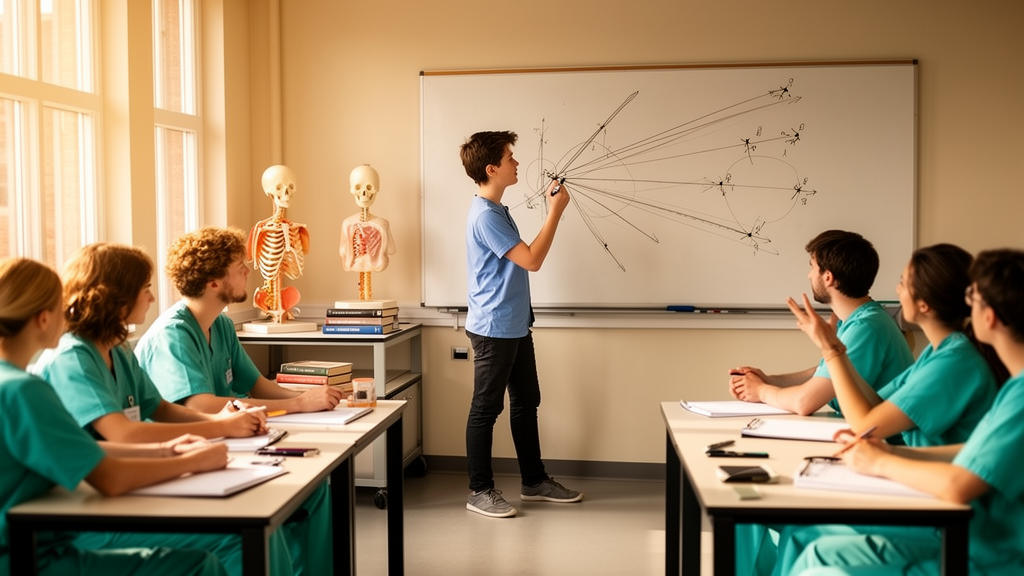
At a South African university of technology, students training to become radiographers are quietly rewriting one of higher education’s most stubborn narratives: that Physics is the course where struggling students go to fail. A new study of 148 students enrolled in the Bachelor of Radiography in Diagnostics and the Extended Curriculum Programme found that more than half of the participants who sat two sequential Physics tests reported moving up a full grade category between the first assessment and the second, a shift the researchers describe as statistically significant with a large effect size. The intervention behind the improvement is supplemental instruction, a peer-assisted learning model in which trained senior students, a postgraduate tutor, and an intern medical physicist run weekly 90-minute problem-solving sessions outside the formal lecture schedule.
The study, published in Frontiers in Education by Nape Matheko Phahlamohlaka and Vukani Siphesihle Ncwane of the Central University of Technology in Bloemfontein, set out to fill a conspicuous gap. Supplemental instruction, often abbreviated as SI, has accumulated decades of evidence in chemistry, anatomy, and mathematics, where it is routinely deployed in modules with failure rates exceeding 30 percent. Yet empirical data on its role in Physics, particularly within health sciences education in South Africa, have remained thin. That gap matters because Physics is the conceptual backbone of radiography: x-ray imaging principles, radiation physics, and clinical applications all rest on ideas that students frequently find abstract and mathematically demanding. Previous research has suggested that radiography students struggle to apply radiation physics concepts when they reach clinical training, making the module a high-risk bottleneck for the profession.
The researchers recruited a convenience sample of 183 students from an eligible population of 350, collecting data between April and June 2025 through structured questionnaires offered in both paper-based and online formats. Of those approached, 81.42 percent responded, and after one age-based exclusion, 148 participants entered the analysis. The design was quantitative, retrospective, and observational, comparing two sequential self-reported assessment categories among students participating in SI. Grades for Test 1 and Test 2 were self-reported, a methodological choice the authors acknowledge as a limitation, since recall and social desirability may have shaped the answers. The findings were interpreted through Vygotsky’s sociocultural theory of learning, which holds that learning occurs through social interaction with more knowledgeable others within the zone of proximal development.
The statistical results were striking. Among the 108 participants with matched Test 1 and Test 2 data, the median self-reported grade category was one category higher in Test 2 than in Test 1, with a 95 percent confidence interval of 0 to 1, a Wilcoxon signed-rank statistic of Z = −5.941, and a p-value below 0.001. The effect size, r = 0.57, is large by conventional standards. Of the matched participants, 51.9 percent reported an improvement, 39.8 percent remained unchanged, and only 8.3 percent reported a lower grade category. The median grade category rose from 56 to 60 percent for Test 1 to 61 to 70 percent for Test 2, suggesting that the cohort as a whole drifted upward across the assessment sequence.
Attendance patterns added nuance to the picture. Lecture attendance showed a moderate positive association with Test 1 grades, with a Spearman correlation coefficient of rho = 0.336 and p < 0.001, and a weaker association with Test 2 grades, rho = 0.239, p = 0.012. Supplemental instruction attendance, by contrast, showed no evidence of an association with Test 1 grades, rho = 0.025, p = 0.769, but a weak positive association with Test 2 grades, rho = 0.191, p = 0.048. The researchers suggest that formal lectures and SI sessions may fulfil complementary educational roles: lectures deliver foundational disciplinary knowledge, while SI offers opportunities for collaborative application and reinforcement. Most students reported attending 80 to 100 percent of scheduled lectures, and nearly three-quarters attended at least 40 percent of SI sessions, with a median SI attendance category of 60 to 79 percent.
Satisfaction with the peer facilitators themselves was favourable. More than half of the respondents, 53.0 percent, rated the facilitation of SI sessions as either good or very good, with a median rating of good and an interquartile range of 3 to 4 on the rating scale. A further 34.7 percent rated facilitation as average, while 12.3 percent rated it as poor or very poor. Perhaps more telling was the perception of content alignment: 70.5 percent of valid respondents agreed or strongly agreed that SI content aligned with the Physics lecture material, with a 95 percent confidence interval of 62.0 to 77.8 percent. Only 4.7 percent disagreed. This alignment is no accident. The university’s SI programme is deliberately engineered to keep peer sessions synchronised with formal teaching, with facilitators co-creating worksheets in consultation with the module lecturer and maintaining weekly communication via email or WhatsApp.
The mechanics of the programme reveal how much infrastructure underpins what appears to students as an informal study group. SI facilitators are selected from senior radiography students with the highest academic performance scores in Physics, identified by the module lecturer, and each facilitator is responsible for a single year group for the remainder of the academic year. Before interacting with students, facilitators complete a one-day training workshop covering the facilitation process, group management, active engagement, collaborative problem-solving strategies, questioning and feedback techniques, and approaches for promoting learner independence. Sessions are interactive and discussion-based rather than repeated lectures, using questions, prompts, explanations, peer discussion, and a whiteboard to guide students through challenging problems. Approximately 20 sessions are offered per academic year, attendance is recommended but voluntary, and the module lecturer conducts quarterly visits to SI sessions to review progress and provide timely feedback.
The theoretical framing of the study gives the intervention its intellectual coherence. Within Vygotsky’s framework, Physics lecturers act as subject experts who introduce core concepts during formal lectures, while trained senior students, a postgraduate tutor, or an intern medical physicist serve as near-peer more knowledgeable others, facilitating scaffolded problem-solving within the zone of proximal development. Through guided discussion and collaborative learning, SI is considered to enable students to strengthen conceptual understanding, build confidence, and develop independent problem-solving skills. Previous studies have reported that SI may support academic confidence, motivation, social integration, and a sense of belonging, outcomes consistent with the possibility that supportive learning relationships facilitate cognitive development through dialogue rather than passive knowledge transmission. The authors are careful, however, to note that engagement and the proposed learning mechanisms were not quantitatively measured in this study.
The researchers are equally candid about the limits of their evidence. The study lacked randomisation and a comparison group, so the observed improvement between Test 1 and Test 2 cannot be attributed solely to SI. Regular teaching, maturation, assessment familiarity, differences in test content or difficulty, lecture attendance, independent study, and other academic support may all have influenced performance. Self-selection into SI may have introduced selection bias, and self-reported attendance may have been affected by recall and social desirability. Missing Test 2 data reduced the matched sample to 108 participants and may have introduced attrition bias. The single-institution setting and non-probability sample further limit generalisability. The authors call for future research using prospective, controlled, multi-institutional designs and validated measures to determine whether SI genuinely improves academic performance rather than merely accompanying it.
Nevertheless, the findings carry practical weight for institutions grappling with high-risk STEM modules. The results support the continued provision of SI as a student-support strategy in the Physics module for the BRad programme and Extended Curriculum Programmes at the South African university. The ECP itself is an initiative of South Africa’s Department of Higher Education and Training that extends an undergraduate qualification by one academic year to provide integrated foundational support for students who have the potential to succeed but require additional preparation. Within the Faculty of Health and Environmental Sciences, ECPs span five programmes, including medical laboratory sciences, clinical technology, environmental health, radiography, and somatology. As universities worldwide search for scalable ways to keep underprepared students in demanding science programmes, the Bloemfontein data suggest that structured peer-assisted learning, carefully aligned with formal teaching and grounded in sociocultural theory, may be one of the more promising tools available, even if the definitive causal verdict still awaits a controlled trial.
Subject of Research: Students’ experiences of supplemental instruction and self-reported academic performance in Physics within the bachelor of radiography and extended curriculum programme
Article Title: Students’ experiences of supplemental instruction and self-reported academic performance in Physics within the bachelor of radiography and extended curriculum programme
Article References: Phahlamohlaka, N. M., & Ncwane, V. S. (2026). Students’ experiences of supplemental instruction and self-reported academic performance in Physics within the bachelor of radiography and extended curriculum programme. Frontiers in Education, 11, Article 1937898. https://doi.org/10.3389/feduc.2026.1937898
Image Credits: AI Generated
DOI: 10.3389/feduc.2026.1937898
Keywords: education, physics, radiography, peer learning, South Africa, Students, experiences, supplemental, instruction, self-reported, academic, performance
Cite Scienmag News
Katie Riggs. (October 17, 2026). Peer-Led Physics Sessions Boost Radiography Students’ Grades, Study Finds. Scienmag. https://scienmag.com/peer-led-physics-sessions-boost-radiography-students-grades-study-finds/
Katie Riggs. "Peer-Led Physics Sessions Boost Radiography Students’ Grades, Study Finds." Scienmag, 17 October 2026, https://scienmag.com/peer-led-physics-sessions-boost-radiography-students-grades-study-finds/. Accessed 17 October 2026.
Katie Riggs. "Peer-Led Physics Sessions Boost Radiography Students’ Grades, Study Finds." Scienmag. October 17, 2026. https://scienmag.com/peer-led-physics-sessions-boost-radiography-students-grades-study-finds/


