


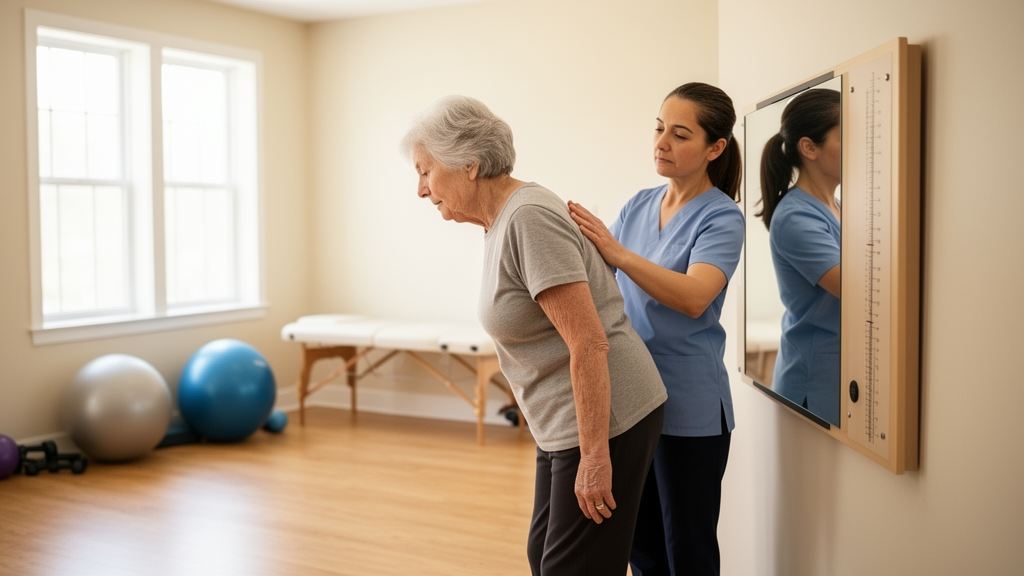
A stooped posture is often dismissed as a cosmetic nuisance of aging, something to be corrected with a reminder to stand up straight. A new study from Japan suggests it may be far more consequential than that. Researchers following hundreds of older adults over five years found that those with severe forward displacement of the spine — a condition known as sagittal imbalance — were more than twice as likely to need certified long-term care compared with people whose spinal alignment remained within normal limits. The findings, drawn from the Locomotive Syndrome and Health Outcomes in the Aizu Cohort Study, known as LOHAS, were published in BMC Geriatrics and offer some of the strongest prospective evidence yet that measurable spinal alignment is a genuine predictor of future dependency in old age.
Sagittal imbalance refers to a disruption of the delicate front-to-back equilibrium of the human spine. Viewed from the side, a healthy spine forms a series of alternating curves: the cervical and lumbar regions curve inward, a configuration called lordosis, while the thoracic and sacral regions curve outward, known as kyphosis. These opposing curves stack the head over the pelvis with minimal muscular effort, allowing an upright human to balance like a tower of precisely counterweighted blocks. When the curves flatten, exaggerate, or collapse with age — through vertebral fractures, disc degeneration, muscle wasting, or adult spinal deformity — the center of gravity drifts forward. The body then compensates by arching the lower back, flexing the hips and knees, and tilting the neck backward, a cascade of adjustments that consumes energy and erodes the capacity to stand and walk for prolonged periods.
The clinical yardstick for this problem is the sagittal vertical axis, or SVA, measured on a standing whole-spine lateral radiograph. Technically, the SVA is the horizontal distance between a plumb line dropped from the center of the C7 vertebra — the prominent seventh cervical vertebra at the base of the neck — and the posterior superior corner of the sacrum. In a well-aligned spine, this plumb line falls close to the sacrum, and the SVA remains small. As imbalance worsens, the C7 plumb line drifts forward, and the SVA grows. Spine surgeons conventionally regard an SVA below roughly 40 millimeters as normal, values between 40 and 95 millimeters as moderately abnormal, and values exceeding 95 millimeters as severely abnormal, a threshold associated with marked disability in adult spinal deformity populations.
What makes the new study notable is that it asks whether this radiographic measurement, familiar mainly to spine surgeons, predicts something with enormous social and economic weight: the need for long-term care. Japan operates a national long-term care insurance system in which dependency is formally certified through standardized assessments of an individual’s ability to perform daily activities. A new certification is an objective, administratively verified marker of incident care need, not a self-reported impression. The LOHAS investigators reasoned that if sagittal imbalance impairs standing and gait — the core components of what Japan defines as locomotive syndrome, a state of mobility limitation that precedes dependency — then people with severe imbalance should drift into certified care need at a higher rate over time.
To test this, the team enrolled 552 participants from the 2010 wave of the LOHAS cohort, a community-based study conducted in the Aizu region of Fukushima Prefecture. Each participant underwent a standing whole-spine lateral radiograph, from which the SVA was measured. The researchers also captured bodily pain using the 12-Item Short-Form Health Survey, or SF-12, and physical function using the 3-meter timed up and go test, a standard mobility assessment in which the time to rise from a chair, walk three meters, turn, return, and sit down is recorded. Baseline characteristics such as heart disease and depression were documented as well. The primary outcome was incident long-term care need, defined as a new certification in the national insurance system during a five-year follow-up period.
The statistical engine of the study was the Cox proportional hazards model, a technique that estimates the rate at which an event occurs over time while accounting for the fact that different participants remain under observation for different durations. The model produced hazard ratios with 95 percent confidence intervals, comparing the rate of new care certification across SVA categories while adjusting for age, sex, pain, timed up and go performance, heart disease, and depression. This adjustment matters: older people and those with more pain or slower mobility are naturally more likely to need care, so the analysis had to strip away those contributions to isolate the effect of spinal alignment itself.
The results were striking. During the five-year follow-up, 63 participants — 11.4 percent of the cohort — obtained new long-term care certification. But the incidence was far from evenly distributed across the alignment spectrum. Among participants with an SVA below 40 millimeters, 9.1 percent needed care. In the intermediate group, with an SVA between 40 and 95 millimeters, the figure rose to 12.7 percent. And among those with severe imbalance, an SVA exceeding 95 millimeters, 31.0 percent obtained new certification — roughly one in three. After adjustment, the severely imbalanced group had a hazard ratio of 2.72, with a 95 percent confidence interval of 1.26 to 5.88, compared with the normal-alignment group, meaning their rate of entering certified care was nearly three times higher. Compared with the intermediate group, the hazard ratio was 2.13, with a confidence interval of 0.97 to 4.70 — a point estimate suggesting more than a doubling of risk, though the interval just crossed the boundary of statistical significance.
The technical details of these numbers reward close reading. The confidence interval for the comparison against the normal group, 1.26 to 5.88, lies entirely above 1.0, indicating a statistically significant association after adjustment for confounders. The comparison against the intermediate group, 0.97 to 4.70, hovers at the edge of significance, a pattern consistent with a dose-response relationship in which risk climbs progressively as the SVA worsens, but with limited numbers of severely imbalanced participants constraining the precision of the estimate. The investigators also note that the association persisted despite adjustment for pain and mobility performance, suggesting that sagittal imbalance is not merely a proxy for back pain or slow gait but carries independent predictive information about future dependency.
Why would a forward-drifting spine predict care need so powerfully? The mechanistic logic runs through the biomechanics of compensation. As the trunk pitches forward, the erector spinae muscles must generate sustained effort to hold the body upright, accelerating fatigue and limiting standing tolerance. Gait becomes slower and less stable, raising fall risk, and falls in older adults frequently trigger vertebral fractures, hip fractures, and hospitalizations that set dependency in motion. The timed up and go test, which the study adjusted for, captures some of this mobility decline, but the radiographic SVA may detect structural deterioration earlier — before it fully expresses itself in walking speed. In this sense, the SVA functions as a structural early-warning signal, visible on a simple standing X-ray, that the postural system is failing.
The implications reach beyond the clinic. Populations are aging rapidly across the developed world, and long-term care insurance systems face mounting financial pressure as the ratio of dependent older adults to working-age contributors rises. If a single radiographic measurement can stratify risk of future care need, it could sharpen screening programs, prioritize preventive interventions such as exercise therapy targeting postural muscles, and identify candidates for closer monitoring before dependency takes hold. The LOHAS findings do not prove that correcting sagittal imbalance would prevent care need — that would require interventional trials — but they establish a compelling prospective association in a community cohort, adjusted for the major confounders. For now, the message is that the spine’s front-to-back alignment, long the preoccupation of deformity surgeons, deserves a place in the broader conversation about healthy aging. A stooped silhouette, measured in millimeters on a standing X-ray, may be one of the quiet structural predictors of how independently a person will live out the final chapters of life.
Subject of Research: Sagittal imbalance as a prospective risk factor for incident long-term care needs in older adults
Article Title: Sagittal imbalance and incident long-term care needs in older adults: the locomotive syndrome and health outcomes in the Aizu Cohort Study (LOHAS)
Article References: Watanabe, K., Otani, K., Sekiguchi, M., Nikaido, T., Kato, K., Kobayashi, H., Kaneuchi, Y., Kameda, T., Hakozaki, M., Yabuki, S., Konno, S.-I., & Matsumoto, Y. (2026). Sagittal imbalance and incident long-term care needs in older adults: the locomotive syndrome and health outcomes in the Aizu Cohort Study (LOHAS). BMC Geriatrics. https://doi.org/10.1186/s12877-026-08490-8
Image Credits: AI Generated
DOI: 10.1186/s12877-026-08490-8
Keywords: sagittal imbalance, sagittal vertical axis, long-term care, older adults, locomotive syndrome, spinal alignment, LOHAS cohort study, geriatrics, mobility limitation, BMC Geriatrics, Sagittal, imbalance
Cite Scienmag News
Ophelia Keating. (October 17, 2026). Severe Sagittal Imbalance Raises Risk of Long-Term Care Needs in Older Adults. Scienmag. https://scienmag.com/severe-sagittal-imbalance-raises-risk-of-long-term-care-needs-in-older-adults/
Ophelia Keating. "Severe Sagittal Imbalance Raises Risk of Long-Term Care Needs in Older Adults." Scienmag, 17 October 2026, https://scienmag.com/severe-sagittal-imbalance-raises-risk-of-long-term-care-needs-in-older-adults/. Accessed 17 October 2026.
Ophelia Keating. "Severe Sagittal Imbalance Raises Risk of Long-Term Care Needs in Older Adults." Scienmag. October 17, 2026. https://scienmag.com/severe-sagittal-imbalance-raises-risk-of-long-term-care-needs-in-older-adults/


